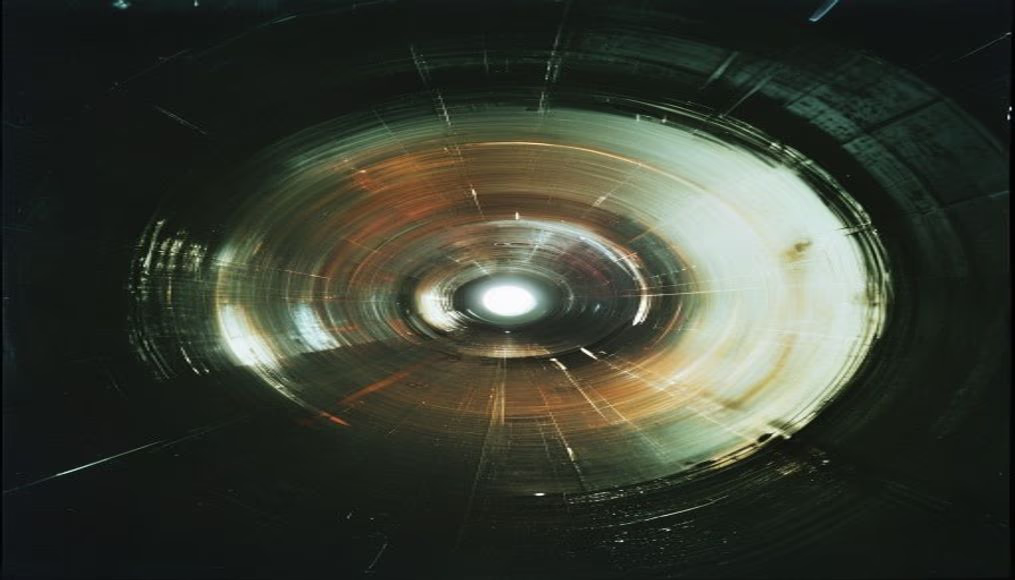
Kuiper belt distant
1344×768 · AVIF · CC BY 4.0

The Kuiper Belt: an icy region beyond Neptune hosting dwarf planets and comets, key to understanding the formation of the Solar System.
About this subject
The Kuiper Belt is a region of the Solar System located beyond Neptune's orbit, extending roughly from 30 to 50 astronomical units (AU) from the Sun. Composed mainly of icy bodies including frozen methane, ammonia, and water, this belt is home to dwarf planets such as Pluto, Eris, Makemake, and Haumea. Indirectly discovered in 1992 with the observation of object 1992 QB1, the Kuiper Belt contains hundreds of thousands of objects over 100 km in diameter, along with billions of short-period comets. Its structure is not uniform: it has a main region and a more scattered one called the scattered disc, which includes objects like Sedna. Studying the Kuiper Belt is crucial for understanding the Solar System's evolution, as its bodies are nearly pristine relics from planetary formation about 4.6 billion years ago. NASA's New Horizons spacecraft, which flew by Pluto in 2015, continues its mission by exploring Kuiper Belt objects such as Arrokoth, revealing details about the composition and dynamics of this icy frontier.
Frequently Asked Questions
What is the difference between the Kuiper Belt and the Oort Cloud?
The Kuiper Belt is a disk-shaped region beyond Neptune, extending to about 50 AU from the Sun, while the Oort Cloud is a much more distant spherical shell (up to 100,000 AU) surrounding the Solar System. The Kuiper Belt contains larger objects like Pluto and short-period comets, whereas the Oort Cloud is the source of long-period comets.
How many dwarf planets are in the Kuiper Belt?
Currently, five dwarf planets are recognized by the International Astronomical Union: Pluto, Eris, Makemake, Haumea, and Ceres (in the asteroid belt). Of these, Pluto, Eris, Makemake, and Haumea are in the Kuiper Belt. Other candidates like Sedna and Quaoar may be officially classified in the future.
What did the New Horizons mission discover in the Kuiper Belt?
New Horizons revealed that Pluto has complex geology with ice mountains, nitrogen plains, and a thin atmosphere. In 2019, it flew by Arrokoth, the most primitive object ever visited, showing it to be a 'contact binary' formed by the merger of two bodies, providing clues about planetesimal accretion in the early Solar System.
Direct URL
https://pub-c7d6a6ea828543ac903a74a341ccb2e1.r2.dev/imagens/kuiper-belt-distant-commercial-product-photography-p4.avifHow to credit
Include a visible link back to UtilizAí. Copy one of the snippets below:
<a href="https://xn--utiliza-eza.com/en/midia/imagens/kuiper-belt-distant-commercial-product-photography-p4">Kuiper belt distant</a> by <a href="https://xn--utiliza-eza.com">UtilizAí</a>, licensed under <a href="https://creativecommons.org/licenses/by/4.0/">CC BY 4.0</a>.
[Kuiper belt distant](https://xn--utiliza-eza.com/en/midia/imagens/kuiper-belt-distant-commercial-product-photography-p4) by [UtilizAí](https://xn--utiliza-eza.com), CC BY 4.0
License: CC-BY-4.0