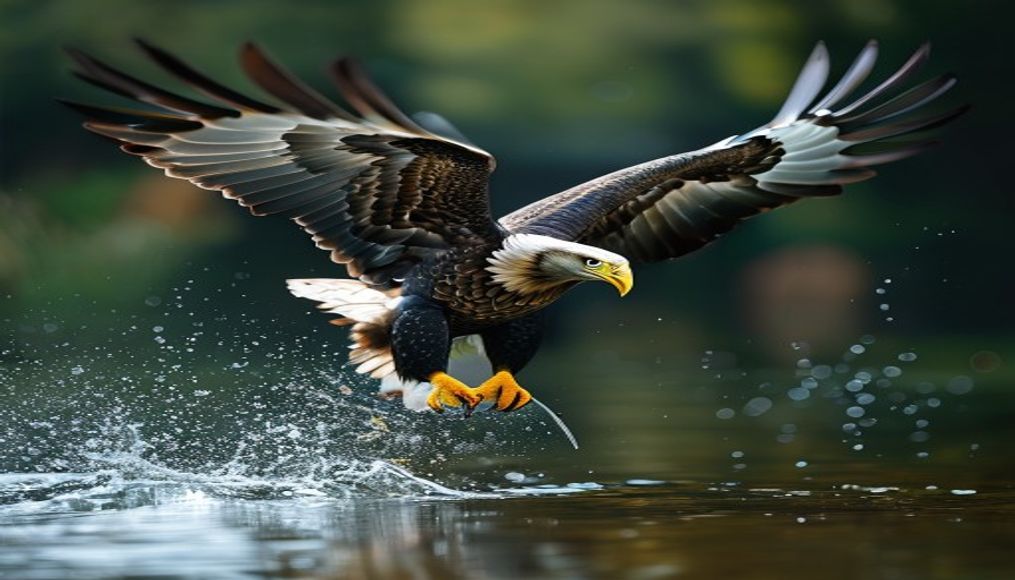
Kingfisher diving water
1344×768 · AVIF · CC BY 4.0

The kingfisher plunges at high speed to catch fish, one of the most impressive behaviors of aquatic birdlife.
About this subject
The kingfisher is a bird renowned for its ability to plunge vertically into water to catch prey, primarily small fish. Belonging to the family Alcedinidae, there are about 90 species worldwide, including the common kingfisher (Alcedo atthis) found in Europe, Asia, and northern Africa, and the ringed kingfisher (Megaceryle torquata), common in the Americas, including Brazil. These birds have remarkable adaptations: a long, sharp bill, binocular vision that compensates for water refraction, and waterproof feathers that minimize drag when entering the water.
Diving is a highly specialized hunting behavior. The kingfisher locates prey from a perch or during hover flight, calculates the refraction angle, and plunges headfirst at speeds exceeding 40 km/h. Upon entry, a transparent nictitating membrane covers the eyes for protection. After catching the fish, the bird returns to its perch to beat the prey against a branch until dead, always swallowing it headfirst to avoid scales getting stuck.
In Brazil, the kingfisher symbolizes abundant water resources, often seen along rivers, lakes, and reservoirs. The ringed kingfisher ranges from Mexico to Tierra del Fuego, inhabiting mangroves to urban water bodies. Its call is a sharp, repetitive sound common along riverbanks. Although not globally threatened, deforestation and water pollution pose risks to its populations, mainly by reducing fish availability.
Interestingly, kingfishers can dive up to 1 meter deep but usually hunt in shallow waters. Their green-blue plumage with metallic sheen is not due to pigments but microscopic structures that scatter light, similar to interference phenomena. Thus, colors may shift with viewing angle. This feature makes kingfisher sightings a delight for photographers and birdwatchers.
Frequently Asked Questions
How fast does a kingfisher dive?
A kingfisher can dive at speeds over 40 km/h, reducing noise and impact to increase capture success.
Is the kingfisher found throughout Brazil?
Yes, several kingfisher species occur in Brazil, with the ringed kingfisher (Megaceryle torquata) being one of the most common in rivers and lakes across all regions.
How does the kingfisher see underwater?
It has a transparent nictitating membrane that closes over its eyes during a dive, protecting them and allowing underwater vision by compensating for light refraction.
Direct URL
https://pub-c7d6a6ea828543ac903a74a341ccb2e1.r2.dev/imagens/kingfisher-diving-water-national-geographic-style-p1.avifHow to credit
Include a visible link back to UtilizAí. Copy one of the snippets below:
<a href="https://xn--utiliza-eza.com/en/midia/imagens/kingfisher-diving-water-national-geographic-style-p1">Kingfisher diving water</a> by <a href="https://xn--utiliza-eza.com">UtilizAí</a>, licensed under <a href="https://creativecommons.org/licenses/by/4.0/">CC BY 4.0</a>.
[Kingfisher diving water](https://xn--utiliza-eza.com/en/midia/imagens/kingfisher-diving-water-national-geographic-style-p1) by [UtilizAí](https://xn--utiliza-eza.com), CC BY 4.0
License: CC-BY-4.0