Jupiter great red spot
1344×768 · AVIF · CC BY 4.0
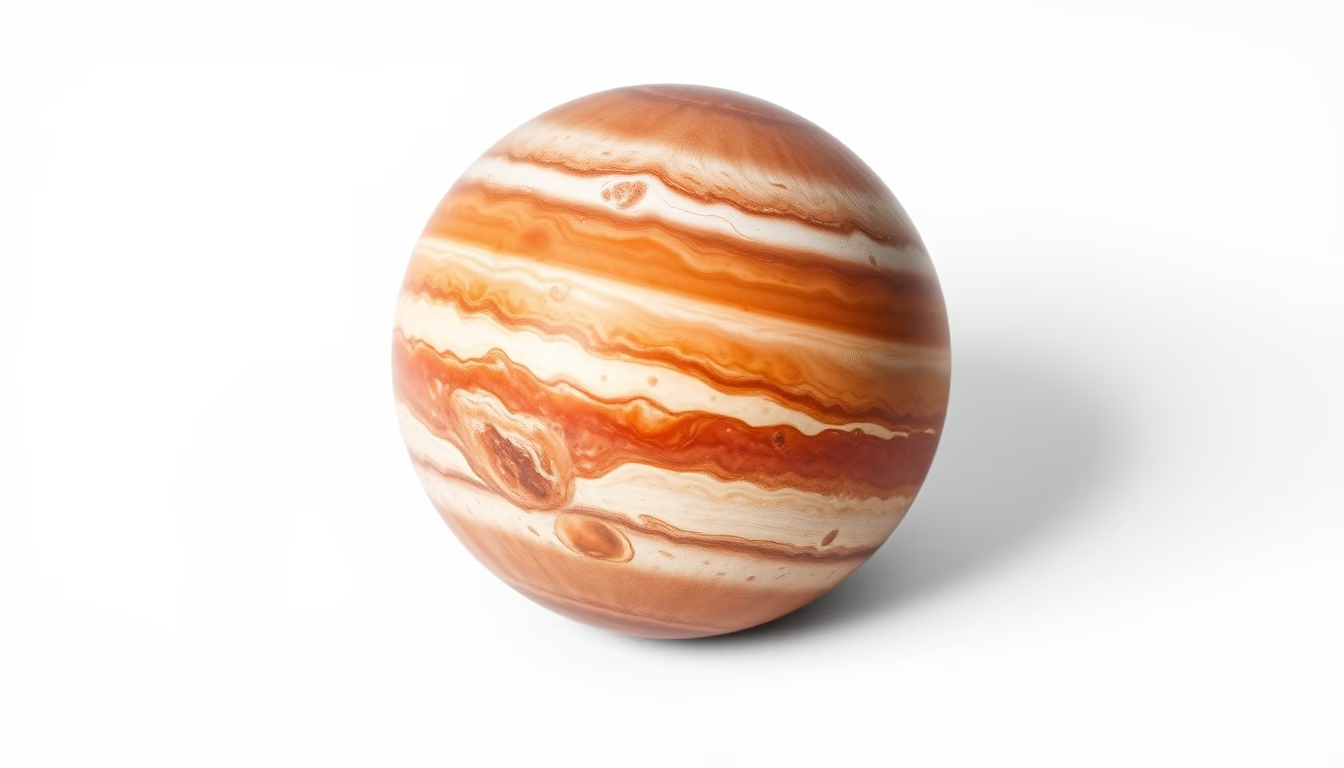
Jupiter's Great Red Spot is a persistent anticyclonic storm, larger than Earth, observed for centuries on the gas giant.
About this subject
The Great Red Spot (GRS) is a high-pressure storm located in Jupiter's southern hemisphere, about 22 degrees south of the equator. It is one of the Solar System's most famous features, visible even with amateur telescopes. Its colossal size has varied: in the 19th century, it was estimated to be about 40,000 km in diameter, but modern observations from the Juno probe indicate it now measures approximately 16,000 km across, still larger than Earth (12,700 km). The storm rotates counterclockwise, with winds reaching up to 430 km/h at its periphery and over 600 km/h in its core.
The discovery of the GRS is attributed to astronomer Robert Hooke in 1664, though Giovanni Cassini made systematic observations starting in 1665. Since then, the spot has been recorded almost continuously, with periods of varying visibility. Its characteristic reddish color is not fully explained, but it is believed to result from chemical compounds such as phosphorus, sulfur, or complex hydrocarbons brought from deeper layers of Jupiter's atmosphere by updrafts.
The GRS's longevity intrigues scientists: storms on Earth last days or weeks, but Jupiter's persists for centuries. Models suggest the storm feeds on thermal energy from the planet's interior and its rapid rotation (a Jovian day lasts about 10 hours). However, recent observations indicate the spot is shrinking and becoming more circular, though it is still unpredictable whether it will disappear completely.
Studies from the Juno mission, in orbit since 2016, reveal that the storm's roots extend at least 300 km below the cloud tops, much deeper than previously thought. The GRS also interacts with other atmospheric features, such as cloud bands and smaller storms, and its color can vary from deep red to pale orange depending on altitude and chemical composition.
Frequently Asked Questions
How big is the Great Red Spot compared to Earth?
The Great Red Spot is about 16,000 km in diameter, while Earth is 12,700 km. So the storm is larger than our planet.
Why is the Great Red Spot red?
The reddish color likely comes from compounds like phosphorus, sulfur, or complex hydrocarbons, brought from deeper layers of Jupiter's atmosphere by updrafts. The color can vary depending on altitude and composition.
Will the Great Red Spot disappear?
Observations show the spot is shrinking and becoming more circular, but it is still unknown if it will disappear completely. Models suggest it may persist for many years, fed by Jupiter's internal energy.
Direct URL
https://pub-c7d6a6ea828543ac903a74a341ccb2e1.r2.dev/imagens/jupiter-great-red-spot-commercial-product-photography-p10.avifHow to credit
Include a visible link back to UtilizAí. Copy one of the snippets below:
<a href="https://xn--utiliza-eza.com/en/midia/imagens/jupiter-great-red-spot-commercial-product-photography-p10">Jupiter great red spot</a> by <a href="https://xn--utiliza-eza.com">UtilizAí</a>, licensed under <a href="https://creativecommons.org/licenses/by/4.0/">CC BY 4.0</a>.
[Jupiter great red spot](https://xn--utiliza-eza.com/en/midia/imagens/jupiter-great-red-spot-commercial-product-photography-p10) by [UtilizAí](https://xn--utiliza-eza.com), CC BY 4.0
License: CC-BY-4.0