Jupiter great red spot
1344×768 · AVIF · CC BY 4.0
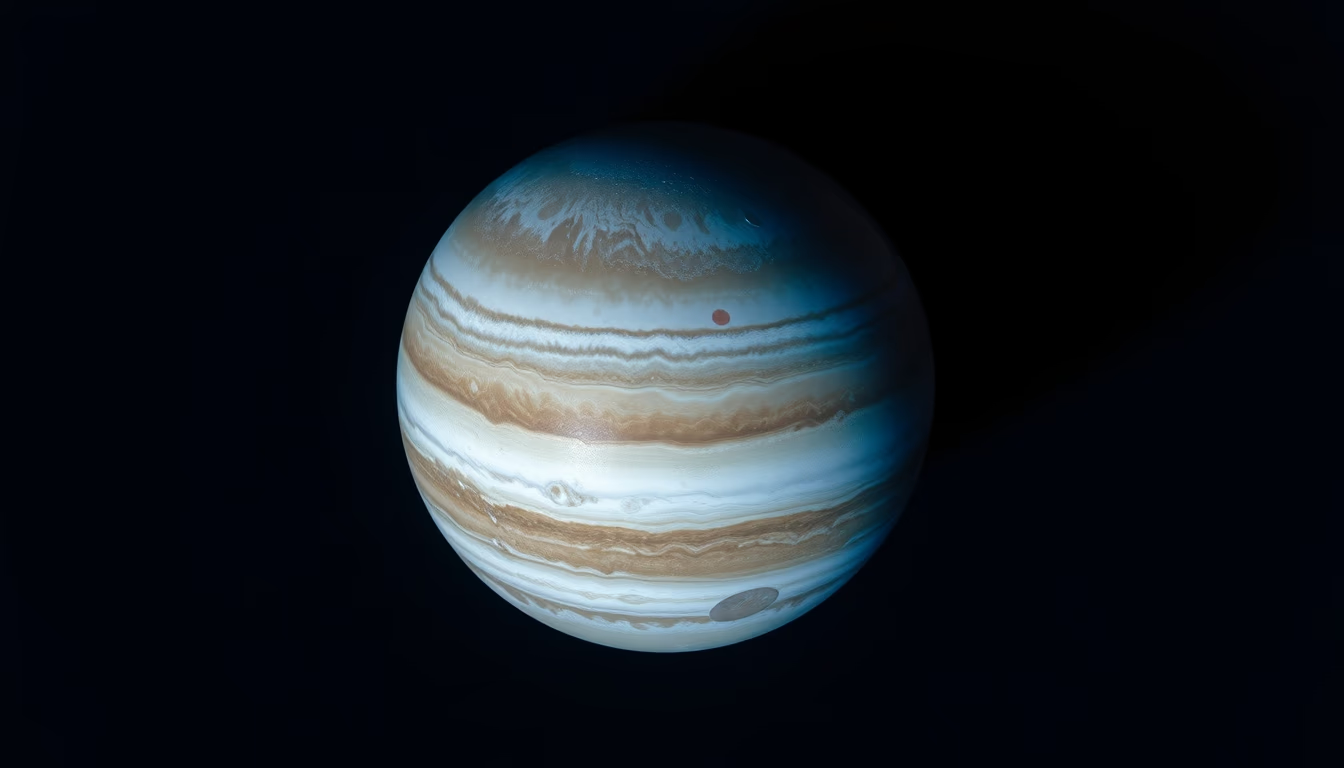
The Great Red Spot is a persistent anticyclonic storm on Jupiter, observed for centuries and larger than Earth.
About this subject
Jupiter's Great Red Spot is one of the most iconic features in the Solar System. It is a giant anticyclonic storm located in the planet's southern hemisphere, in a region of high pressure. Its existence has been known since the 17th century, when astronomers like Giovanni Cassini and Robert Hooke reported observations of a dark spot. However, the current spot may be the same one observed then, or it may have formed later; historical continuity is uncertain due to gaps in observations.
In terms of size, the Great Red Spot is approximately 16,000 kilometers wide, about 1.3 times Earth's diameter. Winds at its edges can reach speeds of up to 432 kilometers per hour. The characteristic red color is not fully understood, but it is believed to result from chemical compounds such as phosphorus, sulfur, or hydrocarbons reacting with solar ultraviolet radiation.
In recent decades, observations from the Voyager spacecraft, the Hubble Space Telescope, and NASA's Juno mission have revealed changes in the storm's shape, color, and size. Since the late 19th century, the spot has shrunk and become more circular. Studies indicate it is shrinking at a rate of about 930 kilometers per year. Moreover, the storm may not be perpetual; models suggest it could disappear within decades or centuries if the current trend continues.
The dynamics of the Great Red Spot are complex. It interacts with other storms and cloud bands on Jupiter, and its depth has been estimated by Juno at about 300 to 500 kilometers below the cloud tops. Studying this storm helps scientists better understand atmospheric processes on gas giant planets, both in the Solar System and on exoplanets.
Frequently Asked Questions
Why is the Great Red Spot red?
The red color likely comes from chemical compounds such as phosphorus, sulfur, or hydrocarbons in the clouds, reacting with solar ultraviolet radiation. The exact composition is still under study.
Is the Great Red Spot shrinking?
Yes, observations show the spot has been shrinking since the late 19th century, decreasing by about 930 km per year. If the trend continues, it may disappear within decades or centuries.
How big is the Great Red Spot compared to Earth?
The Great Red Spot is about 16,000 km wide, roughly 1.3 times Earth's diameter. More than one Earth could fit inside it.
Direct URL
https://pub-c7d6a6ea828543ac903a74a341ccb2e1.r2.dev/imagens/jupiter-great-red-spot-aerial-drone-shot-p5.avifHow to credit
Include a visible link back to UtilizAí. Copy one of the snippets below:
<a href="https://xn--utiliza-eza.com/en/midia/imagens/jupiter-great-red-spot-aerial-drone-shot-p5">Jupiter great red spot</a> by <a href="https://xn--utiliza-eza.com">UtilizAí</a>, licensed under <a href="https://creativecommons.org/licenses/by/4.0/">CC BY 4.0</a>.
[Jupiter great red spot](https://xn--utiliza-eza.com/en/midia/imagens/jupiter-great-red-spot-aerial-drone-shot-p5) by [UtilizAí](https://xn--utiliza-eza.com), CC BY 4.0
License: CC-BY-4.0