Juno jupiter polar
1344×768 · AVIF · CC BY 4.0
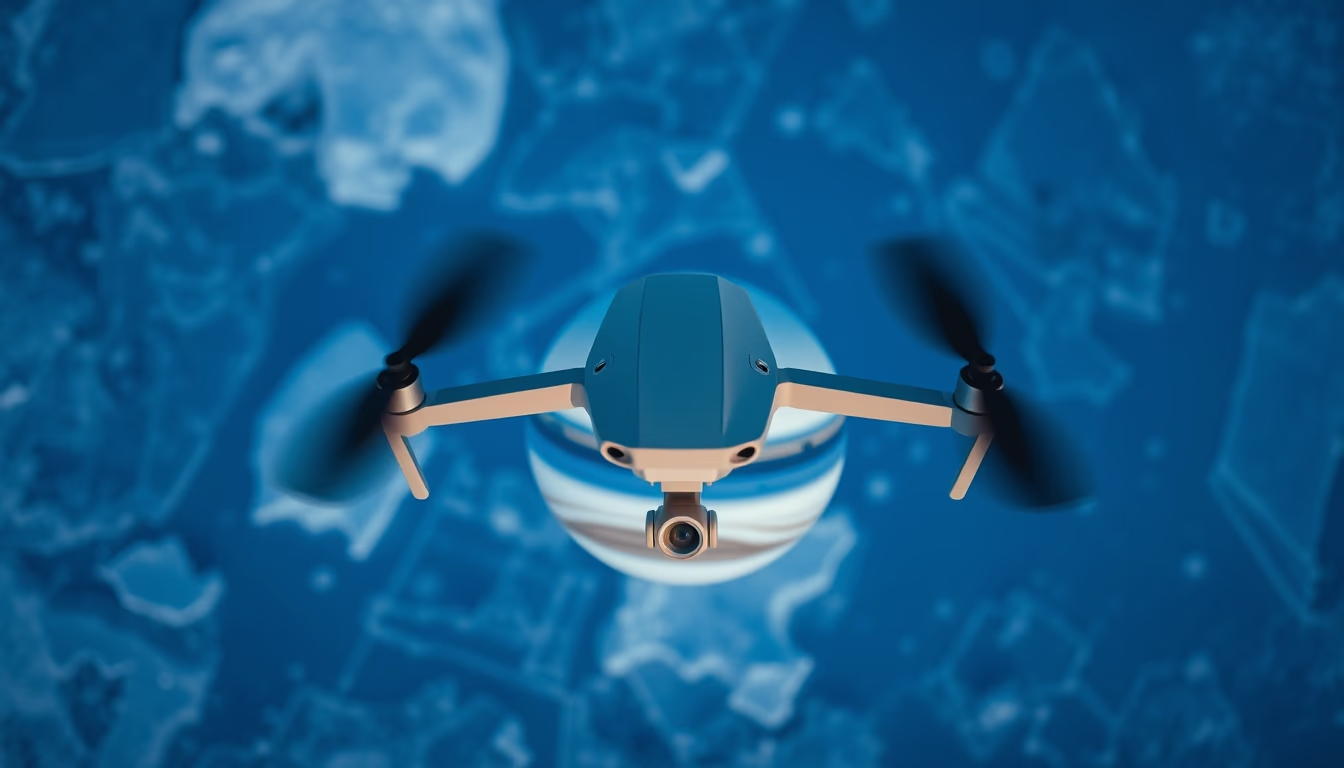
NASA's Juno spacecraft reveals unprecedented details of Jupiter's polar cyclones, providing new insights into the gas giant's atmospheric dynamics.
About this subject
The Juno mission, launched in 2011 and orbiting Jupiter since 2016, primarily aims to study the planet's composition, gravitational field, and magnetic field, as well as investigate its origin and evolution. One of the biggest surprises came from observations of the poles: instead of a calm, uniform environment, the spacecraft found a complex arrangement of massive cyclones, each hundreds of kilometers in diameter, organized into striking geometric patterns. At the north pole, eight cyclones surround a central one, while at the south pole, five cyclones circle a central cyclone. This stable configuration challenges previous atmospheric models and suggests dynamic forces not yet understood. Data from the JunoCam camera and the MWR microwave radiometer allow scientists to observe clouds at different depths, revealing that the cyclones extend tens of kilometers into the Jovian atmosphere. Long-exposure images, like the one that inspired this record, capture the beauty and turbulence of these structures, highlighting vibrant colors ranging from deep blue to orange, reflecting different chemical compounds such as ammonia and hydrocarbons. Continuous observations by Juno will help understand how Jupiter's internal energy and rapid rotation (a day lasts about 9.9 hours) influence the formation and maintenance of these extreme weather systems.
Frequently Asked Questions
What are Jupiter's polar cyclones observed by the Juno spacecraft?
They are massive cyclonic storms located at the planet's north and south poles, with diameters up to 1,000 km. They are arranged in stable geometric patterns, with multiple cyclones orbiting a central one.
How does the Juno mission study Jupiter's atmosphere in depth?
By using instruments like the MWR microwave radiometer, which measures microwave emissions from different depths, and the JunoCam visible-light camera. This allows mapping of clouds and structures below the cloud tops.
Why are images of Jupiter's poles scientifically important?
They reveal extreme atmospheric processes not found on Earth, helping test climate models and understand the physics of storms in planetary atmospheres. They also provide clues about the chemical composition and internal dynamics of the planet.
Direct URL
https://pub-c7d6a6ea828543ac903a74a341ccb2e1.r2.dev/imagens/juno-jupiter-polar-long-exposure-fresh9.avifHow to credit
Include a visible link back to UtilizAí. Copy one of the snippets below:
<a href="https://xn--utiliza-eza.com/en/midia/imagens/juno-jupiter-polar-long-exposure-fresh9">Juno jupiter polar</a> by <a href="https://xn--utiliza-eza.com">UtilizAí</a>, licensed under <a href="https://creativecommons.org/licenses/by/4.0/">CC BY 4.0</a>.
[Juno jupiter polar](https://xn--utiliza-eza.com/en/midia/imagens/juno-jupiter-polar-long-exposure-fresh9) by [UtilizAí](https://xn--utiliza-eza.com), CC BY 4.0
License: CC-BY-4.0