Juno jupiter polar
1344×768 · AVIF · CC BY 4.0

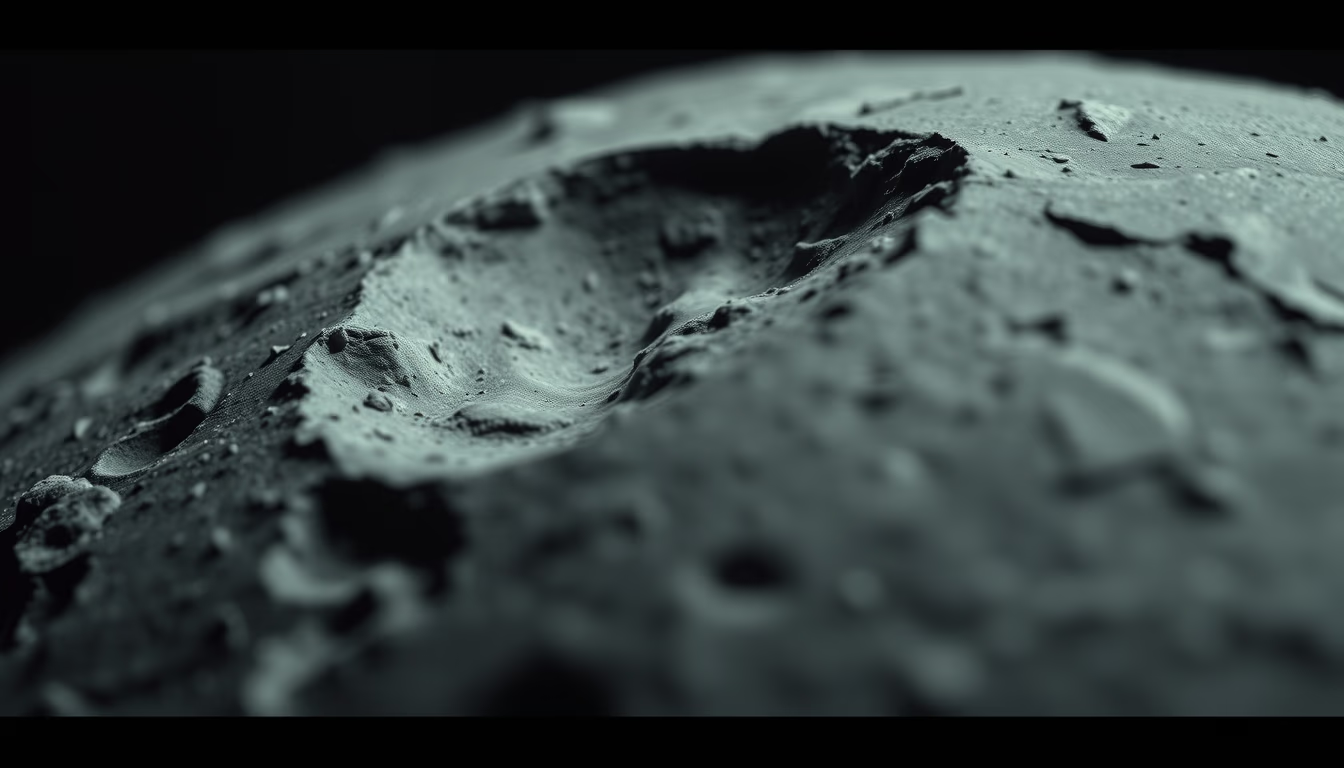
NASA's Juno spacecraft revealed unprecedented details of Jupiter's poles, including hexagonal cyclones and intense auroras.
About this subject
Launched in 2011, NASA's Juno spacecraft entered Jupiter's orbit in July 2016 with a clear goal: study the composition, gravitational field, and magnetic field of the gas giant, as well as explore its polar regions never before seen up close. Unlike previous missions that orbited the equator, Juno adopted a highly elliptical polar orbit, passing just 4,200 km above the clouds every 53 days. This trajectory allowed it to capture stunning images of the poles, revealing a spectacle of cyclonic storms arranged in geometric patterns.
At the north pole, scientists identified eight cyclones surrounding a central cyclone, forming an octagon. At the south pole, there are five cyclones around a central one, forming a pentagon. These storm systems have diameters comparable to the size of the US state of Texas and are extremely persistent. Data from Juno's microwave radiometer showed that these cyclones extend deep into the atmosphere, far beyond what was previously thought.
In addition to the cyclones, Juno studied Jupiter's ultraviolet auroras, which are hundreds of times more energetic than Earth's. They are generated by the interaction of the magnetic field with charged particles from the Sun, but with complex dynamics influenced by the planet's rapid rotation (a day on Jupiter lasts only about 10 hours). The mission also mapped the gravitational field, revealing that Jupiter's core is not compact but rather diffuse and partially dissolved, a discovery that challenges planetary formation models.
Originally scheduled to last until February 2018, the mission has been extended multiple times and currently operates in its extended phase, performing close flybys that provide increasingly detailed data. Juno will remain active until September 2025, when it will be deliberately deorbited to avoid contamination of the moon Europa, a potential habitat for microbial life. Its findings on Jupiter's poles not only expand knowledge of the largest planet in the Solar System but also help understand atmospheric processes on exoplanets.
Frequently Asked Questions
Why was Juno designed to orbit Jupiter's poles?
The polar orbit allows the spacecraft to pass directly over the poorly known polar regions and to study the magnetic and gravitational fields more precisely, as magnetic field lines converge at the poles.
What did Juno discover about Jupiter's poles?
It discovered giant cyclones arranged in geometric patterns: eight at the north pole and five at the south. It also revealed intense auroras and that the planet's core is diffuse, not solid.
How does Juno withstand Jupiter's intense radiation?
The spacecraft has a titanium vault to protect its most sensitive electronics and follows a trajectory that minimizes time spent in high-radiation zones.
Direct URL
https://pub-c7d6a6ea828543ac903a74a341ccb2e1.r2.dev/imagens/juno-jupiter-polar-high-fashion-editorial-fresh4.avifHow to credit
Include a visible link back to UtilizAí. Copy one of the snippets below:
<a href="https://xn--utiliza-eza.com/en/midia/imagens/juno-jupiter-polar-high-fashion-editorial-fresh4">Juno jupiter polar</a> by <a href="https://xn--utiliza-eza.com">UtilizAí</a>, licensed under <a href="https://creativecommons.org/licenses/by/4.0/">CC BY 4.0</a>.
[Juno jupiter polar](https://xn--utiliza-eza.com/en/midia/imagens/juno-jupiter-polar-high-fashion-editorial-fresh4) by [UtilizAí](https://xn--utiliza-eza.com), CC BY 4.0
License: CC-BY-4.0