Juno jupiter polar
1344×768 · AVIF · CC BY 4.0

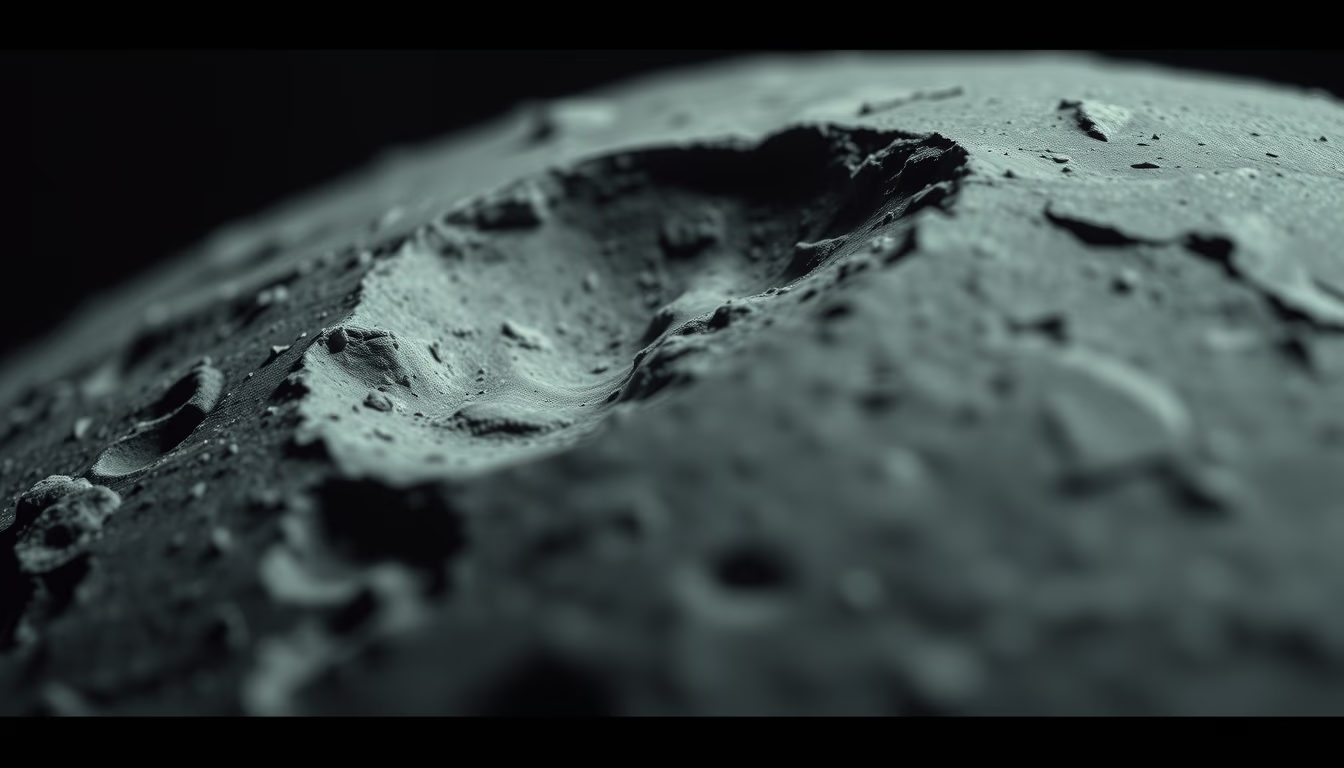
NASA's Juno spacecraft reveals unprecedented details of Jupiter's poles, with cyclones and auroras.
About this subject
Launched in 2011, the Juno spacecraft arrived at Jupiter in 2016 with a bold mission: to study the composition, gravitational and magnetic fields of the giant planet, and to explore its polar regions, which had never been observed up close. Instead of orbiting in the equatorial plane, Juno adopted a highly elliptical polar orbit, passing over Jupiter's poles every 53 days. This trajectory allowed it to capture stunning images of the cloud belts and storms circulating around the poles.
The results were astonishing. Jupiter's north pole features an array of eight massive cyclones arranged in an octagonal pattern, while the south pole harbors five cyclones in a pentagonal formation. These storm systems, with diameters larger than Earth's, are unique in the Solar System and challenge fluid dynamics models. Moreover, ultraviolet observations revealed continuous and intense polar auroras, fueled by charged particles from the planet's magnetic field.
The Juno mission also provided valuable insights into Jupiter's deep atmosphere, indicating that ammonia and water rings vary drastically at different latitudes. The data collected up to 2025 has already yielded over 4,000 scientific papers, transforming our understanding of the formation and evolution of giant gas planets. The spacecraft continues to operate, surviving intense radiation and delivering new findings with each flyby.
Frequently Asked Questions
Why does Juno orbit over Jupiter's poles?
The polar orbit allows the spacecraft to avoid the intense radiation of the equatorial belt and study the polar regions, which were previously almost unknown. This trajectory also facilitates detailed mapping of the gravitational and magnetic fields.
How many cyclones were discovered at Jupiter's poles?
The north pole has eight cyclones in an octagonal formation, while the south pole has five cyclones in a pentagonal arrangement. They are permanent and extremely stable.
Is the Juno spacecraft still active?
Yes, Juno is still operating. Originally planned to last until 2018, its mission has been extended multiple times and is expected to continue at least until 2025, with possible further extensions.
Direct URL
https://pub-c7d6a6ea828543ac903a74a341ccb2e1.r2.dev/imagens/juno-jupiter-polar-documentary-nature-style-fresh3.avifHow to credit
Include a visible link back to UtilizAí. Copy one of the snippets below:
<a href="https://xn--utiliza-eza.com/en/midia/imagens/juno-jupiter-polar-documentary-nature-style-fresh3">Juno jupiter polar</a> by <a href="https://xn--utiliza-eza.com">UtilizAí</a>, licensed under <a href="https://creativecommons.org/licenses/by/4.0/">CC BY 4.0</a>.
[Juno jupiter polar](https://xn--utiliza-eza.com/en/midia/imagens/juno-jupiter-polar-documentary-nature-style-fresh3) by [UtilizAí](https://xn--utiliza-eza.com), CC BY 4.0
License: CC-BY-4.0