Juno jupiter polar
1344×768 · AVIF · CC BY 4.0

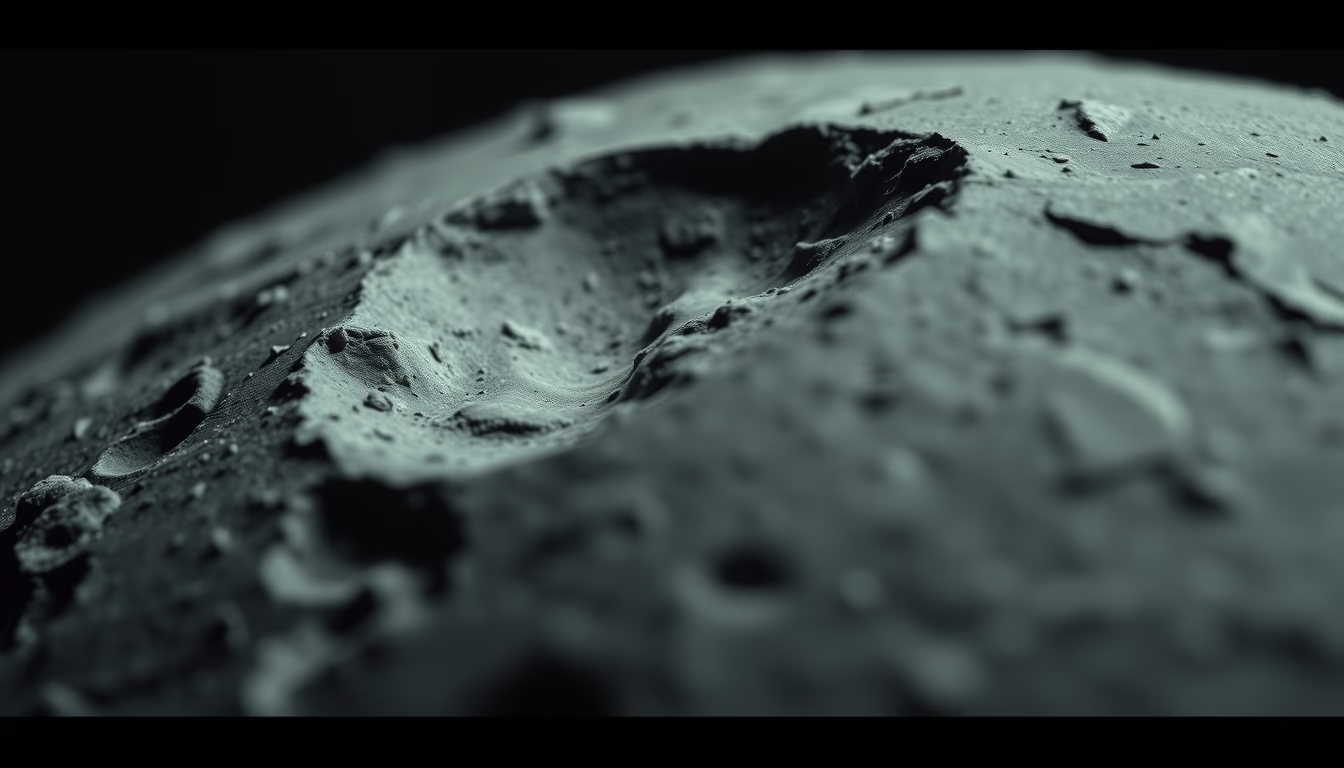
NASA's Juno spacecraft, in polar orbit around Jupiter since 2016, reveals secrets of the gas giant.
About this subject
The Juno mission, launched on August 5, 2011 by NASA, arrived at Jupiter on July 5, 2016 after a nearly five-year journey. Unlike previous missions, Juno was placed in a highly elliptical polar orbit, passing as close as 5,000 km above the planet's cloud tops. This unique trajectory allows the spacecraft to study Jupiter's polar regions, previously unexplored by probes that orbited in the equatorial plane.
Juno's instruments include a microwave radiometer to probe the deep atmosphere, a magnetometer to map the magnetic field, and spectrometers to analyze auroras. The probe has already discovered that Jupiter's poles are covered by cyclonic storms arranged in geometric patterns, such as an octagon at the north pole and a pentagon at the south. These formations are stable and persist for years.
Furthermore, Juno measured Jupiter's gravitational field with unprecedented precision, revealing that the planet's core is not compact but diffused, partially dissolved into the metallic hydrogen envelope. The spacecraft also detected that the atmospheric bands extend hundreds of kilometers deep, far beyond previous assumptions. The original mission was scheduled to end in 2021 but has been extended through 2025 or beyond, allowing additional flybys of Ganymede, Europa, and Io.
Juno carries a plaque honoring Galileo Galilei, who discovered Jupiter's four largest moons in 1610. The spacecraft also has three Lego figurines representing Jupiter, Juno (the Roman goddess), and Galileo. With its polar orbit, Juno is the first craft to directly photograph Jupiter's poles, providing stunning images and crucial data for understanding the formation of the Solar System.
Frequently Asked Questions
What is the main objective of the Juno spacecraft at Jupiter?
The main objective is to study Jupiter's origin, evolution, and structure, including its deep atmosphere, magnetic field, auroras, and composition, to understand the formation of gas giants and the Solar System.
Why is Juno's polar orbit important?
The polar orbit allows Juno to pass directly over Jupiter's poles, regions never before explored close-up, and collect unique data on the magnetosphere and auroras, while avoiding most of the intense radiation from the equatorial belt.
What surprising discoveries has Juno made?
Juno discovered polygon-shaped cyclonic storms at the poles, a diffuse and diluted core, and that atmospheric bands extend to great depth. It also found that Jupiter's magnetic field is more irregular than previously thought.
Direct URL
https://pub-c7d6a6ea828543ac903a74a341ccb2e1.r2.dev/imagens/juno-jupiter-polar-aerial-drone-shot-fresh17.avifHow to credit
Include a visible link back to UtilizAí. Copy one of the snippets below:
<a href="https://xn--utiliza-eza.com/en/midia/imagens/juno-jupiter-polar-aerial-drone-shot-fresh17">Juno jupiter polar</a> by <a href="https://xn--utiliza-eza.com">UtilizAí</a>, licensed under <a href="https://creativecommons.org/licenses/by/4.0/">CC BY 4.0</a>.
[Juno jupiter polar](https://xn--utiliza-eza.com/en/midia/imagens/juno-jupiter-polar-aerial-drone-shot-fresh17) by [UtilizAí](https://xn--utiliza-eza.com), CC BY 4.0
License: CC-BY-4.0