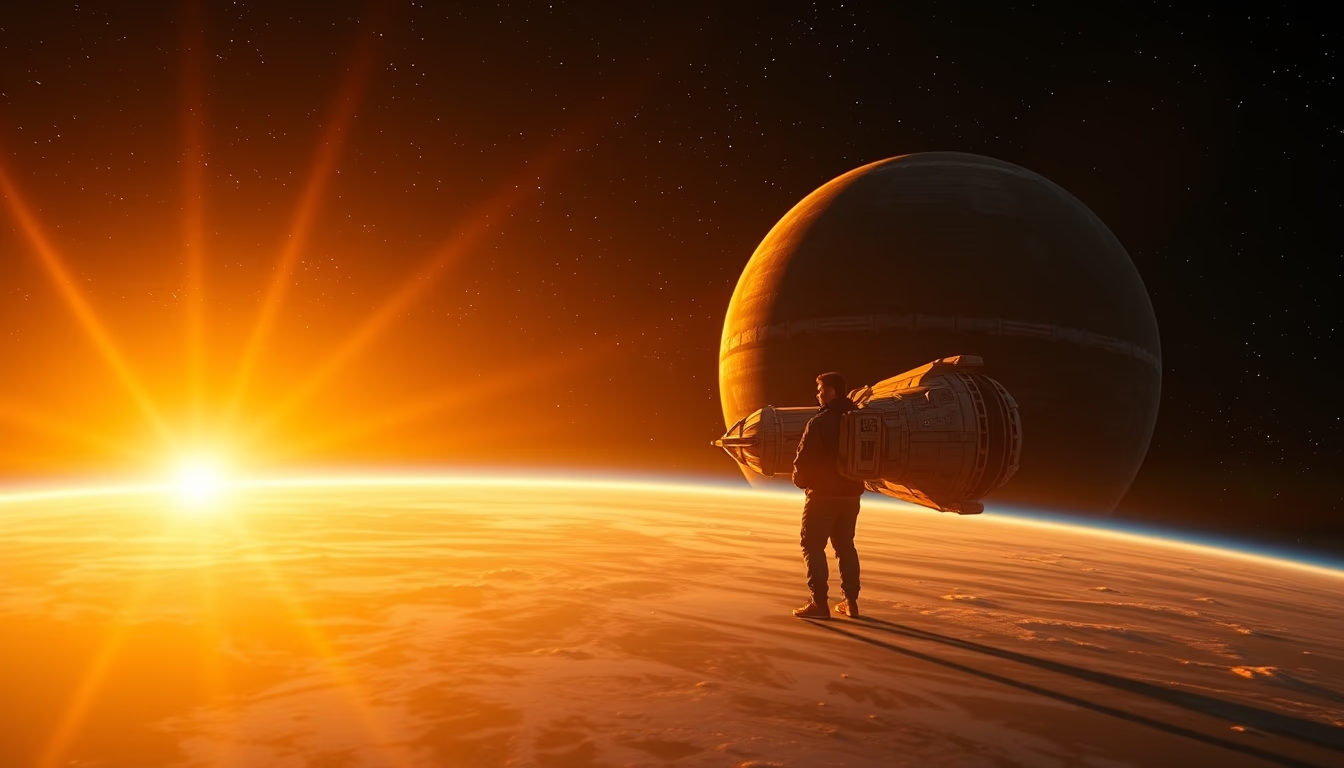
James webb deep field
1344×768 · AVIF · CC BY 4.0

The first James Webb deep field unveiled galaxies from the early Universe, 13.5 billion light-years away.
About this subject
The first deep field image from the James Webb Space Telescope, released in July 2022, revolutionized astronomy by capturing galaxies that existed just 600 million years after the Big Bang. Known as Webb's First Deep Field, it shows the galaxy cluster SMACS 0723, which acts as a gravitational lens, magnifying even more distant objects. Unlike Hubble, Webb operates in the infrared, allowing it to see through cosmic dust and capture the redshifted light of the oldest galaxies.
Webb's resolution and sensitivity revealed unprecedented details, such as structures in young galaxies and the presence of carbon in early Universe galaxies. This deep field set a new distance record for spectroscopically confirmed galaxies, such as JADES-GS-z13-0, with a redshift of 13.2. Ongoing study of these regions is helping understand the formation of the first stars and the evolution of galaxies over cosmic time.
Beyond astronomical discoveries, Webb's deep field has also posed challenges to existing cosmological models, as some galaxies appear more massive and mature than expected so soon after the Big Bang. This raises questions about the rate of star formation and the role of dark matter in assembling early galaxies. The telescope continues to observe this region across multiple wavelengths, providing crucial data for modern astrophysics.
Frequently Asked Questions
What is the James Webb deep field?
It is the first deep field image released by the James Webb Space Telescope, showing the galaxy cluster SMACS 0723 and thousands of distant galaxies, some over 13 billion light-years away.
Why is the Webb deep field important?
It revealed the most distant galaxies ever observed, allowing study of the early Universe and testing theories about the formation of the first stars and galaxies.
How does Webb differ from Hubble in this type of observation?
Webb observes in the infrared, capturing light from very distant objects that have been redshifted, while Hubble primarily sees visible and ultraviolet light. Webb has greater sensitivity and resolution.
Direct URL
https://pub-c7d6a6ea828543ac903a74a341ccb2e1.r2.dev/imagens/james-webb-deep-field-studio-still-life-fresh5.avifHow to credit
Include a visible link back to UtilizAí. Copy one of the snippets below:
<a href="https://xn--utiliza-eza.com/en/midia/imagens/james-webb-deep-field-studio-still-life-fresh5">James webb deep field</a> by <a href="https://xn--utiliza-eza.com">UtilizAí</a>, licensed under <a href="https://creativecommons.org/licenses/by/4.0/">CC BY 4.0</a>.
[James webb deep field](https://xn--utiliza-eza.com/en/midia/imagens/james-webb-deep-field-studio-still-life-fresh5) by [UtilizAí](https://xn--utiliza-eza.com), CC BY 4.0
License: CC-BY-4.0