James webb deep field
1344×768 · AVIF · CC BY 4.0

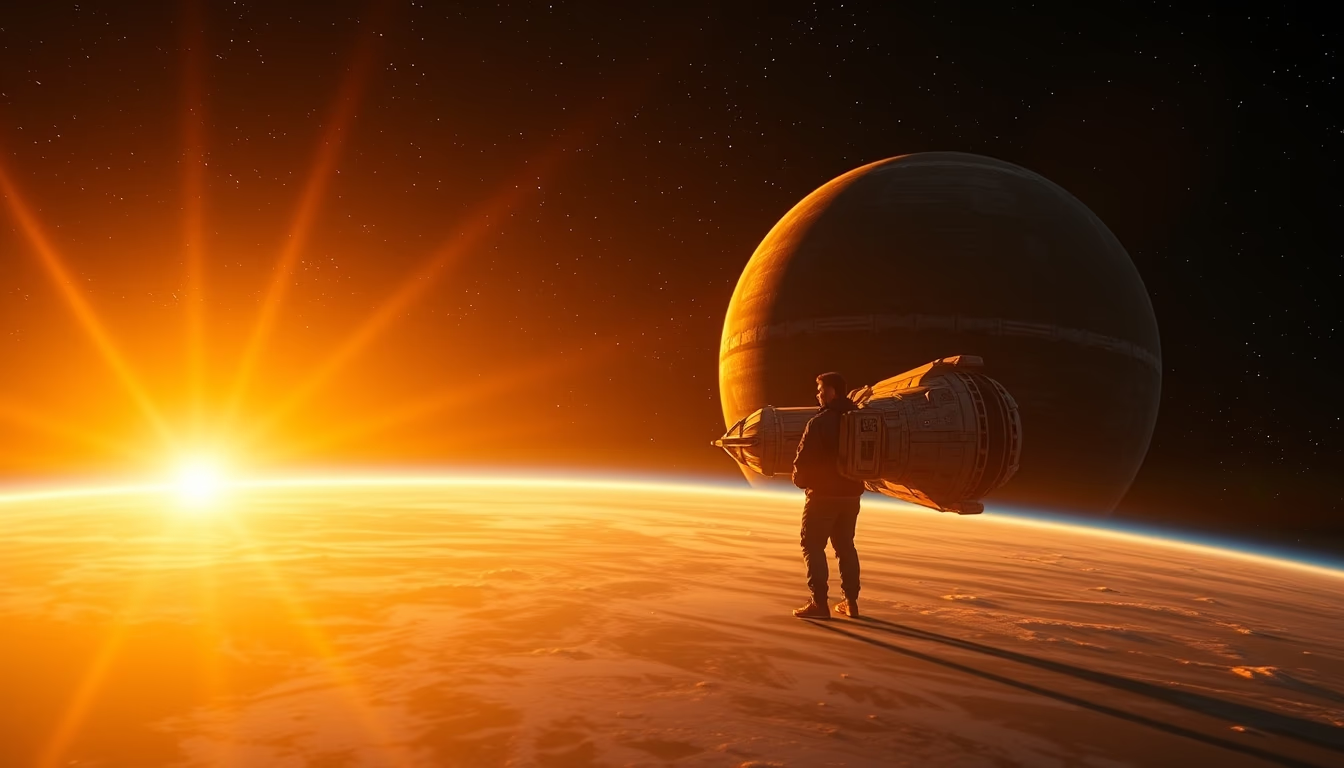
The James Webb Deep Field is the deepest infrared image of the universe ever captured, revealing galaxies formed 600 million years after the Big Bang.
About this subject
The James Webb Deep Field is a composite image obtained by the James Webb Space Telescope (JWST), from NASA, ESA, and CSA, released on July 11, 2022. It is the deepest infrared field ever recorded, surpassing the limits of the Hubble Ultra Deep Field. The image captures thousands of galaxies in a small patch of sky in the constellation Fornax, with light traveling over 13 billion years to reach JWST's detectors.
Technically, this feat was achieved by the NIRCam (Near-Infrared Camera), operating at wavelengths between 0.6 and 5 micrometers. JWST, positioned at the L2 Lagrange point 1.5 million kilometers from Earth, uses its 6.5-meter segmented primary mirror composed of 18 hexagons to collect light from extremely distant objects. The galaxies identified in the Deep Field include some of the oldest ever observed, with redshifts exceeding 10, corresponding to a time when the universe was only 600 million years old.
One of the central scientific goals of this image is to study the formation and evolution of the first galaxies, shortly after the epoch of reionization. By analyzing the light from these sources, astronomers can infer their composition, star formation rate, and mass. The James Webb Deep Field also revealed details of nearby galaxy clusters, such as SMACS 0723, whose gravity acts as a gravitational lens, magnifying background objects. This phenomenon allowed the observation of structures that would otherwise be invisible.
The image marked the beginning of JWST's scientific operations and generated a vast amount of data that continues to be analyzed. Since then, the telescope has conducted other deep observations, such as CEERS (Cosmic Evolution Early Release Science) and GLASS (Grism Lens-Amplified Survey from Space), further expanding knowledge about the primordial universe. The James Webb Deep Field is not just an impressive picture but a fundamental step in understanding cosmic history.
Frequently Asked Questions
What makes the James Webb Deep Field so special?
It is the deepest infrared image ever captured, revealing galaxies that existed only 600 million years after the Big Bang. Thanks to JWST's large mirror and sensitive instruments, we can observe objects with redshifts above 10.
How far away are the galaxies recorded in the Deep Field?
The light from these galaxies has traveled for over 13 billion years to reach us, meaning we see them as they were when the universe was less than 5% of its current age. The present-day comoving distance of these galaxies is about 32 billion light-years.
How did the James Webb telescope capture this image?
JWST used its NIRCam instrument to capture infrared light from a small patch of sky over several hours. The 6.5-meter primary mirror collects light from extremely distant objects, and the observatory is located at the L2 Lagrange point, away from Earth's thermal and light interference.
Direct URL
https://pub-c7d6a6ea828543ac903a74a341ccb2e1.r2.dev/imagens/james-webb-deep-field-cinematic-wide-shot-fresh12.avifHow to credit
Include a visible link back to UtilizAí. Copy one of the snippets below:
<a href="https://xn--utiliza-eza.com/en/midia/imagens/james-webb-deep-field-cinematic-wide-shot-fresh12">James webb deep field</a> by <a href="https://xn--utiliza-eza.com">UtilizAí</a>, licensed under <a href="https://creativecommons.org/licenses/by/4.0/">CC BY 4.0</a>.
[James webb deep field](https://xn--utiliza-eza.com/en/midia/imagens/james-webb-deep-field-cinematic-wide-shot-fresh12) by [UtilizAí](https://xn--utiliza-eza.com), CC BY 4.0
License: CC-BY-4.0