Index cards stacked
1344×768 · AVIF · CC BY 4.0
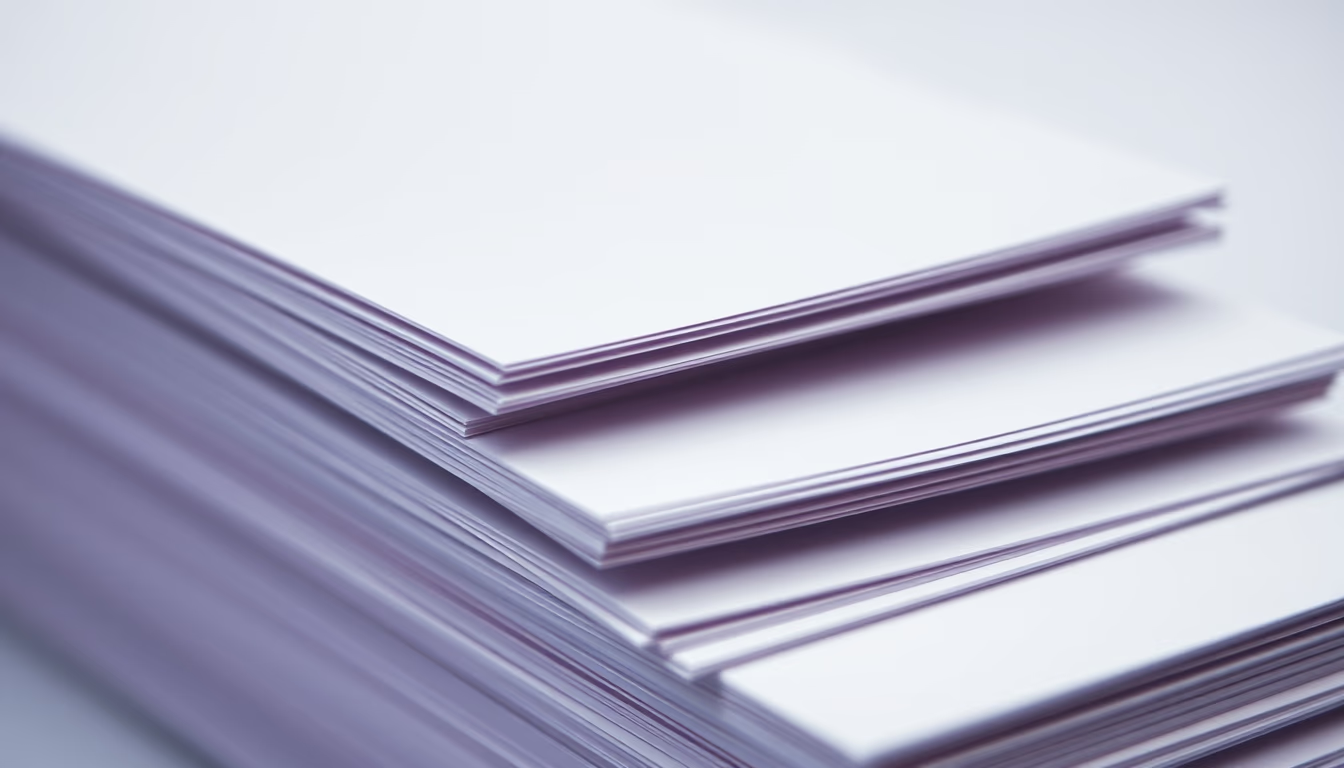
Stacked index cards are a classic organization tool, used for note-taking, studying, and indexing since the 18th century.
About this subject
Index cards, also known as note cards or filing cards, are small rectangular pieces of cardstock typically sold in packs. The most common standard size is 3 inches by 5 inches (7.6 cm by 12.7 cm), but variations like 4x6 and 5x8 inches exist. They come in various colors, with white and light yellow being traditional, and often feature lines or grid lines to aid handwriting.
The origin of index cards dates back to Swedish naturalist Carl Linnaeus, who in the 18th century developed a card system for classifying species. In the 19th century, librarian Melvil Dewey popularized the use of cards for library catalogs, standardizing the 3x5 inch size. Even in the digital age, index cards remain widely used in education and professional settings, particularly for study methods like Spaced Repetition Systems (SRS) and flashcard techniques.
Beyond academic note-taking, index cards are common in offices for organizing contacts, tasks, and ideas. They are often stored in dedicated boxes with alphabetical or numerical dividers. In the United States, they are a staple in stationery stores and can be found in various weights, from 90 lb to 180 lb (approximately 120 g/m² to 300 g/m²), to withstand frequent handling.
Interestingly, the term "index" in index card comes from the practice of creating cross-reference cards to quickly locate information. Despite the rise of digital apps and software, many educators and students still advocate for physical cards because they promote active recall and provide a break from screens. The stacked arrangement in a macro close-up image highlights the texture and soft edges of the paper, evoking a sense of order and tangibility.
Frequently Asked Questions
What are index cards used for?
Index cards are used for quick notes, study flashcards, organizing contacts and tasks, creating outlines, and as a tool for active recall and spaced repetition.
What is the standard size of an index card?
The most common size is 3 inches by 5 inches (76 mm by 127 mm), but 4x6 inches (102x152 mm) and 5x8 inches (127x203 mm) are also popular.
How to organize index cards?
You can store them in dedicated boxes with alphabetical or numbered dividers, use color coding, or bind them with rings for topical sets.
Direct URL
https://pub-c7d6a6ea828543ac903a74a341ccb2e1.r2.dev/imagens/index-cards-stacked-macro-closeup-fresh16.avifHow to credit
Include a visible link back to UtilizAí. Copy one of the snippets below:
<a href="https://xn--utiliza-eza.com/en/midia/imagens/index-cards-stacked-macro-closeup-fresh16">Index cards stacked</a> by <a href="https://xn--utiliza-eza.com">UtilizAí</a>, licensed under <a href="https://creativecommons.org/licenses/by/4.0/">CC BY 4.0</a>.
[Index cards stacked](https://xn--utiliza-eza.com/en/midia/imagens/index-cards-stacked-macro-closeup-fresh16) by [UtilizAí](https://xn--utiliza-eza.com), CC BY 4.0
License: CC-BY-4.0