Horsehead nebula dark
1344×768 · AVIF · CC BY 4.0
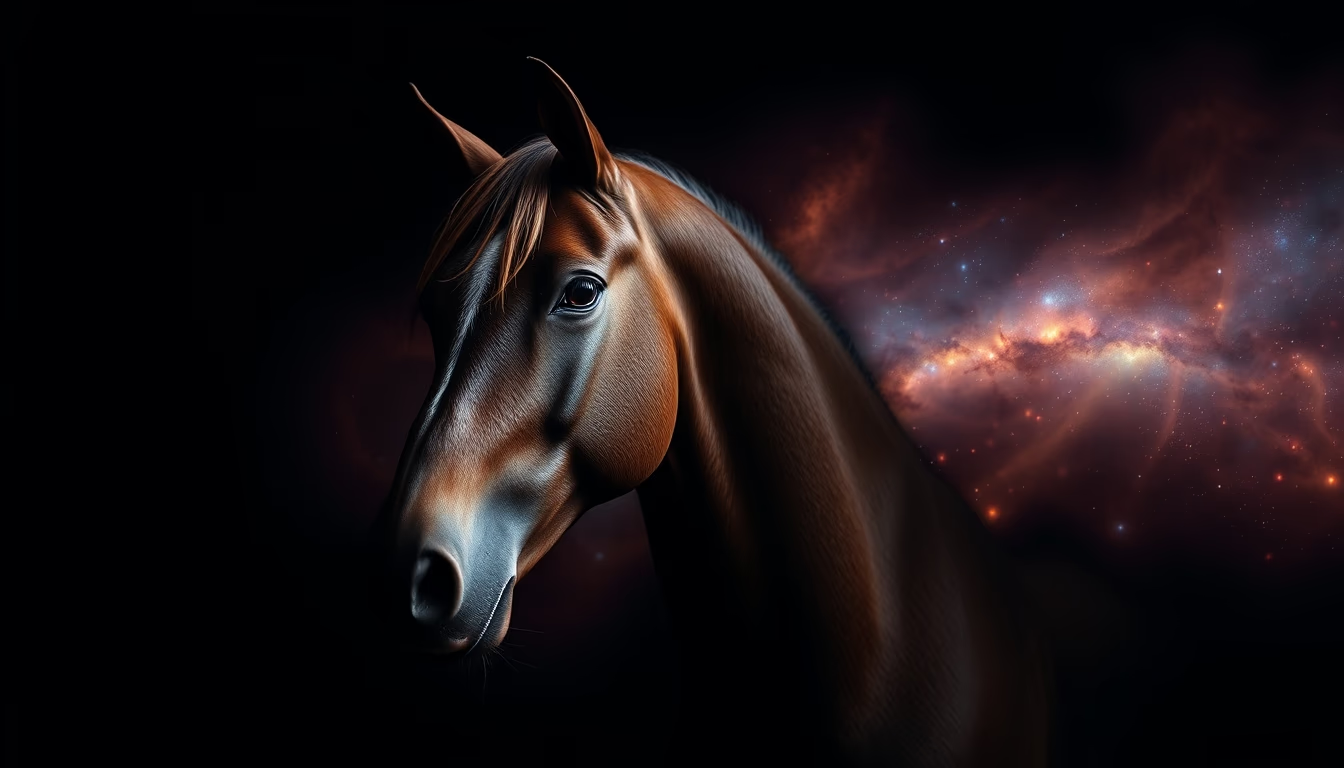
The Horsehead Nebula is a dark cloud of interstellar dust in the constellation Orion, famous for its equine silhouette against the red glow of nebula IC 434.
About this subject
The Horsehead Nebula, cataloged as Barnard 33, is a dark cloud of dust and gas located approximately 1,375 light-years from Earth in the constellation Orion. It is part of the Orion Molecular Cloud Complex, a vast star-forming region visible to the naked eye as Orion's Sword. Its iconic shape arises because dense dust blocks the light from the emission nebula IC 434, which glows red due to hydrogen ionization by the star Sigma Orionis.
Discovered on photographic plates from the Harvard College Observatory in 1888 by Williamina Fleming, the Horsehead became one of the most photographed objects in the night sky. Amateur and professional astronomers use it as a classic example of a dark nebula. The structure measures about 3.5 light-years across and its density is so high that some dust particles reach temperatures of only 10 to 30 Kelvin.
Despite its static appearance, the Horsehead Nebula is slowly dissipating. Ultraviolet radiation from Sigma Orionis erodes the cloud, and it is estimated to vanish within a few million years. For now, it remains a natural laboratory to study interstellar chemistry and star formation processes, as new stars are born inside it.
Culturally, the nebula has inspired countless artistic and scientific images. NASA frequently releases versions at different wavelengths, such as those from the Hubble Space Telescope, revealing fine details of the dust. For ground observers, it is a challenge: even with medium telescopes, the silhouette is only visible under dark skies and with special filters.
Frequently Asked Questions
Why does the Horsehead Nebula have that shape?
The shape results from a dense dust cloud blocking the light of emission nebula IC 434, creating a silhouette resembling a horse's head. Radiation from the star Sigma Orionis illuminates the background, making the outline visible.
How far is the Horsehead Nebula from Earth?
It is located approximately 1,375 light-years away, in the constellation Orion. This distance is based on parallax measurements and studies of the Orion molecular complex.
Can the Horsehead Nebula be seen with amateur telescopes?
Yes, but it is challenging. Even with 8 to 10 inch telescopes, the silhouette is only visible under dark skies and with narrowband filters (such as H-alpha). It is not observable with the naked eye or binoculars.
Direct URL
https://pub-c7d6a6ea828543ac903a74a341ccb2e1.r2.dev/imagens/horsehead-nebula-dark-studio-editorial-portrait-p11.avifHow to credit
Include a visible link back to UtilizAí. Copy one of the snippets below:
<a href="https://xn--utiliza-eza.com/en/midia/imagens/horsehead-nebula-dark-studio-editorial-portrait-p11">Horsehead nebula dark</a> by <a href="https://xn--utiliza-eza.com">UtilizAí</a>, licensed under <a href="https://creativecommons.org/licenses/by/4.0/">CC BY 4.0</a>.
[Horsehead nebula dark](https://xn--utiliza-eza.com/en/midia/imagens/horsehead-nebula-dark-studio-editorial-portrait-p11) by [UtilizAí](https://xn--utiliza-eza.com), CC BY 4.0
License: CC-BY-4.0