Horsehead nebula dark
1344×768 · AVIF · CC BY 4.0
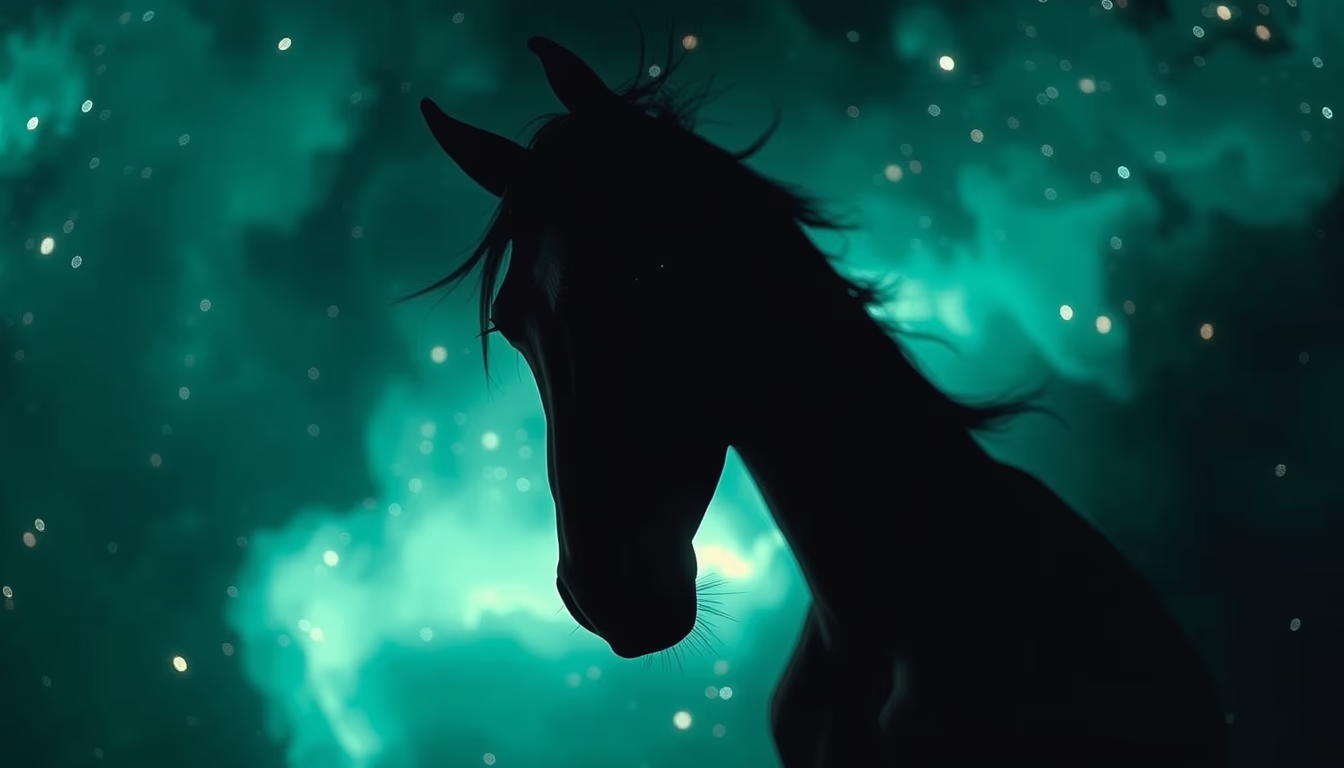
The Horsehead Nebula, also known as Barnard 33, is a dark nebula in the constellation Orion, famous for its silhouette resembling a horse's head.
About this subject
The Horsehead Nebula, cataloged as Barnard 33, is a dark nebula located approximately 1500 light-years from Earth in the constellation Orion. It is part of the Orion Molecular Cloud Complex, a vast star-forming region. Its dark, distinctive appearance is caused by a dense cloud of dust and gas that blocks the light from stars and bright nebulae behind it. The iconic horse-head shape is outlined by the red emission of the IC 434 nebula, which provides the necessary contrast to highlight the silhouette.
Discovered in 1888 by astronomer Williamina Fleming on photographic plates taken at Harvard College Observatory, the nebula was later included in Edward Emerson Barnard's catalog of dark nebulae. Fleming, one of the first women to make significant contributions to astronomy, identified the nebula while examining photographic plates. The discovery marked an advance in the study of dark nebulae, which were previously poorly understood.
Scientifically, the Horsehead Nebula is a natural laboratory for studying star formation and interstellar chemistry. The dust cloud consists mainly of carbon and silicate grains that absorb visible light and re-emit it in the infrared. Inside, young stars are being formed, observable in infrared and radio wavelengths. The Orion complex, which includes the nebula, also hosts the famous Orion Nebula (M42) and the Trapezium cluster.
Culturally, the Horsehead Nebula is one of the most photographed and recognizable astronomical objects in the night sky. Its elegant silhouette inspires artists and astronomy enthusiasts alike. Despite its fame, the nebula is difficult to observe visually with amateur telescopes, being best appreciated in long-exposure astrophotographs. In 2020, the Hubble Space Telescope captured detailed images of the region, revealing complex structures in the dust cloud.
Frequently Asked Questions
How far away is the Horsehead Nebula?
The Horsehead Nebula is located approximately 1500 light-years from Earth, in the constellation Orion.
Why does the nebula appear dark?
It is a dark nebula formed by a dense cloud of dust and gas that blocks light from the stars and bright nebulae behind it, creating its characteristic silhouette.
Can the Horsehead Nebula be seen with a common telescope?
It is very difficult visually, even with amateur telescopes, due to its low contrast requiring very dark skies. The best way to observe it is through long-exposure astrophotography.
Direct URL
https://pub-c7d6a6ea828543ac903a74a341ccb2e1.r2.dev/imagens/horsehead-nebula-dark-high-fashion-editorial-p0.avifHow to credit
Include a visible link back to UtilizAí. Copy one of the snippets below:
<a href="https://xn--utiliza-eza.com/en/midia/imagens/horsehead-nebula-dark-high-fashion-editorial-p0">Horsehead nebula dark</a> by <a href="https://xn--utiliza-eza.com">UtilizAí</a>, licensed under <a href="https://creativecommons.org/licenses/by/4.0/">CC BY 4.0</a>.
[Horsehead nebula dark](https://xn--utiliza-eza.com/en/midia/imagens/horsehead-nebula-dark-high-fashion-editorial-p0) by [UtilizAí](https://xn--utiliza-eza.com), CC BY 4.0
License: CC-BY-4.0