Horsehead nebula dark
1344×768 · AVIF · CC BY 4.0
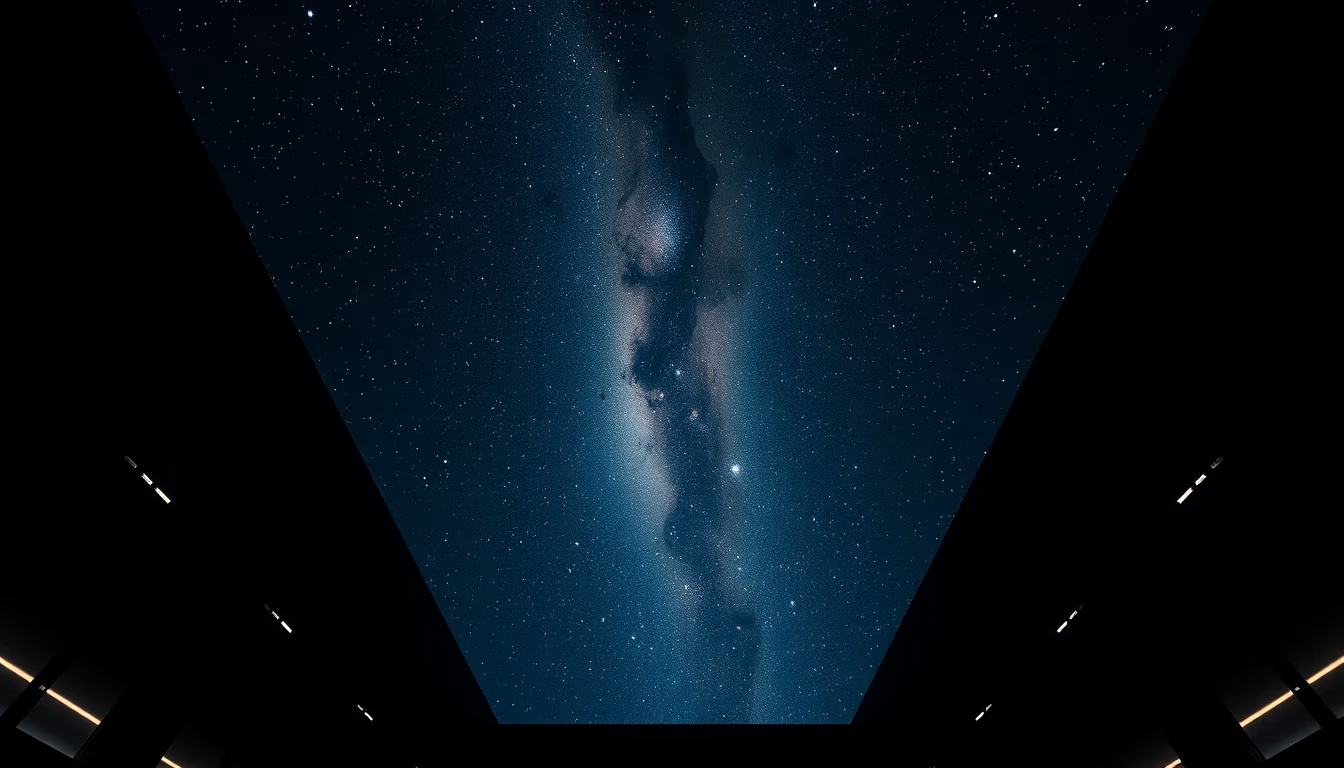
The Horsehead Nebula is a dark dust cloud in the constellation Orion, famous for its iconic shape and role in studying star formation.
About this subject
The Horsehead Nebula (Barnard 33) is a dark nebula located in the constellation Orion, approximately 1,500 light-years from Earth. It is part of the Orion B molecular cloud complex, a vast star-forming region. Its distinctive horsehead shape arises from a dense cloud of interstellar dust that blocks light from stars and nebulae behind it, while ionized hydrogen gas illuminated by the star Sigma Orionis glows red in the background. Discovered in 1888 by astronomer Williamina Fleming from a photographic plate taken at the Harvard College Observatory, the nebula is one of the most photographed objects in the night sky.
The nebula spans about 3.5 light-years across, and its darkness is due to a high concentration of dust grains that absorb visible light. This opacity allows astronomers to study photodissociation regions, where ultraviolet radiation from nearby stars interacts with molecular gas, creating complex structures. The Horsehead is also a key target for telescopes like Hubble and the James Webb Space Telescope, which reveal details of its morphology and the protoplanetary disks around young forming stars.
Located near the star Alnitak in Orion's Belt, the nebula is not visible to the naked eye but can be captured with amateur astrophotography gear. Its dramatic appearance and scientific significance make it an icon of astronomy, inspiring both researchers and enthusiasts. In 2020, the Hubble Space Telescope released one of the most detailed infrared images of the nebula, penetrating the dust to reveal newborn stars.
Frequently Asked Questions
Why does the Horsehead Nebula appear dark?
It is a dark nebula: a dense cloud of dust and gas that blocks light from stars and bright nebulae behind it. The dust absorbs visible light, creating the dark silhouette against the reddish glow of ionized hydrogen.
How far away is the Horsehead Nebula?
It is about 1,500 light-years from Earth, in the constellation Orion, near the star Alnitak in Orion's Belt.
Can the Horsehead Nebula be seen with the naked eye?
No. Even though it is large, its low surface brightness and poor contrast with the surrounding sky make it invisible without optical instruments. Medium-sized telescopes or astrophotography are required to observe it.
Direct URL
https://pub-c7d6a6ea828543ac903a74a341ccb2e1.r2.dev/imagens/horsehead-nebula-dark-architectural-photography-p1.avifHow to credit
Include a visible link back to UtilizAí. Copy one of the snippets below:
<a href="https://xn--utiliza-eza.com/en/midia/imagens/horsehead-nebula-dark-architectural-photography-p1">Horsehead nebula dark</a> by <a href="https://xn--utiliza-eza.com">UtilizAí</a>, licensed under <a href="https://creativecommons.org/licenses/by/4.0/">CC BY 4.0</a>.
[Horsehead nebula dark](https://xn--utiliza-eza.com/en/midia/imagens/horsehead-nebula-dark-architectural-photography-p1) by [UtilizAí](https://xn--utiliza-eza.com), CC BY 4.0
License: CC-BY-4.0