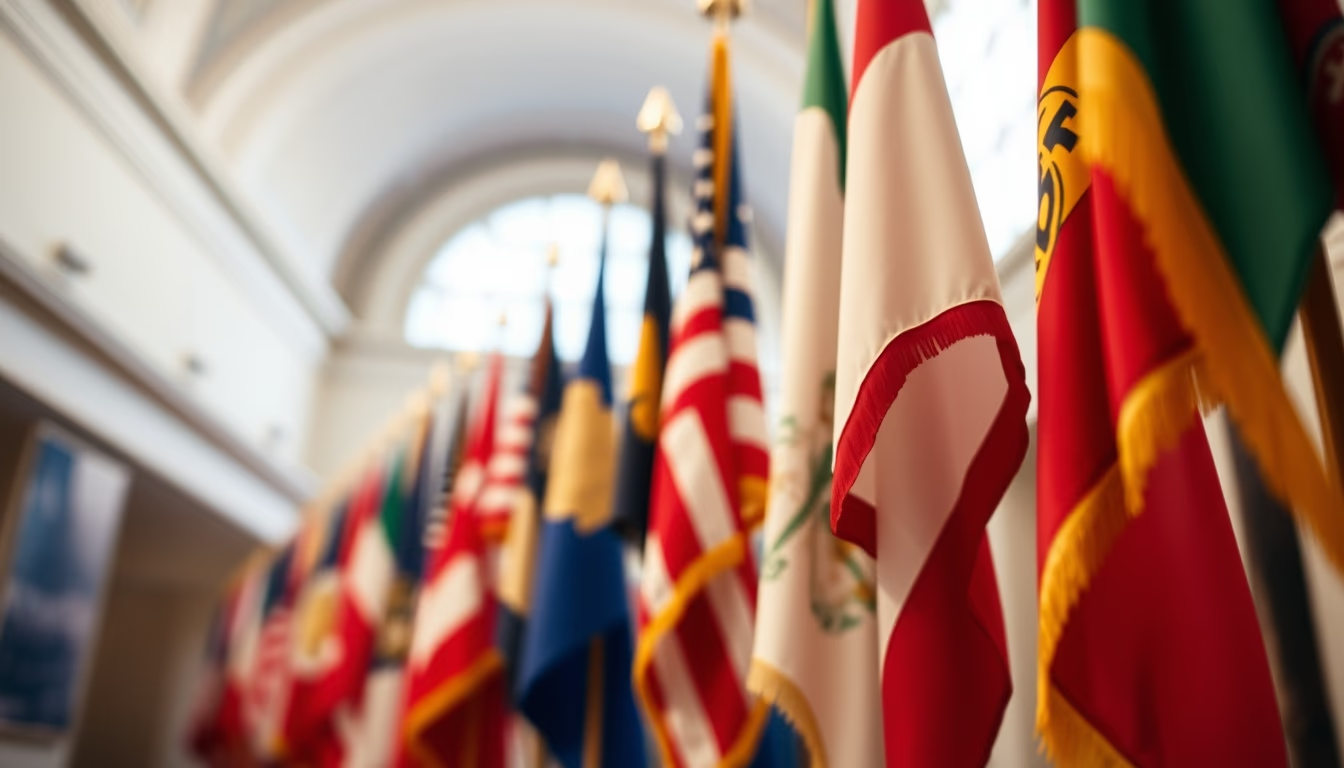
Historical flags museum
1344×768 · AVIF · CC BY 4.0

Historical flags museums preserve specimens from different countries and eras, revealing the evolution of national symbols.
About this subject
Historical flags museums are institutions dedicated to the conservation, study, and exhibition of flags from different periods and cultures. They function as living archives of national and regional symbology, housing everything from battle standards to civil and ceremonial banners. One of the most well-known examples is the National Flag Museum in Shenzhen, China, which holds the world's largest collection of flags, with over 4,000 specimens. In South America, the Museu Histórico Nacional in Rio de Janeiro maintains an important collection of Brazilian flags, including the first flag of the Empire of Brazil and pavilions from extinct states.
Conserving ancient flags is a technical challenge, as fabrics degrade with light, humidity, and handling. Specialists use chemical stabilization methods and low-light storage to prolong the life of these artifacts. Many historical flags have been restored for temporary exhibitions, such as the original flag of the Farroupilha Revolution, which underwent a lengthy process of cleaning and fiber reinforcement.
Beyond their historical value, these museums offer insight into the visual identity of peoples. Flags tell stories of independence, resistance, and unity. For example, the Immigration Museum in São Paulo displays flags from foreign communities that arrived in Brazil, such as Italian, Japanese, and German, illustrating the country's cultural diversity. Visitors can compare how different nations represent concepts like freedom and sovereignty through colors and symbols.
Visiting a historical flags museum also educates on the evolution of design and heraldry. Many flags have undergone modifications over time, reflecting political and social changes. The collection at the Flag Museum in Washington, D.C., for instance, includes U.S. flags with different numbers of stars, showing the country's territorial expansion. These collections are primary sources for historians and researchers of vexillology, the study of flags.
Frequently Asked Questions
What is the largest flag museum in the world?
The National Flag Museum in Shenzhen, China, is considered the largest, with over 4,000 flags in its collection, including specimens from all UN-recognized countries.
How are historical flags preserved?
Flags are stored in rooms with controlled temperature and humidity, protected from direct light. Restoration techniques include dry cleaning, fiber consolidation, and support with inert fabrics.
Is there a flag museum in Brazil?
Yes, the Museu Histórico Nacional in Rio de Janeiro has an important collection of historical Brazilian flags. Additionally, the Immigration Museum in São Paulo displays flags from foreign communities.
Direct URL
https://pub-c7d6a6ea828543ac903a74a341ccb2e1.r2.dev/imagens/historical-flags-museum-commercial-product-photography-fresh2.avifHow to credit
Include a visible link back to UtilizAí. Copy one of the snippets below:
<a href="https://xn--utiliza-eza.com/en/midia/imagens/historical-flags-museum-commercial-product-photography-fresh2">Historical flags museum</a> by <a href="https://xn--utiliza-eza.com">UtilizAí</a>, licensed under <a href="https://creativecommons.org/licenses/by/4.0/">CC BY 4.0</a>.
[Historical flags museum](https://xn--utiliza-eza.com/en/midia/imagens/historical-flags-museum-commercial-product-photography-fresh2) by [UtilizAí](https://xn--utiliza-eza.com), CC BY 4.0
License: CC-BY-4.0