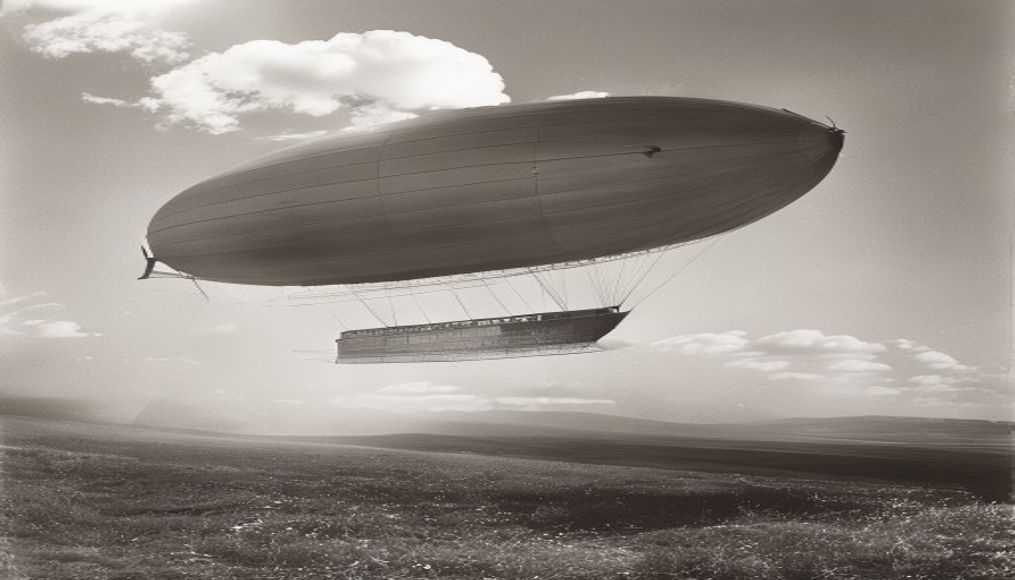
Hindenburg airship
1344×768 · AVIF · CC BY 4.0

The Hindenburg airship, the largest ever built, marked aviation history with its 1937 disaster in Lakehurst, New Jersey.
About this subject
The LZ 129 Hindenburg was a German rigid airship of the Zeppelin class, launched in 1936. At 245 meters in length, it was the largest flying object ever built, surpassing the Graf Zeppelin in size. It was powered by four diesel engines and could carry up to 72 passengers in luxurious cabins, featuring a dining room, library, and an aluminum piano. Its frame was made of duralumin, covered with cotton fabric treated with nitrocellulose and aluminum powder for weather protection.
The Hindenburg was designed for regular transatlantic flights, connecting Frankfurt to New York and Rio de Janeiro. In its first season, it completed 17 Atlantic crossings, transporting over 2,000 passengers. The airship used hydrogen as lifting gas, highly flammable, due to US export restrictions on helium. This choice proved fatal on May 6, 1937, when the airship caught fire while landing in Lakehurst, killing 36 people.
The exact cause of the fire has never been conclusively determined, but theories include atmospheric electrical discharge, mechanical failure, or sabotage. The disaster was widely covered by media and broadcast live, creating global trauma and effectively ending the era of commercial airships. The Hindenburg remains a symbol of technological risk and the transition to fixed-wing aviation.
Trivia: The Hindenburg's gas volume was about 200,000 cubic meters, and its top speed reached 135 km/h. The outer coating contained aluminum powder, which may have contributed to the rapid spread of flames. The accident was so striking that the term "Hindenburg" became synonymous with impending disaster.
Frequently Asked Questions
How large was the Hindenburg?
The Hindenburg was 245 meters long, making it the largest airship ever built. For comparison, it was longer than three football fields.
How many people died in the Hindenburg disaster?
The fire in Lakehurst killed 36 people: 13 passengers, 22 crew members, and one ground crew member.
Why did the Hindenburg use hydrogen instead of helium?
The United States controlled most of the world's helium and imposed export restrictions for military reasons. Germany had to use flammable hydrogen to fill the airship.
Direct URL
https://pub-c7d6a6ea828543ac903a74a341ccb2e1.r2.dev/imagens/hindenburg-airship-long-exposure-p1.avifHow to credit
Include a visible link back to UtilizAí. Copy one of the snippets below:
<a href="https://xn--utiliza-eza.com/en/midia/imagens/hindenburg-airship-long-exposure-p1">Hindenburg airship</a> by <a href="https://xn--utiliza-eza.com">UtilizAí</a>, licensed under <a href="https://creativecommons.org/licenses/by/4.0/">CC BY 4.0</a>.
[Hindenburg airship](https://xn--utiliza-eza.com/en/midia/imagens/hindenburg-airship-long-exposure-p1) by [UtilizAí](https://xn--utiliza-eza.com), CC BY 4.0
License: CC-BY-4.0