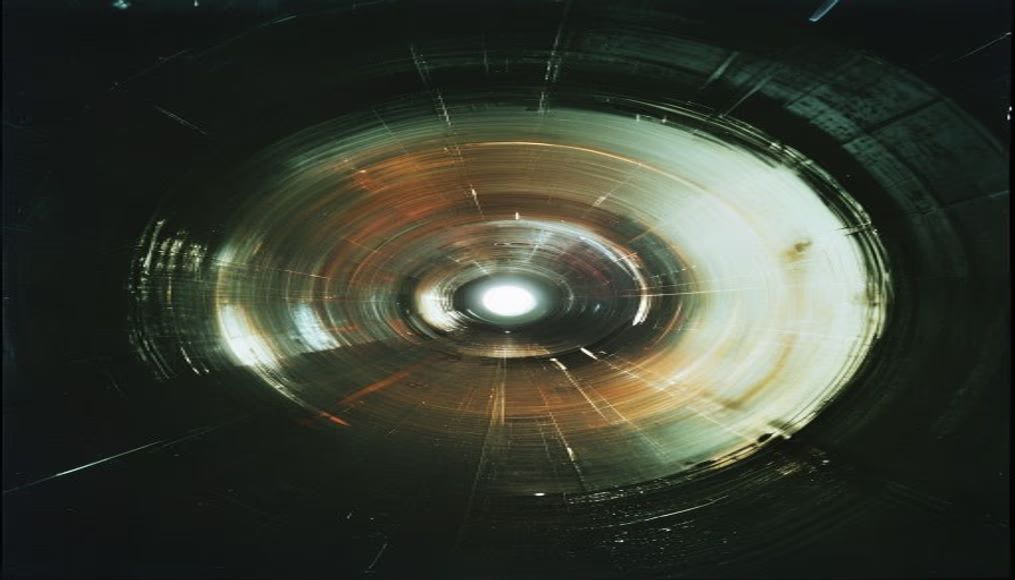
Gravitational lensing visualization
1344×768 · AVIF · CC BY 4.0

Gravitational lensing visualization demonstrates how spacetime curvature magnifies and distorts light from distant objects, unveiling cosmic secrets.
About this subject
Gravitational lensing is a phenomenon predicted by Einstein's general theory of relativity in 1915. It occurs when light from a distant source, such as a galaxy or quasar, passes near a massive object (another galaxy, cluster, or black hole) and its path is bent by gravity. This effect acts as a natural lens, magnifying and distorting the background source's image. There are two main types: strong lensing, which produces arcs, multiple images, and even Einstein rings, and weak lensing, which causes subtle distortions in galaxy shapes.
The first observational confirmation came in 1979 with the discovery of QSO 0957+561, a quasar whose light appeared duplicated due to gravitational lensing by an intervening galaxy. Since then, the phenomenon has become an essential tool in astrophysics. It allows mapping the distribution of dark matter (invisible but having mass) in galaxy clusters, studying very distant and faint galaxies, and measuring the expansion of the universe via lensed supernovae. The Hubble Space Telescope and the James Webb Space Telescope have captured stunning images of gravitational lenses, such as the galaxy cluster MACS J0416 and the so-called "Einstein ring."
Interestingly, gravitational lensing can also reveal exoplanets. When one star passes in front of another, the microlensing effect creates a temporary brightening that can reveal planets orbiting the foreground star. This method has already discovered dozens of distant worlds. Moreover, gravitational lensing is one of the most precise tests of general relativity, as its mathematical predictions closely match observations.
Frequently Asked Questions
What is gravitational lensing and how does it work?
Gravitational lensing is a phenomenon of general relativity where a massive object's gravity curves spacetime, bending light from a distant source. This magnifies and distorts the source's image, acting as a natural lens.
How does gravitational lensing help study dark matter?
By analyzing distortions from weak lensing in background galaxies, astronomers map the distribution of invisible mass (dark matter) in clusters, revealing its structure and density.
What are some famous examples of gravitational lenses?
Examples include the Einstein Cross (four images of a quasar), the Einstein Ring (complete ring), and the galaxy cluster MACS J0416, showing multiple arcs and duplicated images.
Direct URL
https://pub-c7d6a6ea828543ac903a74a341ccb2e1.r2.dev/imagens/gravitational-lensing-visualization-studio-editorial-portrait-p1.avifHow to credit
Include a visible link back to UtilizAí. Copy one of the snippets below:
<a href="https://xn--utiliza-eza.com/en/midia/imagens/gravitational-lensing-visualization-studio-editorial-portrait-p1">Gravitational lensing visualization</a> by <a href="https://xn--utiliza-eza.com">UtilizAí</a>, licensed under <a href="https://creativecommons.org/licenses/by/4.0/">CC BY 4.0</a>.
[Gravitational lensing visualization](https://xn--utiliza-eza.com/en/midia/imagens/gravitational-lensing-visualization-studio-editorial-portrait-p1) by [UtilizAí](https://xn--utiliza-eza.com), CC BY 4.0
License: CC-BY-4.0