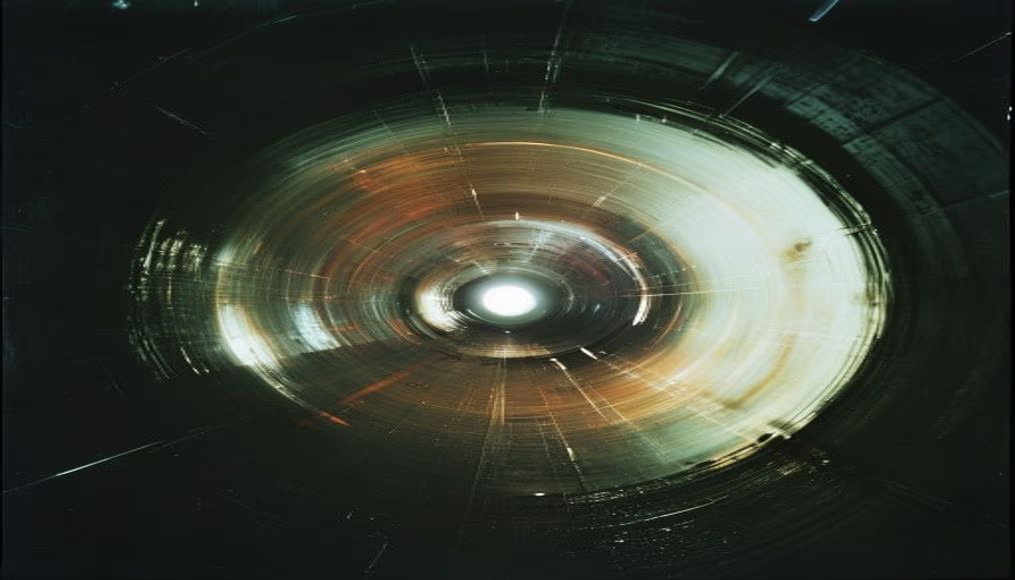
Gravitational lensing visualization
1344×768 · AVIF · CC BY 4.0

Gravitational lensing bends light from distant galaxies, revealing invisible masses and testing Einstein's general relativity.
About this subject
Gravitational lensing is a phenomenon predicted by Einstein's general theory of relativity, where the gravity of a massive object, such as a galaxy cluster or black hole, warps the spacetime around it. When light from a distant source passes near this massive object, its path is bent, creating distortions that can magnify, multiply, or even form complete rings around the lens. This effect is analogous to an optical lens, but on a cosmic scale.
The first observed example of gravitational lensing was in 1979 with the double quasar QSO 0957+561, which appeared as two nearby objects in the sky but was actually the same quasar whose light was deflected by an intervening galaxy. Since then, gravitational lenses have become essential tools in astronomy. They allow mapping the distribution of dark matter, which does not emit light but influences gravity. By analyzing the distortion of background galaxies, astronomers can reconstruct the location and density of dark matter in clusters.
Gravitational lenses are also used to study very distant and faint galaxies that would otherwise be invisible. The Hubble Space Telescope has captured stunning images of lenses, such as the galaxy cluster Abell 2744, which distorts the light of thousands of background galaxies. In 2022, the James Webb Space Telescope revealed new lenses, including one showing a galaxy from the early universe, with a redshift of 9.5, magnified by a cluster. These observations help understand the formation and evolution of the first galaxies.
Beyond scientific value, gravitational lensing produces uniquely beautiful images, with luminous arcs and rings reminiscent of abstract art. This cosmic aesthetic inspires both scientists and artists, and is often incorporated into visual representations of modern astronomy. Ongoing study of gravitational lenses promises to unveil secrets about the nature of dark matter, the expansion of the universe, and the validity of general relativity under extreme conditions.
Frequently Asked Questions
What causes the gravitational lensing effect?
Gravitational lensing is caused by the curvature of spacetime due to the presence of a massive object, such as a galaxy cluster. Light from a distant source follows this curvature, being bent and distorted.
How do gravitational lenses help study dark matter?
By observing the distortion of background galaxy shapes, astronomers can map the total mass distribution, including dark matter. Regions with more dark matter cause greater distortion, allowing inference of their location and density.
What was the first observed example of gravitational lensing?
The first example was the double quasar QSO 0957+561, discovered in 1979. Two nearby bright points were found to be images of the same quasar, due to gravitational deflection by a galaxy between the quasar and Earth.
Direct URL
https://pub-c7d6a6ea828543ac903a74a341ccb2e1.r2.dev/imagens/gravitational-lensing-visualization-high-fashion-editorial-p10.avifHow to credit
Include a visible link back to UtilizAí. Copy one of the snippets below:
<a href="https://xn--utiliza-eza.com/en/midia/imagens/gravitational-lensing-visualization-high-fashion-editorial-p10">Gravitational lensing visualization</a> by <a href="https://xn--utiliza-eza.com">UtilizAí</a>, licensed under <a href="https://creativecommons.org/licenses/by/4.0/">CC BY 4.0</a>.
[Gravitational lensing visualization](https://xn--utiliza-eza.com/en/midia/imagens/gravitational-lensing-visualization-high-fashion-editorial-p10) by [UtilizAí](https://xn--utiliza-eza.com), CC BY 4.0
License: CC-BY-4.0