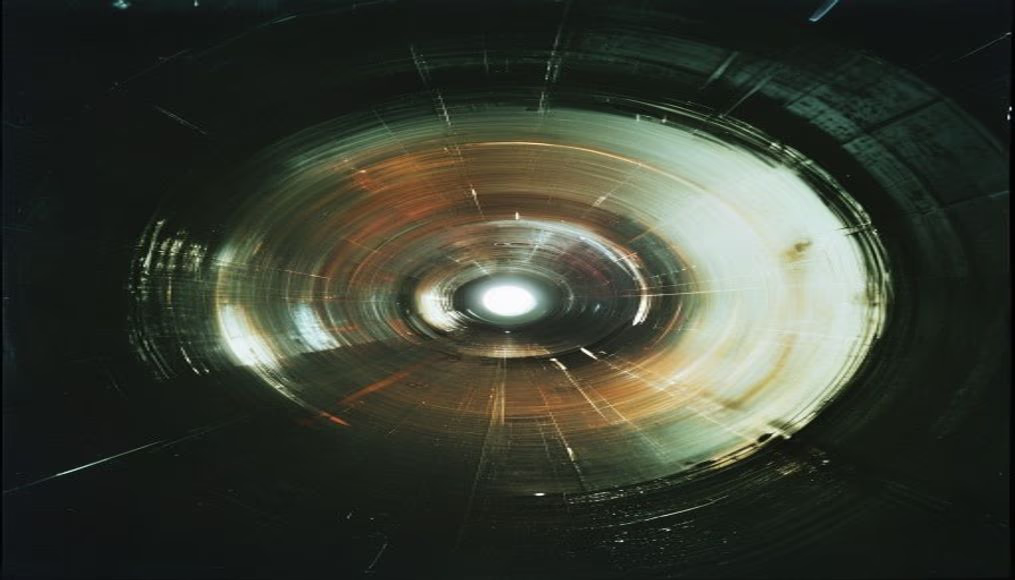
Gravitational lensing visualization
1344×768 · AVIF · CC BY 4.0

Visual simulation of gravitational lensing, predicted by Einstein, where light from distant objects is bent by the gravity of intervening masses.
About this subject
Gravitational lensing is a phenomenon predicted by Albert Einstein's general theory of relativity. It occurs when light emitted by a distant object, such as a galaxy or quasar, passes near a very massive object, like a galaxy cluster or black hole. The curvature of spacetime caused by this mass deflects the light's path, creating visual distortions that can magnify, stretch, or even multiply the image of the background object. This effect is analogous to an optical lens but on a cosmic scale.
The first evidence of gravity bending light came in 1919 during a solar eclipse, when the apparent positions of stars near the Sun were measured. However, strong gravitational lensing, capable of forming multiple images or Einstein rings, was only observed decades later. Today, gravitational lenses are essential tools in astronomy. They allow scientists to study the distribution of dark matter in galaxy clusters, since dark matter does not emit light but contributes to the curvature. They also magnify extremely distant galaxies that would otherwise be invisible, helping to understand the formation and evolution of the early universe.
Notable examples include the Abell 2218 cluster, which distorts light from galaxies behind it into arcs and multiple images, and the double quasar system Q0957+561, where a single quasar appears as two images due to a lensing galaxy in between. The phenomenon can also produce complete Einstein rings when the source, lens, and observer are perfectly aligned. Computer visualizations, such as the one that generated this image, help illustrate complex concepts by showing how light bends around a central mass against a background of galaxies.
Frequently Asked Questions
What causes gravitational lensing?
It is caused by the curvature of spacetime due to a large mass, such as a galaxy cluster or black hole. Light from distant objects follows this curvature, resulting in visual distortions.
How do gravitational lenses help astronomers?
They allow study of dark matter, magnification of distant objects, and measurement of the Universe's expansion rate. They are also used to detect exoplanets via microlensing.
What are the types of gravitational lensing?
There are three types: strong lensing (producing multiple images or Einstein rings), weak lensing (subtle distortions of background galaxies), and microlensing (temporary brightening of stars or planets).
Direct URL
https://pub-c7d6a6ea828543ac903a74a341ccb2e1.r2.dev/imagens/gravitational-lensing-visualization-film-grain-authentic-p12.avifHow to credit
Include a visible link back to UtilizAí. Copy one of the snippets below:
<a href="https://xn--utiliza-eza.com/en/midia/imagens/gravitational-lensing-visualization-film-grain-authentic-p12">Gravitational lensing visualization</a> by <a href="https://xn--utiliza-eza.com">UtilizAí</a>, licensed under <a href="https://creativecommons.org/licenses/by/4.0/">CC BY 4.0</a>.
[Gravitational lensing visualization](https://xn--utiliza-eza.com/en/midia/imagens/gravitational-lensing-visualization-film-grain-authentic-p12) by [UtilizAí](https://xn--utiliza-eza.com), CC BY 4.0
License: CC-BY-4.0