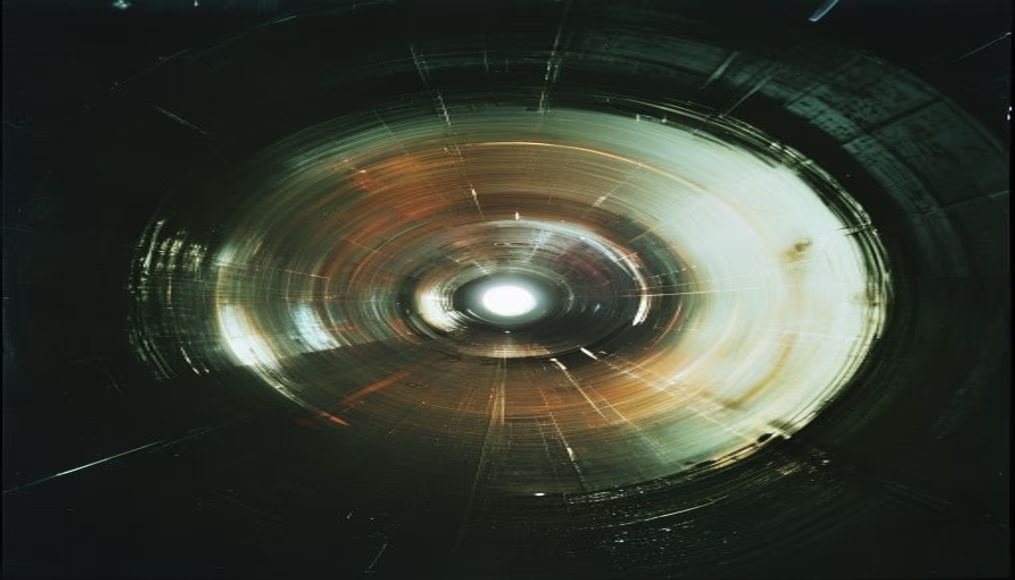
Gravitational lensing visualization
1344×768 · AVIF · CC BY 4.0
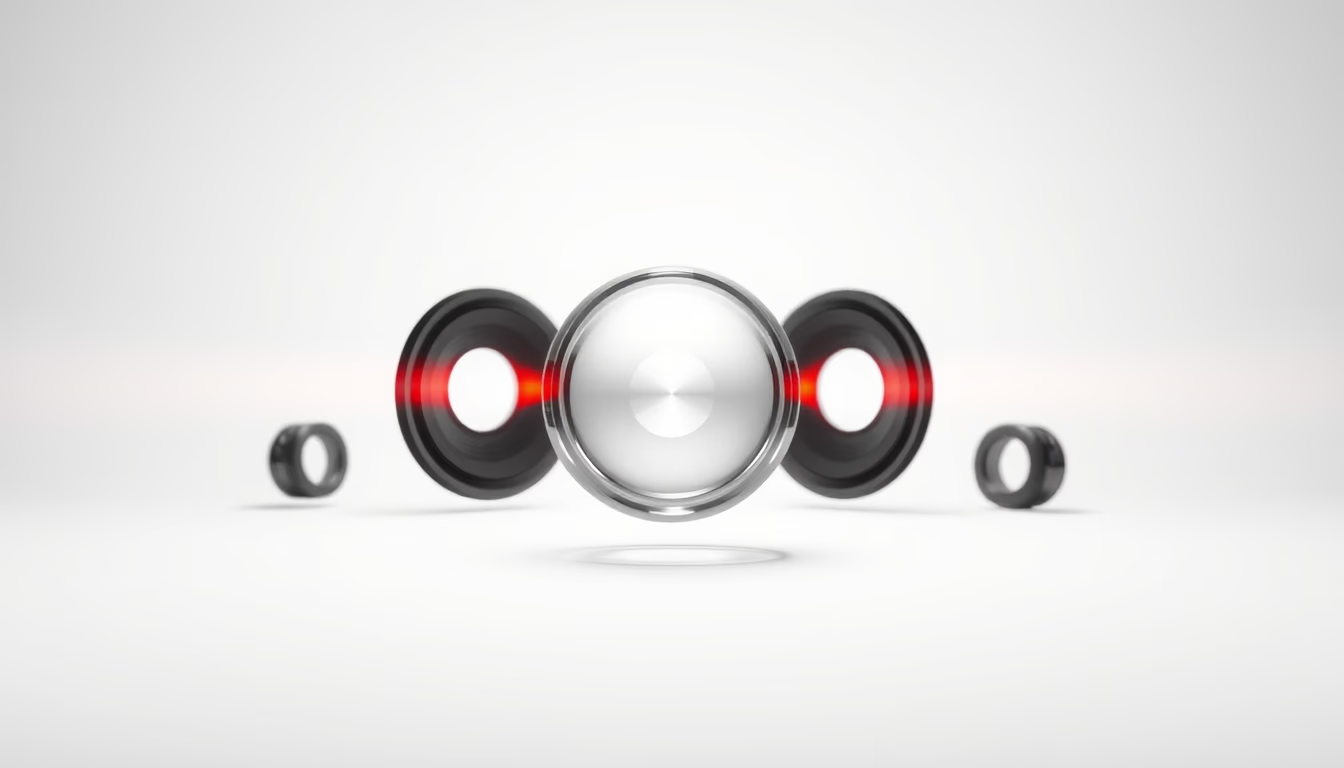
Gravitational lensing is a phenomenon predicted by general relativity, where light from distant objects is bent by the gravity of massive bodies, creating distorted or multiple images.
About this subject
Gravitational lensing occurs when light from a distant source, such as a galaxy or quasar, passes near a massive object (another galaxy or cluster) and its path is curved by the gravitational field. This effect was predicted by Albert Einstein in 1915, but only indirectly observed in 1919 during a solar eclipse, when starlight was bent by the Sun. The first strong gravitational lens was discovered in 1979, the so-called “Twin Quasar” (Q0957+561), which is actually a single source with duplicated images.
There are three main types of gravitational lensing: strong, weak, and microlensing. Strong lensing produces multiple images, arcs, or Einstein rings, such as the famous LRG 3-757 ring. Weak lensing subtly distorts the shapes of background galaxies, allowing mapping of invisible mass distribution (dark matter). Microlensing occurs when compact objects like stars or black holes temporarily amplify the brightness of distant stars, a technique used in exoplanet searches.
In modern astronomy, gravitational lensing is an essential tool. It enables the study of very distant and faint galaxies that would otherwise be invisible without the brightness boost. It also helps measure the mass of galaxy clusters and test cosmological models. For example, the James Webb Space Telescope uses gravitational lenses to observe the first galaxies in the universe, expanding our view of the primordial cosmos.
A curious fact: the phenomenon was initially considered just a theoretical curiosity, but today it is one of the strongest pieces of evidence for the existence of dark matter. In 2023, the ESA's Euclid satellite was launched with the goal of mapping weak gravitational lensing across the entire sky, revolutionizing our understanding of the universe's expansion.
Frequently Asked Questions
What causes gravitational lensing?
Gravitational lensing is caused by the curvature of spacetime due to the presence of mass, as predicted by Einstein's general relativity. Light follows the curvature, resulting in distortion or amplification of the distant source image.
What is the difference between strong and weak gravitational lensing?
In strong lensing, the distortion is large and visible, forming multiple images or rings. In weak lensing, the distortion is subtle and statistical, requiring analysis of many galaxies to map dark matter.
How does gravitational lensing help in the search for exoplanets?
Through gravitational microlensing, a planet can briefly amplify the light of a distant star when it passes along the line of sight, revealing its existence. This method is sensitive to low-mass and distant planets.
Direct URL
https://pub-c7d6a6ea828543ac903a74a341ccb2e1.r2.dev/imagens/gravitational-lensing-visualization-commercial-product-photography-p7.avifHow to credit
Include a visible link back to UtilizAí. Copy one of the snippets below:
<a href="https://xn--utiliza-eza.com/en/midia/imagens/gravitational-lensing-visualization-commercial-product-photography-p7">Gravitational lensing visualization</a> by <a href="https://xn--utiliza-eza.com">UtilizAí</a>, licensed under <a href="https://creativecommons.org/licenses/by/4.0/">CC BY 4.0</a>.
[Gravitational lensing visualization](https://xn--utiliza-eza.com/en/midia/imagens/gravitational-lensing-visualization-commercial-product-photography-p7) by [UtilizAí](https://xn--utiliza-eza.com), CC BY 4.0
License: CC-BY-4.0