Gravitational lensing visualization
1344×768 · AVIF · CC BY 4.0
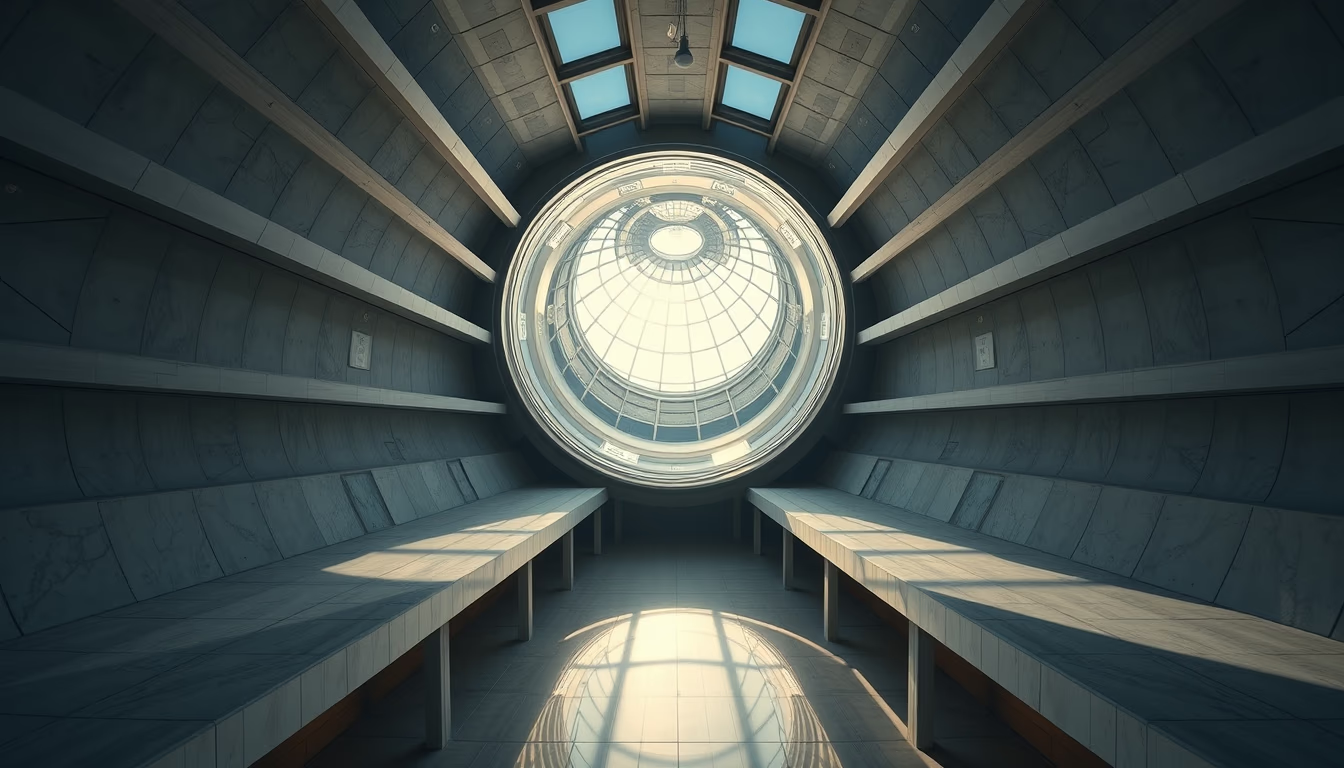
Gravitational lensing visualization shows how spacetime curvature bends light from distant galaxies, a phenomenon predicted by Einstein in 1915.
About this subject
Gravitational lenses are one of the most fascinating effects of Einstein's general theory of relativity, published in 1915. They occur when the gravity of a massive object, such as a galaxy cluster, warps the spacetime around it, bending the path of light passing nearby. This effect was first confirmed in 1919 during a solar eclipse, when the apparent position of stars near the Sun was measured with distortion.
There are three main types of gravitational lenses: strong lenses, which produce visible arcs and Einstein rings; weak lenses, which cause small statistical distortions in the shapes of galaxies; and microlenses, which temporarily amplify the brightness of individual stars. These phenomena are essential tools in modern astrophysics, enabling studies of dark matter distribution, measurement of cosmological distances, and even exoplanet detection.
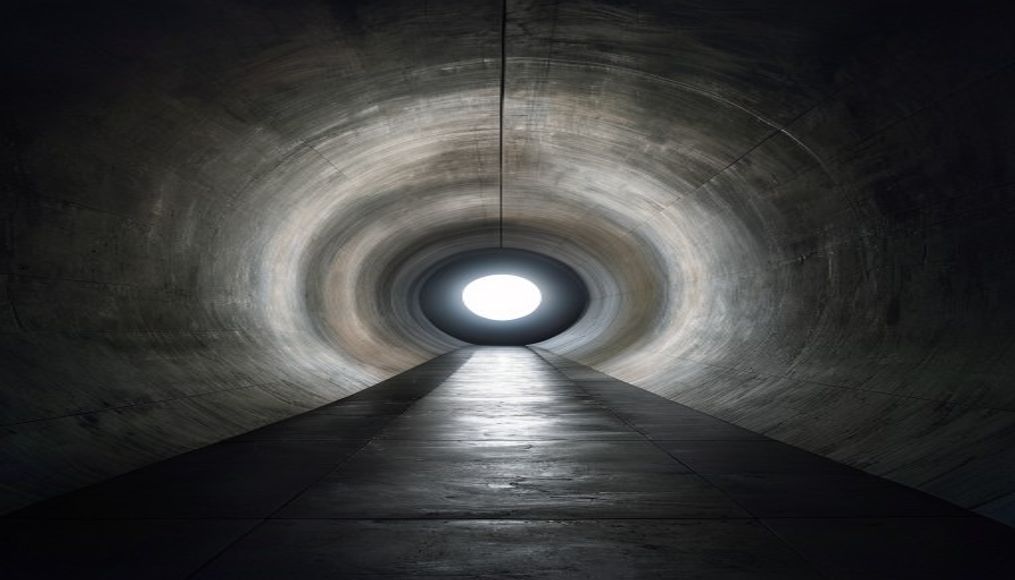
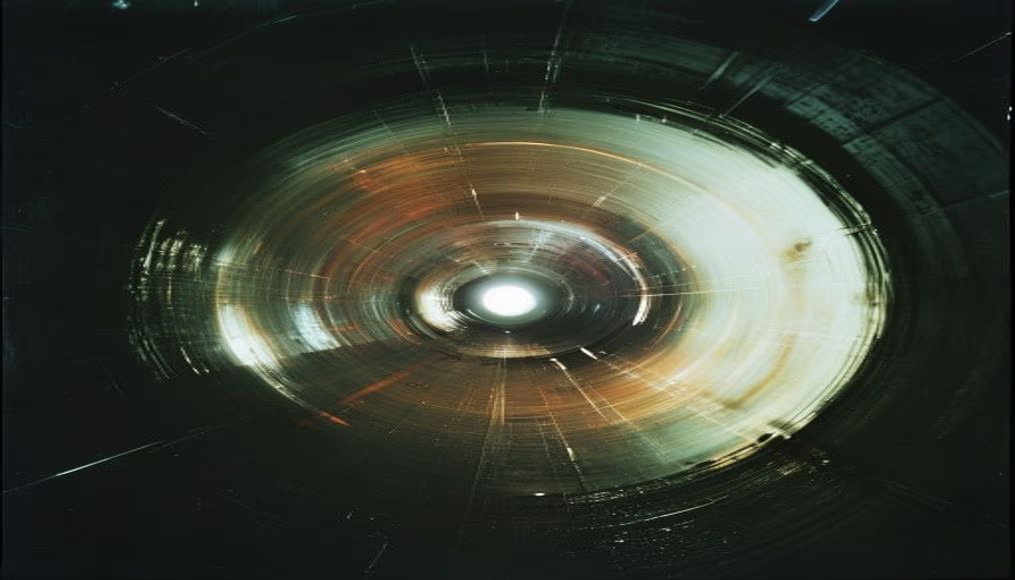
Computer visualizations like this one are created from simulations of fluid dynamics and numerical relativity. They help astronomers interpret real observations and communicate complex concepts to the public. The fractal structure and luminous arcs in the image resemble architectural forms like cathedrals or bridges, but every detail represents real scientific data about spacetime curvature.
Notably, in 2019, astronomers used gravitational lenses to measure the Hubble constant with a precision of 2.4%, contributing to the debate on the Universe's expansion rate. The phenomenon also enabled the discovery of the most distant galaxy observed, MACS0647-JD, with a redshift of 10.7.
Frequently Asked Questions
What is a gravitational lens?
It is a phenomenon predicted by general relativity where the gravity of a massive object curves spacetime, bending light passing nearby, similar to an optical lens.
How do gravitational lenses help study dark matter?
Weak lensing distortion maps the mass distribution, including dark matter that emits no light, allowing astronomers to infer its presence and amount.
What was the first observation of a gravitational lens?
In 1919, Arthur Eddington and his team measured the deflection of starlight during a solar eclipse, confirming Einstein's prediction.
Direct URL
https://pub-c7d6a6ea828543ac903a74a341ccb2e1.r2.dev/imagens/gravitational-lensing-visualization-architectural-photography-p11.avifHow to credit
Include a visible link back to UtilizAí. Copy one of the snippets below:
<a href="https://xn--utiliza-eza.com/en/midia/imagens/gravitational-lensing-visualization-architectural-photography-p11">Gravitational lensing visualization</a> by <a href="https://xn--utiliza-eza.com">UtilizAí</a>, licensed under <a href="https://creativecommons.org/licenses/by/4.0/">CC BY 4.0</a>.
[Gravitational lensing visualization](https://xn--utiliza-eza.com/en/midia/imagens/gravitational-lensing-visualization-architectural-photography-p11) by [UtilizAí](https://xn--utiliza-eza.com), CC BY 4.0
License: CC-BY-4.0