Gpu nvidia rtx
1344×768 · AVIF · CC BY 4.0
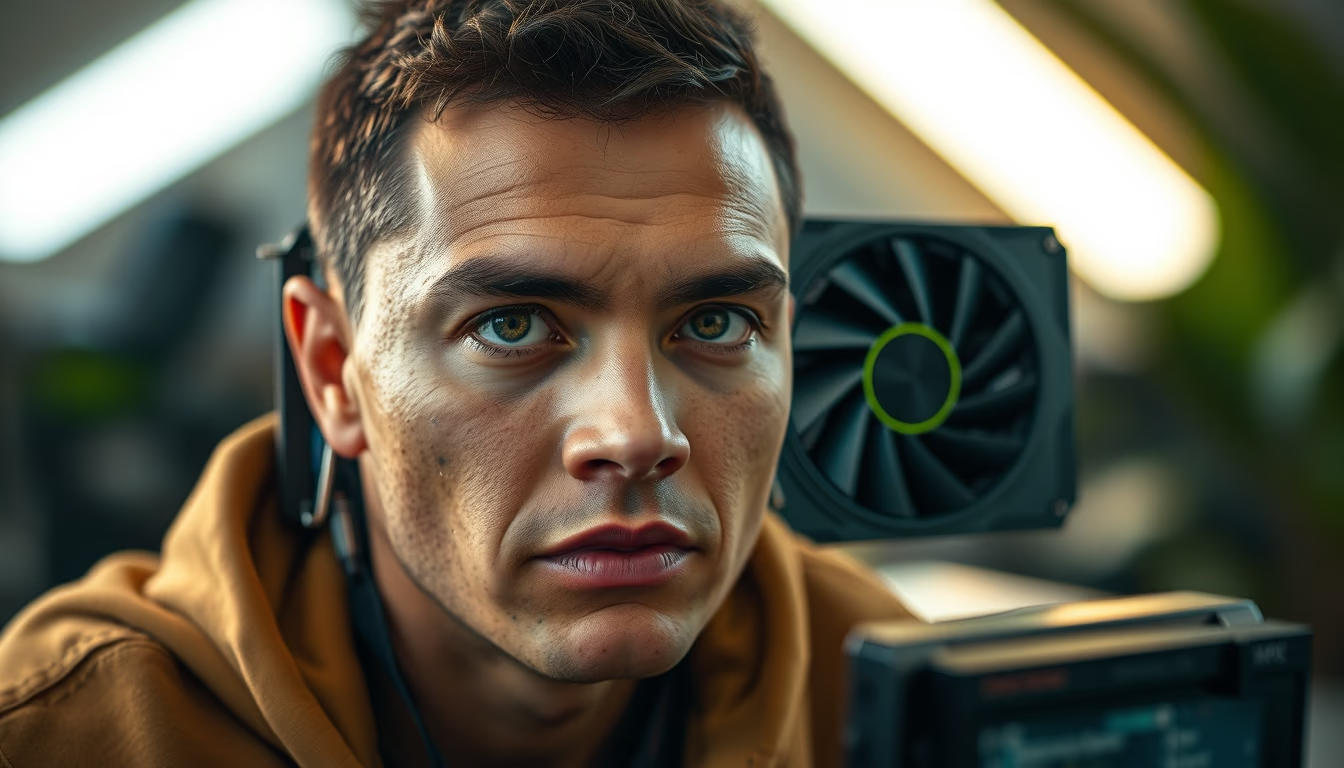
Nvidia RTX graphics cards revolutionized real-time ray tracing and AI-powered graphics, setting a new benchmark for gaming and content creation.
About this subject
The Nvidia RTX series, launched in 2018 with the Turing architecture, introduced hardware-accelerated real-time ray tracing to consumers for the first time. RTX GPUs combine traditional CUDA cores with dedicated RT cores for ray tracing calculations and Tensor cores for AI inference. DLSS (Deep Learning Super Sampling) uses deep learning to upscale low-resolution images, delivering higher performance without significant quality loss.
Each subsequent generation brought major improvements. The RTX 30 series (Ampere, 2020) doubled ray tracing performance and introduced RTX IO for fast texture loading. The RTX 40 series (Ada Lovelace, 2022) improved energy efficiency and added DLSS 3 with frame generation, capable of multiplying frame rates in supported games. In the professional segment, RTX A-series (formerly Quadro) offers ISV certification and ECC memory for workstations in engineering, architecture, and data science.
The RTX ecosystem extends beyond gaming. Content creators use NVENC encoding for streaming and video editing with minimal performance impact. AI researchers and developers train machine learning models on these GPUs, leveraging frameworks like TensorFlow, PyTorch, and CUDA. Nvidia also provides Omniverse, a real-time 3D collaboration platform that fully exploits ray tracing and physical simulation.
Competition from AMD (Radeon RX series) and Intel (Arc) drives constant innovation. While AMD introduced its own ray tracing, Nvidia maintains an edge in software ecosystem, with Game Ready drivers and technologies like Reflex (latency reduction) and Broadcast (AI-driven audio/video filters). For enthusiasts, cards like the RTX 4090 represent the pinnacle of performance, while models like the RTX 4060 offer good value for 1080p gaming with ray tracing.
Frequently Asked Questions
What is the difference between RTX 30 and RTX 40 series?
The RTX 40 series (Ada Lovelace) features better energy efficiency, DLSS 3 with frame generation, and third-gen RT cores, delivering up to twice the ray tracing performance compared to the RTX 30 series.
What is DLSS and how does it work?
DLSS (Deep Learning Super Sampling) is an AI upscaling technology that renders at a lower resolution and uses neural networks to reconstruct a high-quality image, improving performance without sacrificing visual fidelity.
Is an RTX GPU worth it for professional work?
Yes. RTX cards offer Tensor cores for AI acceleration, NVENC encoding for video editing, and certified drivers for CAD and BIM applications, making them ideal for designers, engineers, and data scientists.
Direct URL
https://pub-c7d6a6ea828543ac903a74a341ccb2e1.r2.dev/imagens/gpu-nvidia-rtx-national-geographic-style-p0.avifHow to credit
Include a visible link back to UtilizAí. Copy one of the snippets below:
<a href="https://xn--utiliza-eza.com/en/midia/imagens/gpu-nvidia-rtx-national-geographic-style-p0">Gpu nvidia rtx</a> by <a href="https://xn--utiliza-eza.com">UtilizAí</a>, licensed under <a href="https://creativecommons.org/licenses/by/4.0/">CC BY 4.0</a>.
[Gpu nvidia rtx](https://xn--utiliza-eza.com/en/midia/imagens/gpu-nvidia-rtx-national-geographic-style-p0) by [UtilizAí](https://xn--utiliza-eza.com), CC BY 4.0
License: CC-BY-4.0