Glider sailplane sky
1344×768 · AVIF · CC BY 4.0
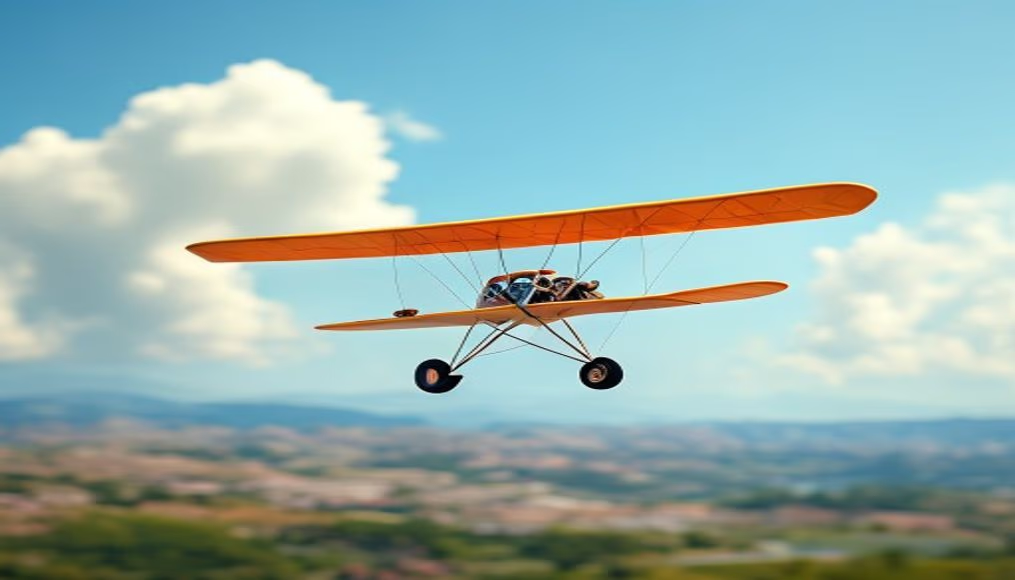
Gliders, or sailplanes, are motorless aircraft that exploit rising air currents to fly long distances, combining engineering and meteorology.
About this subject
Gliders, also known as sailplanes, are aircraft designed to fly without engines, relying solely on natural atmospheric forces. Soaring flight exploits rising air currents such as thermals (generated by solar heating of the ground), mountain waves, or ridge lift. From Otto Lilienthal's pioneering experiments in the 19th century to modern carbon-fiber sailplanes, technological evolution has enabled these aircraft to reach altitudes above 15,000 meters and cover distances over 2,000 kilometers in a single flight.
Brazil has a strong gliding tradition, driven by the sky of Rio Claro and the Escola de Especialistas de Aeronáutica in Guaratinguetá. The mountainous region of Rio de Janeiro, especially Pico do Papagaio, is recognized worldwide for exceptional wave soaring conditions. World Gliding Championships have been held in the country, highlighting Brazilian pilots like Luís Fernando Neto.
The operating principle of a glider involves glide ratio (aerodynamic efficiency) and sink rate. While a typical powered airplane has a glide ratio of about 15:1, high-performance sailplanes achieve 60:1 or more, meaning for each meter of altitude lost, they travel 60 meters horizontally. To gain altitude, the pilot seeks areas of upward air movement, often identified by cumulus clouds or using instruments like the variometer.
Interesting fact: in 2020, German pilot Klaus Ohlmann set a record by flying 2,200 km in a glider over Patagonia. Another notable achievement was Jim Payne and Morgan Sandercock's 2015 flight of 1,734 km across the Chilean Andes. Gliding is not just an air sport but a demonstration of human ability to master the elements with elegance and precision.
Frequently Asked Questions
How can a glider fly without an engine?
Gliders use rising air currents (thermals, mountain waves, or ridge lift) to gain altitude. Once airborne, the aircraft gradually glides downward, but the pilot seeks new rising air to stay aloft for hours.
What is the difference between a glider and a sailplane?
In many contexts, the terms are used interchangeably. However, 'sailplane' often refers to high-performance gliders designed for extended soaring, while 'glider' is a broader term for any engineless aircraft.
Is gliding safe?
Yes, gliding has an excellent safety record when practiced with proper training and maintenance. Gliders are certified aircraft, and pilots undergo specialized instruction.
Direct URL
https://pub-c7d6a6ea828543ac903a74a341ccb2e1.r2.dev/imagens/glider-sailplane-sky-tilt-shift-miniature-p1.avifHow to credit
Include a visible link back to UtilizAí. Copy one of the snippets below:
<a href="https://xn--utiliza-eza.com/en/midia/imagens/glider-sailplane-sky-tilt-shift-miniature-p1">Glider sailplane sky</a> by <a href="https://xn--utiliza-eza.com">UtilizAí</a>, licensed under <a href="https://creativecommons.org/licenses/by/4.0/">CC BY 4.0</a>.
[Glider sailplane sky](https://xn--utiliza-eza.com/en/midia/imagens/glider-sailplane-sky-tilt-shift-miniature-p1) by [UtilizAí](https://xn--utiliza-eza.com), CC BY 4.0
License: CC-BY-4.0