Fractal infinite zoom
1344×768 · AVIF · CC BY 4.0
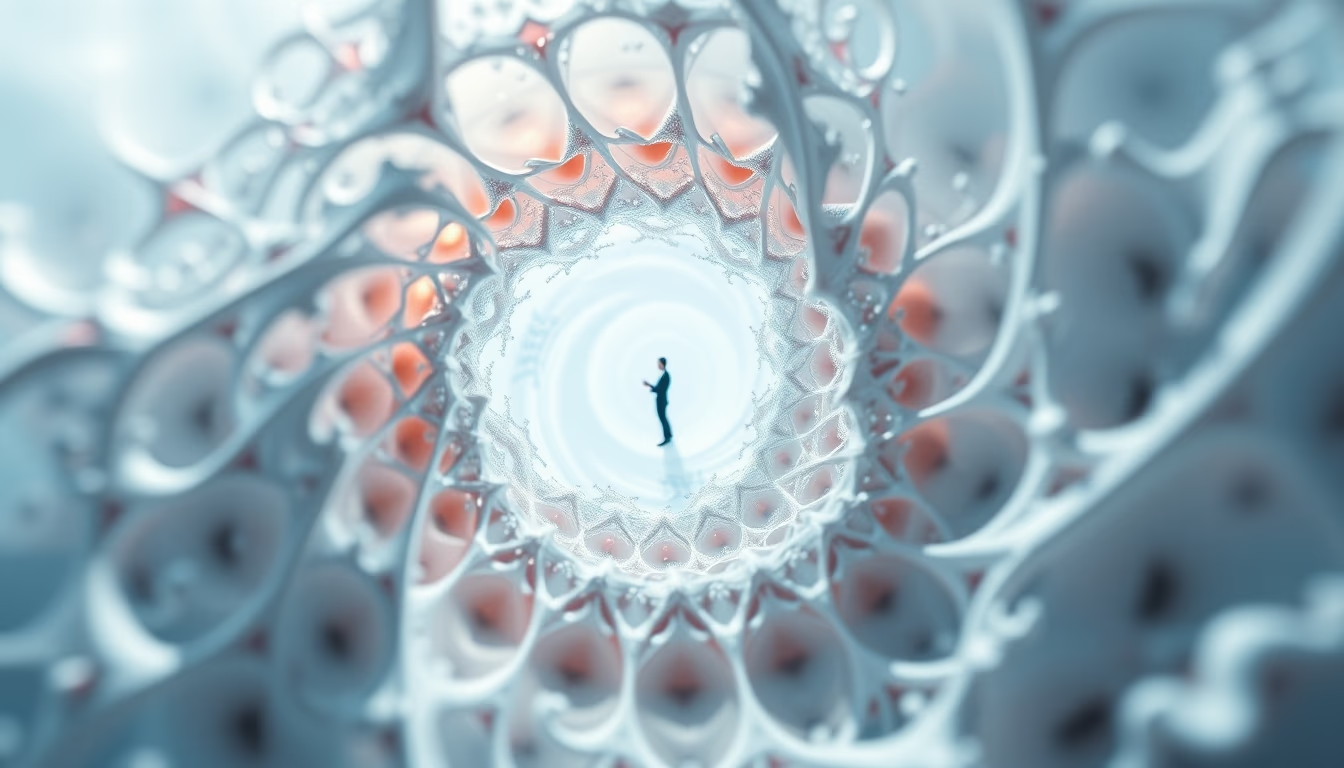
Infinite zoom fractals reveal mathematical patterns that repeat at tiny scales, with applications from computer graphics to quantum physics.
About this subject
Fractals are geometric structures characterized by self-similarity: each part resembles the whole at different scales. The concept was formalized by mathematician Benoit Mandelbrot in the 1970s while studying natural phenomena such as irregular coastlines and galaxy distribution. The Mandelbrot set, generated by a simple iterative equation (z = z² + c), is the most famous example of an infinitely zoomable fractal. As you zoom into a boundary region, complex and intricate shapes emerge, never exactly repeating but maintaining the signature of the whole.
The discovery of fractals revolutionized fields like computer graphics, enabling realistic landscapes, clouds, and natural textures in movies and games. In nature, fractal structures abound: trees, vascular systems, snowflakes, and even Romanesco broccoli exhibit self-similar patterns. In medicine, fractal analysis of tissue images aids in diagnosing diseases like cancer. More recently, research in quantum physics suggests fractals may describe particle behavior at subatomic scales.
The fascination with infinite zoom fractals extends beyond mathematics. Artists and musicians use these forms to create psychedelic and immersive works. Navigating a fractal, descending endless layers of detail, is often compared to a hallucinogenic journey. Despite their abstract origin, fractals bridge the micro and macro, revealing hidden beauty in the laws of nature.
Frequently Asked Questions
What is a fractal?
A fractal is a geometric shape that exhibits self-similarity, meaning its parts resemble the whole at different scales. Common examples include snowflakes, Romanesco broccoli, and the Mandelbrot set.
How does infinite zoom work in fractals?
Infinite zoom works because the mathematical equation generating the fractal produces ever-smaller details that maintain complexity. As you magnify, new structures appear while still resembling the original pattern.
Where are fractals used?
Fractals are used in computer graphics to create realistic landscapes and textures, in medicine for image analysis, in physics to model complex systems, and in art to generate hypnotic visual patterns.
Direct URL
https://pub-c7d6a6ea828543ac903a74a341ccb2e1.r2.dev/imagens/fractal-infinite-zoom-magazine-editorial-p3.avifHow to credit
Include a visible link back to UtilizAí. Copy one of the snippets below:
<a href="https://xn--utiliza-eza.com/en/midia/imagens/fractal-infinite-zoom-magazine-editorial-p3">Fractal infinite zoom</a> by <a href="https://xn--utiliza-eza.com">UtilizAí</a>, licensed under <a href="https://creativecommons.org/licenses/by/4.0/">CC BY 4.0</a>.
[Fractal infinite zoom](https://xn--utiliza-eza.com/en/midia/imagens/fractal-infinite-zoom-magazine-editorial-p3) by [UtilizAí](https://xn--utiliza-eza.com), CC BY 4.0
License: CC-BY-4.0