Fiber optic transceiver
1344×768 · AVIF · CC BY 4.0
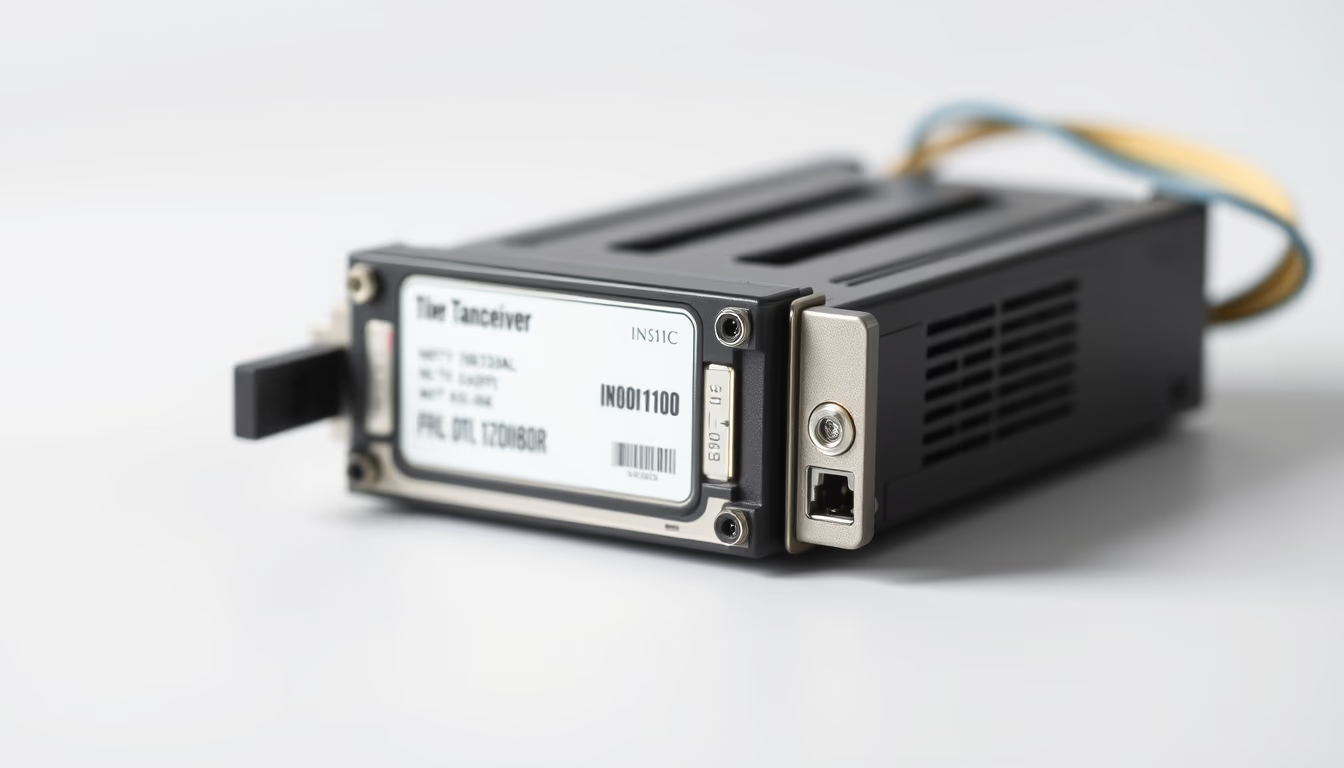
Fiber optic transceivers convert electrical signals to optical and back, enabling high-speed data transmission over long distances.
About this subject
A fiber optic transceiver is a fundamental device in telecommunications and data centers. It integrates a transmitter (laser or LED) and a receiver (photodetector) into a compact module, converting electrical signals into light pulses and vice versa. This conversion is essential for leveraging the immense bandwidth of optical fiber, which can achieve tens of terabits per second. Industry-standard modules such as SFP, SFP+, and QSFP enable connectivity from a few meters to over 100 km, depending on power and fiber type (single-mode or multimode).
The evolution of transceivers has paralleled internet growth. In the 1990s, GBIC (Gigabit Interface Converter) modules were bulky; today, SFP+ (Small Form-factor Pluggable Plus) supports 10 Gbps with a reduced footprint. Modern data centers use QSFP28 for 100 Gbps and QSFP-DD for 400 Gbps, driven by demand for streaming, cloud computing, and artificial intelligence. Wavelength-division multiplexing (WDM) allows multiple transceivers to operate on different light colors over the same fiber, multiplying capacity without new cables.
Globally, transceiver manufacturing is dominated by companies like Finisar (now II-VI), Broadcom, and Cisco, with increasing Chinese production. Brazil's fiber expansion in metropolitan and intercity networks relies on these modules. Operators such as Vivo, Claro, and Oi use transceivers in their backbones, while regional FTTH (Fiber to the Home) providers employ GPON and EPON modules. Critical specifications include operating temperature, power consumption (typically under 1 W), and latency (sub-microsecond), vital for applications like financial trading and 5G.
Interestingly, an SFP+ transceiver can transmit data at 10 Gbps over 10 km using a 1310 nm laser in single-mode fiber. Modules for 400 Gbps use 8 channels of 50 Gbps each (PAM4) with 1310 nm or 1550 nm lasers. Reliability is high, with mean time between failures (MTBF) exceeding 1 million hours.
Frequently Asked Questions
What is the difference between SFP, SFP+, and QSFP transceivers?
SFP (Small Form-factor Pluggable) supports up to 1 Gbps; SFP+ goes up to 10 Gbps; QSFP (Quad SFP) aggregates 4 channels, with versions for 40 Gbps (QSFP+) and 100 Gbps (QSFP28). The choice depends on speed and equipment port density.
How to choose between single-mode and multimode fiber for a transceiver?
Single-mode fiber (small core, ~9 µm) is ideal for long distances (>2 km) using 1310 or 1550 nm lasers. Multimode fiber (50 or 62.5 µm) is used for shorter distances (<550 m) with LEDs or 850 nm VCSEL lasers, offering lower cost. Consider distance and budget.
Do optical transceivers interfere with other network equipment?
No, each transceiver operates at a specific wavelength and has electromagnetic interference shielding. In WDM systems, multiple transceivers at different colors share the same fiber without mutual interference, enabling capacity expansion.
Direct URL
https://pub-c7d6a6ea828543ac903a74a341ccb2e1.r2.dev/imagens/fiber-optic-transceiver-commercial-product-photography-p4.avifHow to credit
Include a visible link back to UtilizAí. Copy one of the snippets below:
<a href="https://xn--utiliza-eza.com/en/midia/imagens/fiber-optic-transceiver-commercial-product-photography-p4">Fiber optic transceiver</a> by <a href="https://xn--utiliza-eza.com">UtilizAí</a>, licensed under <a href="https://creativecommons.org/licenses/by/4.0/">CC BY 4.0</a>.
[Fiber optic transceiver](https://xn--utiliza-eza.com/en/midia/imagens/fiber-optic-transceiver-commercial-product-photography-p4) by [UtilizAí](https://xn--utiliza-eza.com), CC BY 4.0
License: CC-BY-4.0