Exoplanet earth-like
1344×768 · AVIF · CC BY 4.0
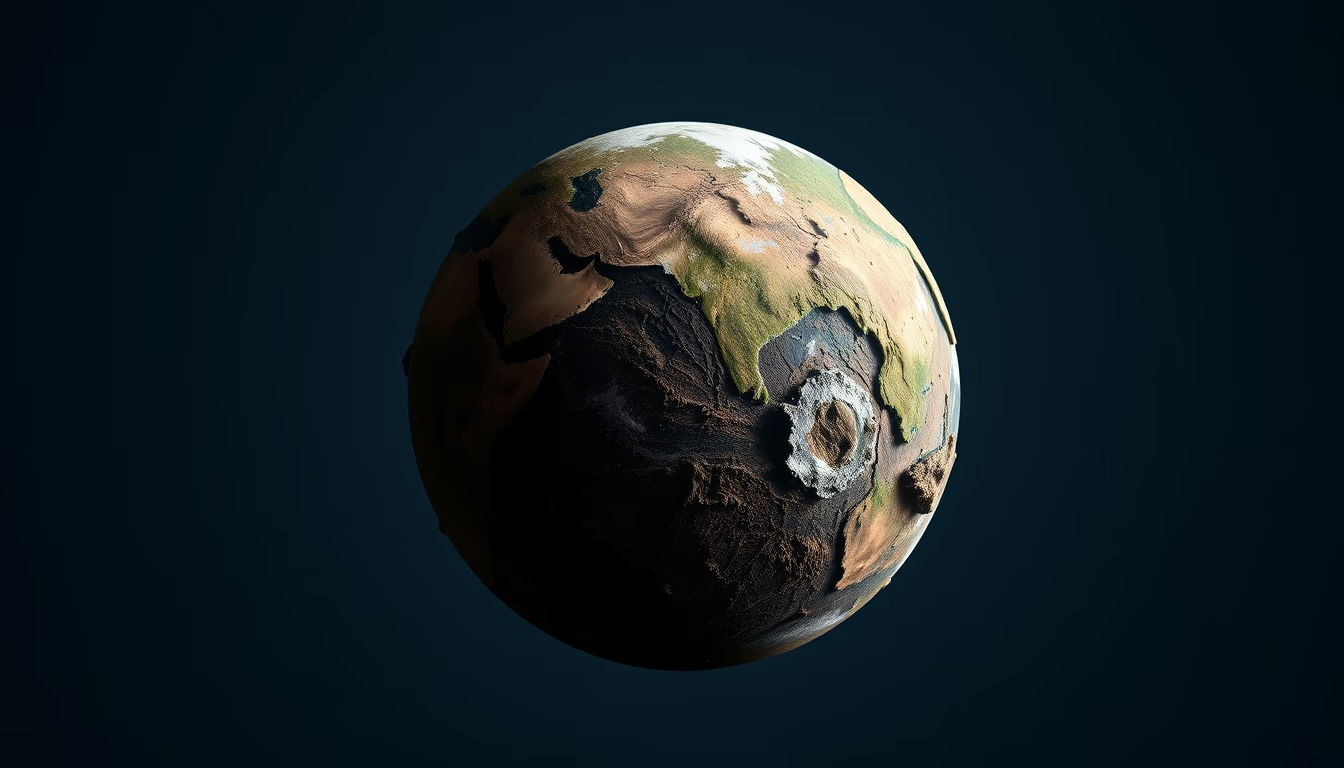
Earth-like exoplanets are rocky worlds in the habitable zone of their stars, with potential for liquid water and life.
About this subject
Earth-like exoplanets are rocky bodies whose size and mass approximate Earth's, orbiting within the habitable zone of their star, the region where temperatures allow liquid water to exist on the surface. Since early discoveries such as Proxima Centauri b, about 4.2 light-years away, to more complex systems like TRAPPIST-1, astronomy has catalogued hundreds of candidates. The Kepler space telescope identified over 2,600 confirmed exoplanets, many of which are super-Earths or similar-sized rocky planets.
The classification of an exoplanet as 'Earth-like' goes beyond size: it also requires assessing its atmospheric composition, geological activity, and potential magnetic field. The habitable zone, however, does not guarantee habitability, stellar activity and atmospheric composition can render the surface inhospitable. Exoplanets like Kepler-452b, nicknamed 'Earth's older cousin', have received attention for being in optimistic habitable zones, but they still lack spectroscopic data.
Detection of these worlds primarily uses the transit method (dimming of starlight) and the radial velocity method (stellar wobble). The James Webb Space Telescope now allows atmospheric composition analysis of some exoplanets, searching for signatures of gases such as oxygen, methane, and water vapor. In 2023, carbon dioxide signals were detected in WASP-39b, a gas giant, but the technique is already being applied to rocky candidates.
The future of research involves missions like PLATO (ESA) and Nancy Grace Roman (NASA), which will seek small, rocky planets in habitable zones. The discovery of a true Earth analog remains a central goal, as it would enable detailed studies on the origin of life and the possibility of extraterrestrial life.
Frequently Asked Questions
How many Earth-like exoplanets have been discovered so far?
There is no exact number, as the 'Earth-like' classification involves criteria such as size and habitable zone. Of the over 5,500 confirmed exoplanets, it is estimated that a few dozen are rocky and lie within their star's habitable zone.
What is the distance of the closest Earth-like exoplanet?
The closest candidate is Proxima Centauri b, about 4.2 light-years away. Another nearby is TRAPPIST-1e in the TRAPPIST-1 system, approximately 39 light-years away.
How do scientists detect these planets?
The main methods are the transit method (observing the star's dimming as the planet passes in front) and the radial velocity method (detecting the star's wobble caused by the planet's gravity). The James Webb Space Telescope can also analyze atmospheric composition during transits.
Direct URL
https://pub-c7d6a6ea828543ac903a74a341ccb2e1.r2.dev/imagens/exoplanet-earth-like-studio-editorial-portrait-p2.avifHow to credit
Include a visible link back to UtilizAí. Copy one of the snippets below:
<a href="https://xn--utiliza-eza.com/en/midia/imagens/exoplanet-earth-like-studio-editorial-portrait-p2">Exoplanet earth-like</a> by <a href="https://xn--utiliza-eza.com">UtilizAí</a>, licensed under <a href="https://creativecommons.org/licenses/by/4.0/">CC BY 4.0</a>.
[Exoplanet earth-like](https://xn--utiliza-eza.com/en/midia/imagens/exoplanet-earth-like-studio-editorial-portrait-p2) by [UtilizAí](https://xn--utiliza-eza.com), CC BY 4.0
License: CC-BY-4.0