Exoplanet earth-like
1344×768 · AVIF · CC BY 4.0
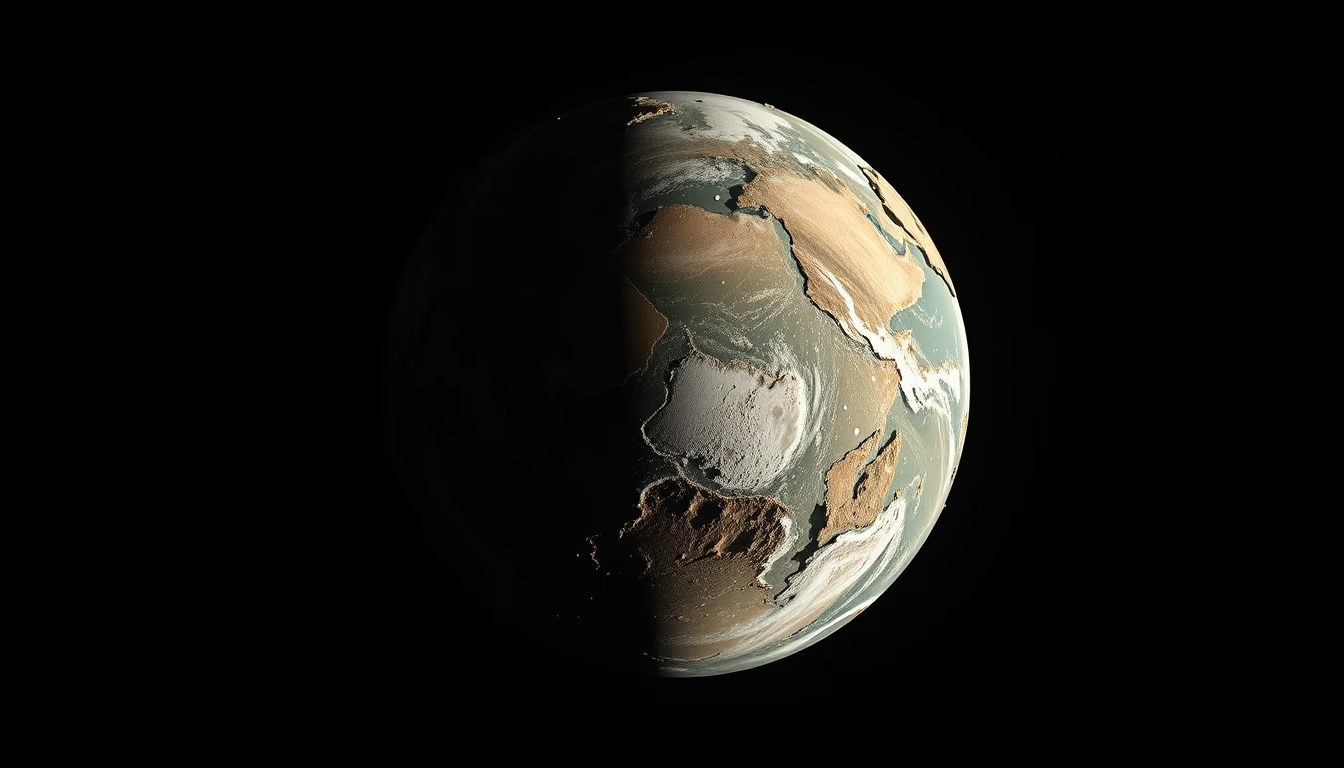
Earth-like exoplanets are rocky worlds with potential for liquid water and perhaps life, orbiting distant stars in the habitable zone.
About this subject
Earth-like exoplanets, or rocky exoplanets, are celestial bodies with composition similar to Earth: mostly silicates and metals. Their key feature is a solid surface, unlike gas giants such as Jupiter. Since the discovery of the first exoplanet in 1992 (orbiting a pulsar) and the first around a Sun-like star (51 Pegasi b, 1995), the search for Earth analogs has intensified. NASA's Kepler mission (2009-2018) identified thousands of candidates, many in the habitable zone, where temperatures could allow liquid water on the surface.
Detection methods for terrestrial exoplanets include the transit method (dimming of starlight as the planet passes in front) and radial velocity (stellar wobble due to gravitational pull). One standout system is TRAPPIST-1, with seven rocky planets, three in the habitable zone. Another example is Proxima Centauri b, discovered in 2016, orbiting the nearest star to the Sun. These worlds are prime targets for atmospheric studies with telescopes like the James Webb Space Telescope, searching for gases such as oxygen, methane, and water vapor, possible biosignatures.
Beyond the search for life, studying Earth-like exoplanets helps us understand planet formation and the diversity of solar systems. Each new discovery broadens our knowledge of the conditions necessary for life and the limits of habitability. Future missions like PLATO (ESA) and the Nancy Grace Roman Space Telescope (NASA) are expected to catalog tens of thousands of new candidates, bringing humanity closer to answering whether we are alone in the universe.
Frequently Asked Questions
How do scientists detect Earth-like exoplanets?
The main methods are transit and radial velocity. In transit, the star's brightness dims as the planet passes in front. In radial velocity, the star's slight wobble from the planet's gravitational pull is detected. These methods help estimate the planet's size and mass.
What is the most Earth-like exoplanet discovered so far?
Several candidates exist, but one of the most promising is TRAPPIST-1e in the TRAPPIST-1 system. It has similar size and mass to Earth and lies in the habitable zone of its star. Another is Proxima Centauri b, though its star emits intense flares that could affect the atmosphere.
Is there a possibility of life on Earth-like exoplanets?
Yes, theoretically. If a rocky planet is in the habitable zone and has a suitable atmosphere, it could host liquid water and conditions for microbial life. Telescopes like the James Webb are analyzing atmospheres of these planets for biosignatures such as oxygen and methane.
Direct URL
https://pub-c7d6a6ea828543ac903a74a341ccb2e1.r2.dev/imagens/exoplanet-earth-like-magazine-editorial-p7.avifHow to credit
Include a visible link back to UtilizAí. Copy one of the snippets below:
<a href="https://xn--utiliza-eza.com/en/midia/imagens/exoplanet-earth-like-magazine-editorial-p7">Exoplanet earth-like</a> by <a href="https://xn--utiliza-eza.com">UtilizAí</a>, licensed under <a href="https://creativecommons.org/licenses/by/4.0/">CC BY 4.0</a>.
[Exoplanet earth-like](https://xn--utiliza-eza.com/en/midia/imagens/exoplanet-earth-like-magazine-editorial-p7) by [UtilizAí](https://xn--utiliza-eza.com), CC BY 4.0
License: CC-BY-4.0