Emerald rough green
1344×768 · AVIF · CC BY 4.0
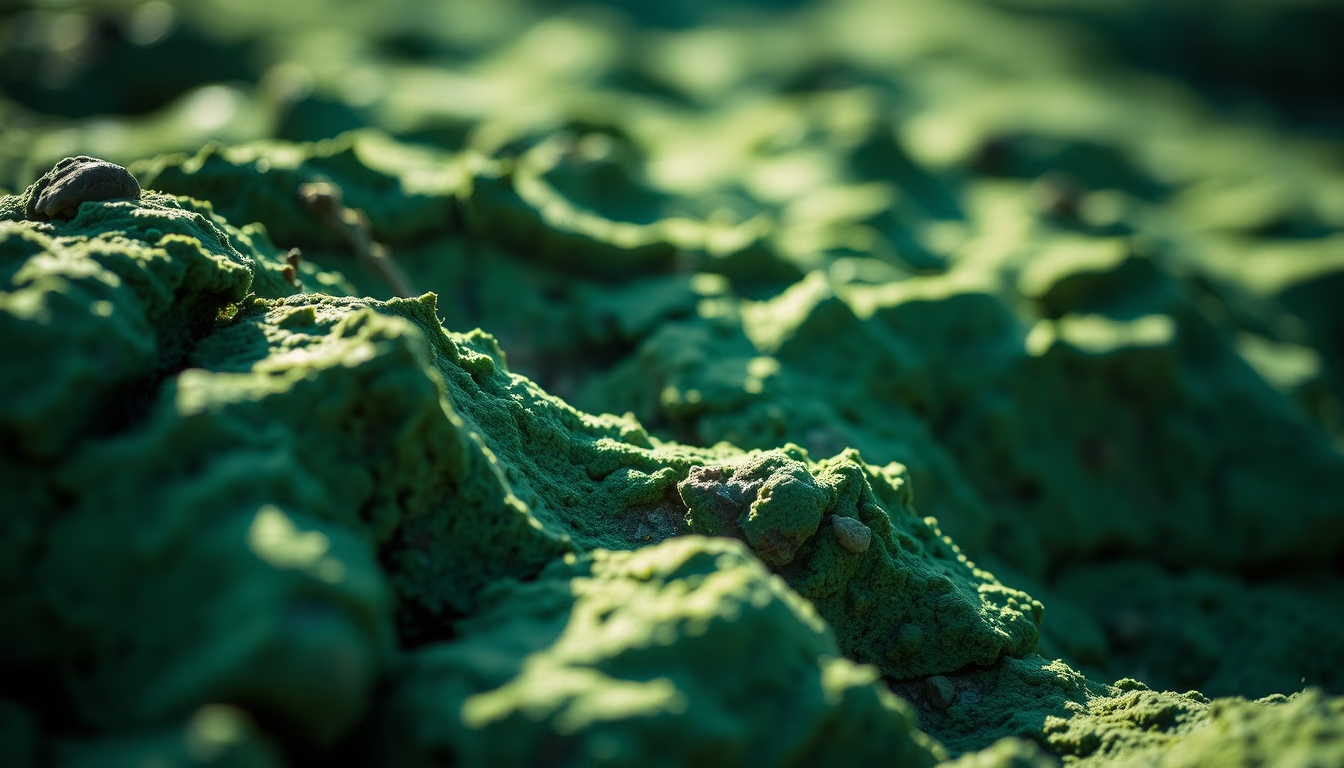
Rough green emerald: a precious gemstone with intense color, formed in metamorphic rocks and highly valued in jewelry and mineral collections.
About this subject
Emerald is a green variety of beryl, a mineral composed of beryllium and aluminum. Its characteristic color comes from traces of chromium and vanadium in its crystal structure. The most valued emeralds have an intense, saturated green tone with no visible inclusions to the naked eye. Famous deposits include the Muzo and Chivor mines in Colombia, which produce some of the world's finest emeralds. Other important sources are Brazil (Bahia, Minas Gerais), Zambia, Zimbabwe, and Afghanistan.
Emeralds form in specific geological environments such as metamorphic rocks or pegmatites, where beryllium-rich hydrothermal fluids react with chromium-bearing host rocks. Crystals can reach considerable sizes, but fractures and inclusions are common, reducing their cutting value. Emerald has a hardness of 7.5 to 8 on the Mohs scale, making it suitable for jewelry, but it requires care due to its brittleness.
Culturally, emerald symbolizes rebirth and love. Ancient Egyptians already mined them in the Eastern Desert. In modern times, emerald is one of the four traditional precious gemstones, alongside diamond, ruby, and sapphire. In Brazil, the Jequitinhonha Valley in Minas Gerais is a historic mining region. The gem is also used in technology, such as in lasers and atomic clocks, due to beryl's properties.
Fun fact: the largest emerald ever found weighs over 360 kg and was discovered in 2018 in Zambia, dubbed “Chipembele.” This giant contains emerald crystals embedded in a quartz matrix. An emerald's value depends on color, clarity, cut, and carat weight.
Frequently Asked Questions
What distinguishes an emerald from other green gemstones?
Emerald is a variety of beryl colored by chromium and vanadium. It differs from other green gems like green tourmaline or peridot in hardness, composition, and crystal structure, as well as its characteristic color.
Where do the world's finest emeralds come from?
Colombian emeralds from the Muzo and Chivor mines are considered the highest quality due to deep green color and fewer inclusions. Other important sources are Brazil, Zambia, and Afghanistan.
Why do emeralds often have inclusions?
Inclusions are common in emeralds because of their formation in high-pressure, high-temperature environments with mineral-rich fluids. They may be accepted as 'jardin' (garden-like inclusions) and even used to identify origin.
Direct URL
https://pub-c7d6a6ea828543ac903a74a341ccb2e1.r2.dev/imagens/emerald-rough-green-documentary-photography-p6.avifHow to credit
Include a visible link back to UtilizAí. Copy one of the snippets below:
<a href="https://xn--utiliza-eza.com/en/midia/imagens/emerald-rough-green-documentary-photography-p6">Emerald rough green</a> by <a href="https://xn--utiliza-eza.com">UtilizAí</a>, licensed under <a href="https://creativecommons.org/licenses/by/4.0/">CC BY 4.0</a>.
[Emerald rough green](https://xn--utiliza-eza.com/en/midia/imagens/emerald-rough-green-documentary-photography-p6) by [UtilizAí](https://xn--utiliza-eza.com), CC BY 4.0
License: CC-BY-4.0