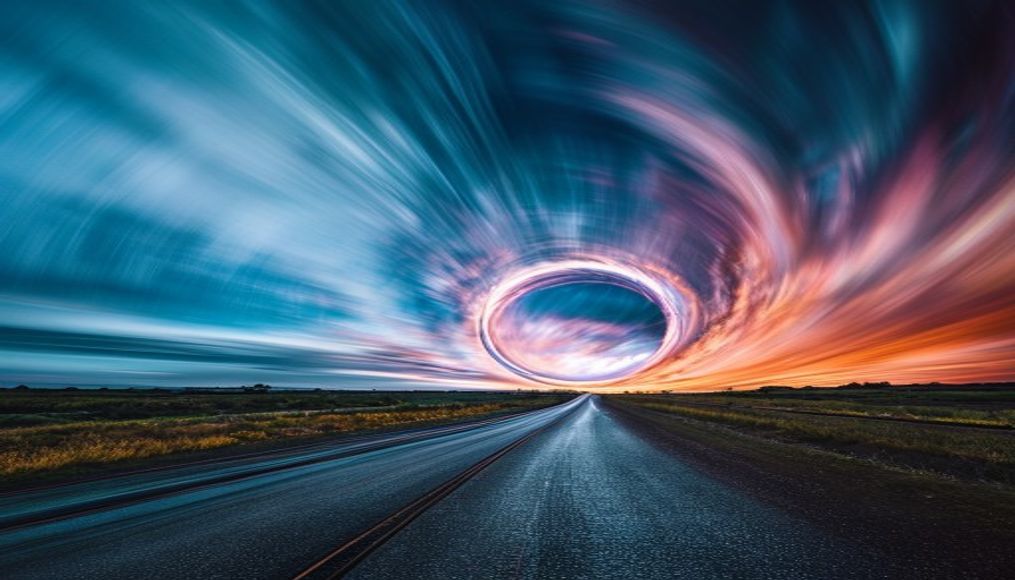
Eclipse solar diamond ring
1344×768 · AVIF · CC BY 4.0

The diamond ring effect is a striking visual phenomenon that occurs moments before and after totality during a total solar eclipse.
About this subject
The diamond ring effect is one of the most photographed and thrilling moments of a total solar eclipse. It occurs when the last ray of sunlight passes through a valley on the Moon's edge, creating a bright point that resembles a diamond, while the rest of the solar disk is still covered, forming a ring around the lunar silhouette. This phenomenon lasts only a few seconds and is visible both at the beginning (first contact) and at the end (third contact) of totality.
The appearance of the diamond ring varies depending on lunar topography. Mountains and valleys on the Moon's limb determine the exact point where light bursts through. During the total solar eclipse of August 21, 2017, which crossed the United States, millions of people witnessed this effect. Brazilian astrophotographers were not left out: many recorded the phenomenon in locations such as Ceará, which hosted the total eclipse of 1994.
Historically, the first photograph of a total solar eclipse, in 1851, already captured the solar corona, but the diamond ring only became widely known with the popularization of digital photography. The name 'diamond ring' was coined by amateur astronomers in the 20th century. Images of this instant are used by scientists to study the solar chromosphere, as the light filtered through the narrow beam reveals details of the solar atmosphere.
The effect should not be confused with the 'ring of fire' of an annular eclipse, where the Moon does not completely cover the Sun. In the diamond ring, totality is almost complete, but a single point of light shines intensely. Observers must use proper eye protection until the exact moment of totality and resume it immediately after totality ends to avoid eye damage.
Frequently Asked Questions
What causes the diamond ring effect in a solar eclipse?
The effect occurs when the last or first ray of sunlight passes through a valley or depression on the Moon's limb, creating a bright point while the rest of the Sun is still covered by the Moon. This phenomenon lasts only a few seconds during the initial and final phases of totality.
What is the difference between the diamond ring and the ring of fire of an annular eclipse?
In the diamond ring, the Sun is almost completely covered by the Moon, leaving only a single bright point of light. In an annular eclipse, the Moon is farther from Earth and does not completely cover the solar disk, forming a continuous ring of light around the Moon, without the burst of a bright point.
Is it safe to photograph the diamond ring effect without eye protection?
No. Even during the brief moment of the effect, sunlight is still intense and can cause permanent retinal damage. Proper solar filters on the camera and eclipse glasses are mandatory, except during complete totality when light is blocked. But the diamond appears just before and after totality, requiring protection.
Direct URL
https://pub-c7d6a6ea828543ac903a74a341ccb2e1.r2.dev/imagens/eclipse-solar-diamond-ring-travel-photography-p1.avifHow to credit
Include a visible link back to UtilizAí. Copy one of the snippets below:
<a href="https://xn--utiliza-eza.com/en/midia/imagens/eclipse-solar-diamond-ring-travel-photography-p1">Eclipse solar diamond ring</a> by <a href="https://xn--utiliza-eza.com">UtilizAí</a>, licensed under <a href="https://creativecommons.org/licenses/by/4.0/">CC BY 4.0</a>.
[Eclipse solar diamond ring](https://xn--utiliza-eza.com/en/midia/imagens/eclipse-solar-diamond-ring-travel-photography-p1) by [UtilizAí](https://xn--utiliza-eza.com), CC BY 4.0
License: CC-BY-4.0