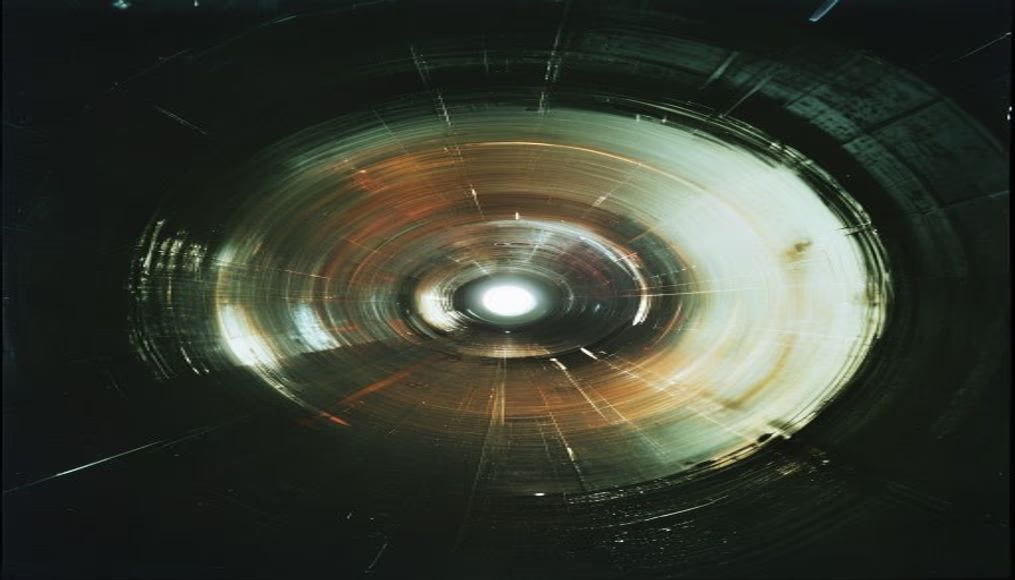
Dark matter visualization
1344×768 · AVIF · CC BY 4.0

Conceptual visualization of dark matter, one of the greatest mysteries in modern cosmology, comprising about 85% of the universe's matter.
About this subject
Dark matter is a hypothetical form of matter that does not interact with light or other electromagnetic radiation, making it invisible to traditional telescopes. Its existence was first proposed in the 1930s by astronomer Fritz Zwicky, after observing anomalous motions in galaxy clusters. Today, the strongest evidence comes from spiral galaxy rotation curves, where stars at the edges rotate faster than expected from visible matter, indicating an extra invisible mass.
Cosmological simulations such as the Illustris project and the Millennium Simulation model the universe's evolution including dark matter. These simulations successfully reproduce the large-scale distribution of galaxies, forming a cosmic web of filaments and voids. Dark matter acts as a gravitational framework that guides structure formation, acting as cosmic 'glue'.
Although never directly detected, experiments like LUX-ZEPLIN (in underground mines) and AMS-02 (on the International Space Station) search for rare interactions with known particles. Theoretical candidates include WIMPs (Weakly Interacting Massive Particles), axions, and sterile neutrinos. Discovering dark matter would revolutionize particle physics and cosmology, potentially revealing new physics beyond the Standard Model.
Interestingly, dark energy, responsible for the accelerating expansion of the cosmos, should not be confused with dark matter. While dark matter attracts gravitationally, dark energy repels. Together they constitute about 95% of the universe's energy content, leaving only 5% ordinary matter (baryons). Conceptual visualizations of dark matter often use cool colors and diffuse shapes to represent its elusive nature.
Frequently Asked Questions
What is dark matter?
Dark matter is a hypothetical form of matter that does not emit, absorb, or reflect light, making it invisible. It accounts for about 85% of all matter in the universe and is only detected through its gravitational effects.
Why is dark matter called 'dark'?
Because it does not interact with electromagnetic radiation, such as light. This means ordinary telescopes cannot directly observe it. Its presence is inferred from phenomena like gravitational lensing and galaxy rotation curves.
How do scientists try to detect dark matter?
They use ultra-sensitive underground detectors (e.g., LUX-ZEPLIN), search for signals in space (e.g., AMS-02), and attempt to produce it in particle accelerators like the LHC. No direct detection has been confirmed so far.
Direct URL
https://pub-c7d6a6ea828543ac903a74a341ccb2e1.r2.dev/imagens/dark-matter-visualization-minimalist-composition-p3.avifHow to credit
Include a visible link back to UtilizAí. Copy one of the snippets below:
<a href="https://xn--utiliza-eza.com/en/midia/imagens/dark-matter-visualization-minimalist-composition-p3">Dark matter visualization</a> by <a href="https://xn--utiliza-eza.com">UtilizAí</a>, licensed under <a href="https://creativecommons.org/licenses/by/4.0/">CC BY 4.0</a>.
[Dark matter visualization](https://xn--utiliza-eza.com/en/midia/imagens/dark-matter-visualization-minimalist-composition-p3) by [UtilizAí](https://xn--utiliza-eza.com), CC BY 4.0
License: CC-BY-4.0