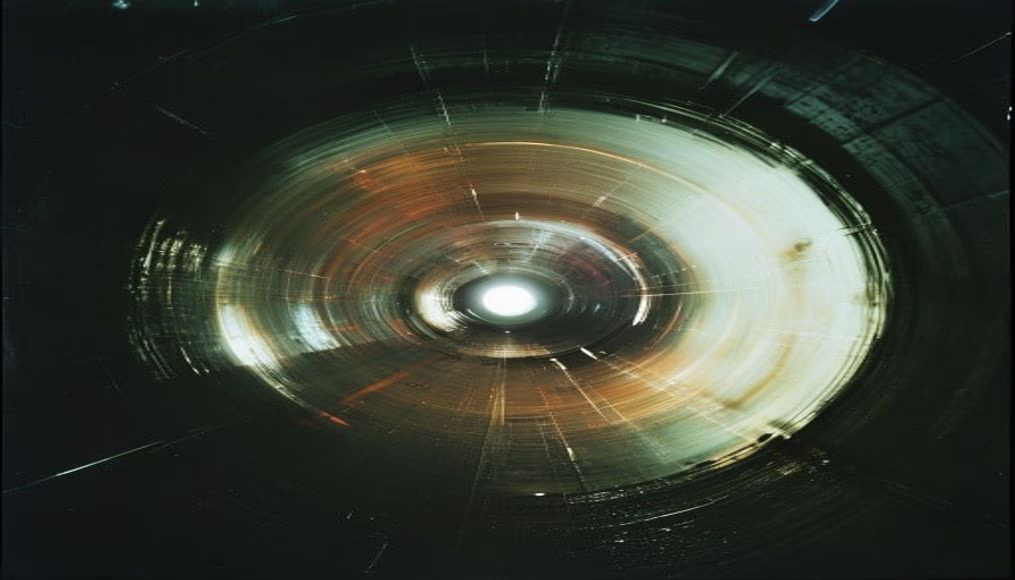
Dark matter visualization
1344×768 · AVIF · CC BY 4.0

Dark matter makes up about 27% of the universe, yet it does not interact with light. Learn how scientists detect it indirectly.
About this subject
Dark matter is a form of matter that does not emit, absorb, or reflect light, making it invisible to conventional telescopes. Its existence was first proposed by astronomer Fritz Zwicky in 1933, when he observed that galaxies in the Coma Cluster moved faster than expected from visible mass. Decades later, Vera Rubin solidified the evidence by measuring rotation curves of spiral galaxies, showing that stars at the outskirts orbited as fast as those at the center, indicating a large amount of invisible mass.
Dark matter is thought to form halos around galaxies, extending far beyond the visible matter. These halos are crucial for cosmic structure formation, acting as gravitational scaffolds that attract gas and dust to form galaxies and clusters. N-body simulations, such as the Millennium Simulation, successfully reproduce the observed cosmic web only when dark matter is included.
Despite its central role, the nature of dark matter remains unknown. Underground experiments like XENON1T and LUX seek to detect weakly interacting massive particles (WIMPs). The Large Hadron Collider attempts to produce them in high-energy collisions. Space observatories, such as the Fermi Gamma-ray Space Telescope, look for signals of dark matter annihilation in gamma rays. Other candidates include axions and sterile neutrinos.
The future of research depends on missions like the ESA's Euclid telescope and the Vera Rubin Observatory, which will map dark matter distribution through weak gravitational lensing. Understanding dark matter is essential for cosmology and may reveal new physics beyond the Standard Model.
Frequently Asked Questions
What is dark matter?
Dark matter is a hypothetical form of matter that does not interact with light, detected only through gravitational effects.
How do we know dark matter exists?
Evidence comes from galaxy rotation curves, gravitational lensing, and the cosmic microwave background.
Why is dark matter important?
It is crucial for explaining galaxy formation and the large-scale structure of the universe.
Direct URL
https://pub-c7d6a6ea828543ac903a74a341ccb2e1.r2.dev/imagens/dark-matter-visualization-macro-closeup-p2.avifHow to credit
Include a visible link back to UtilizAí. Copy one of the snippets below:
<a href="https://xn--utiliza-eza.com/en/midia/imagens/dark-matter-visualization-macro-closeup-p2">Dark matter visualization</a> by <a href="https://xn--utiliza-eza.com">UtilizAí</a>, licensed under <a href="https://creativecommons.org/licenses/by/4.0/">CC BY 4.0</a>.
[Dark matter visualization](https://xn--utiliza-eza.com/en/midia/imagens/dark-matter-visualization-macro-closeup-p2) by [UtilizAí](https://xn--utiliza-eza.com), CC BY 4.0
License: CC-BY-4.0