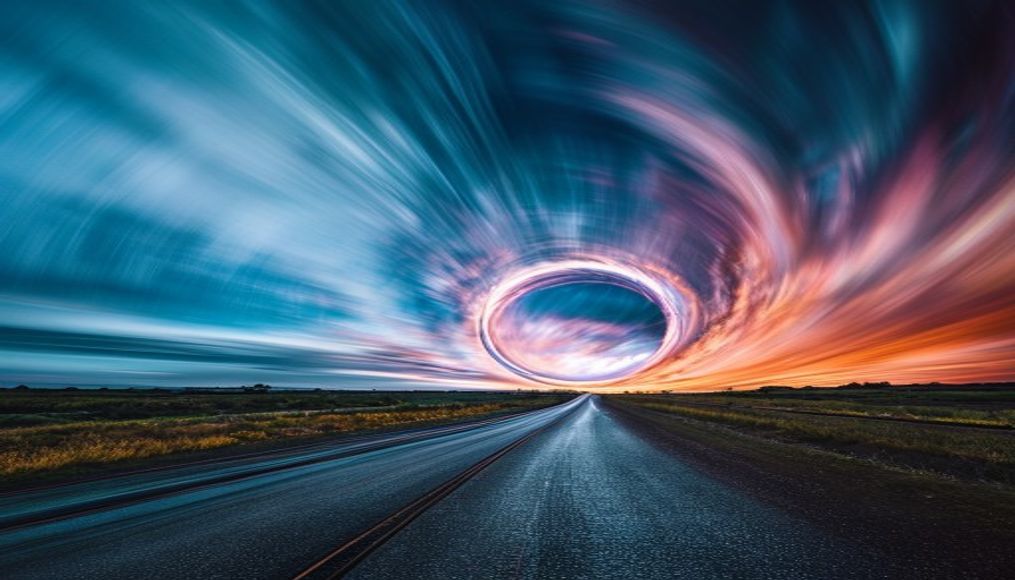
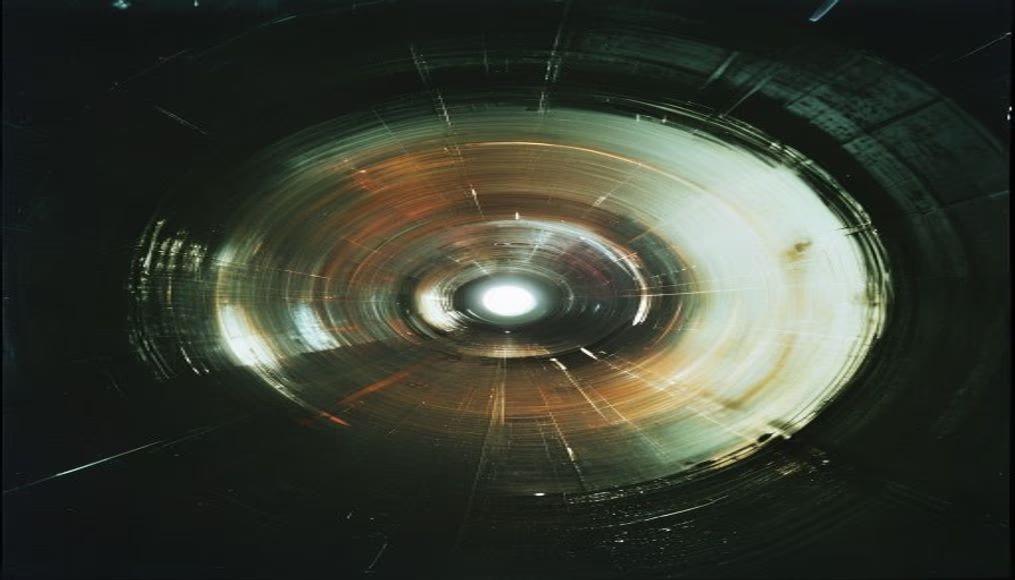
Dark matter visualization
1344×768 · AVIF · CC BY 4.0

Dark matter makes up about 85% of the universe's mass but emits no light; its existence is inferred from gravitational effects on galaxies and clusters.
About this subject
Dark matter is a hypothetical form of matter that does not interact with electromagnetic radiation, making it invisible to telescopes. Its presence is detected indirectly through gravitational lensing, galaxy rotation curves, and large-scale structure formation. Estimates based on the Lambda-CDM cosmological model indicate that about 27% of the universe's energy content is dark matter, while ordinary baryonic matter accounts for only 5%.
The first evidence came in the 1930s, when Fritz Zwicky observed that the Coma cluster moved faster than expected from visible mass. In subsequent decades, Vera Rubin confirmed the phenomenon in spiral galaxies. Today, experiments like the Large Hadron Collider and underground detectors (XENON1T, LUX) search for candidate particles such as WIMPs (weakly interacting massive particles). Computer simulations, such as those from the Illustris project, recreate the cosmic web of dark matter that connects galaxies.
Scientific visualizations often use gravitational lensing maps or N-body simulations to represent dark matter distribution. Artistic or lo-fi styles can evoke the elusive and mysterious nature of this cosmic component. In Brazil, researchers from INPE and the National Observatory contribute to studies in cosmology and particle astrophysics.
Frequently Asked Questions
What is dark matter and why is it called dark?
Dark matter is a type of matter that does not emit, absorb, or reflect light, making it invisible. It is called 'dark' because it cannot be detected through electromagnetic radiation.
What are the main pieces of evidence for dark matter?
Key evidence includes the anomalous rotation curves of galaxies, gravitational lensing in clusters, and fluctuations in the cosmic microwave background, all of which require unseen mass to be explained.
Are there experiments in Brazil related to dark matter?
Yes, Brazilian researchers from INPE and the National Observatory participate in international collaborations like the AMS-02 experiment on the ISS and develop theoretical models for dark matter particles.
Direct URL
https://pub-c7d6a6ea828543ac903a74a341ccb2e1.r2.dev/imagens/dark-matter-visualization-lo-fi-disposable-camera-p12.avifHow to credit
Include a visible link back to UtilizAí. Copy one of the snippets below:
<a href="https://xn--utiliza-eza.com/en/midia/imagens/dark-matter-visualization-lo-fi-disposable-camera-p12">Dark matter visualization</a> by <a href="https://xn--utiliza-eza.com">UtilizAí</a>, licensed under <a href="https://creativecommons.org/licenses/by/4.0/">CC BY 4.0</a>.
[Dark matter visualization](https://xn--utiliza-eza.com/en/midia/imagens/dark-matter-visualization-lo-fi-disposable-camera-p12) by [UtilizAí](https://xn--utiliza-eza.com), CC BY 4.0
License: CC-BY-4.0