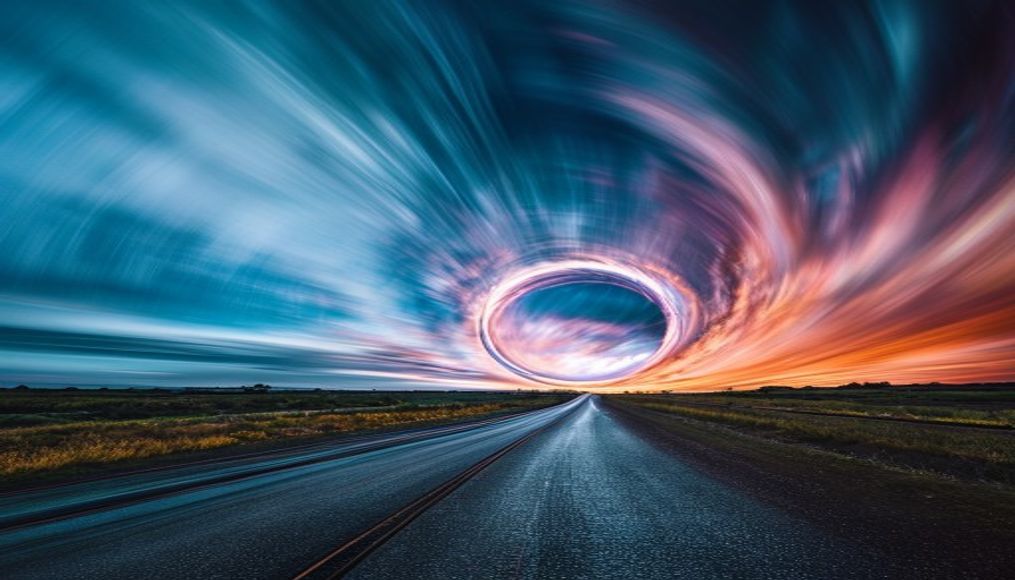
Dark matter visualization
1344×768 · AVIF · CC BY 4.0

Dark matter, an invisible component making up about 27% of the universe, is visualized in cosmological simulations.
About this subject
Dark matter is a hypothetical form of matter that does not emit, absorb, or reflect light, making it undetectable by conventional telescopes. Its existence was proposed in the 1930s by astronomer Fritz Zwicky, after observing that galaxy clusters moved faster than visible mass could explain. Today, dark matter is estimated to make up about 27% of the universe's total mass-energy content, while ordinary matter accounts for only 5%.
Additional evidence came from rotation curves of spiral galaxies, notably observed by Vera Rubin in the 1970s. The speed of stars at the edges of galaxies remained constant, implying a vast amount of invisible mass surrounding them. Computer simulations of cosmic structure formation, such as the Millennium Simulation, rely on dark matter to explain the cosmic web of filaments and voids we observe.
The exact nature of dark matter remains unknown. Candidate particles include WIMPs (weakly interacting massive particles), axions, and sterile neutrinos. Underground experiments like LUX-ZEPLIN and the Large Hadron Collider (LHC) seek to directly detect them. To date, no observation has confirmed these particles, but the search is ongoing.
Interestingly, dark matter does not interact with light, but its presence is inferred through gravitational effects such as weak gravitational lensing. Observatories like Hubble and Euclid map its distribution across the cosmos. Understanding dark matter is crucial for cosmological models, including the Big Bang theory and galaxy evolution.
Frequently Asked Questions
What is dark matter?
It is an invisible form of matter that does not interact with light but exerts gravitational force. It makes up about 27% of the universe and is required to explain the dynamics of galaxies and clusters.
How do we know dark matter exists?
Through gravitational effects: galaxy rotation curves, cluster motions, and gravitational lensing. These observations show there is more mass than what is visible.
Has dark matter been directly photographed?
No. Dark matter has never been directly detected because it does not emit light. Only its gravitational effects are recorded, often represented in simulations or mass distribution maps.
Direct URL
https://pub-c7d6a6ea828543ac903a74a341ccb2e1.r2.dev/imagens/dark-matter-visualization-fine-art-photography-p4.avifHow to credit
Include a visible link back to UtilizAí. Copy one of the snippets below:
<a href="https://xn--utiliza-eza.com/en/midia/imagens/dark-matter-visualization-fine-art-photography-p4">Dark matter visualization</a> by <a href="https://xn--utiliza-eza.com">UtilizAí</a>, licensed under <a href="https://creativecommons.org/licenses/by/4.0/">CC BY 4.0</a>.
[Dark matter visualization](https://xn--utiliza-eza.com/en/midia/imagens/dark-matter-visualization-fine-art-photography-p4) by [UtilizAí](https://xn--utiliza-eza.com), CC BY 4.0
License: CC-BY-4.0