Dark matter visualization
1344×768 · AVIF · CC BY 4.0
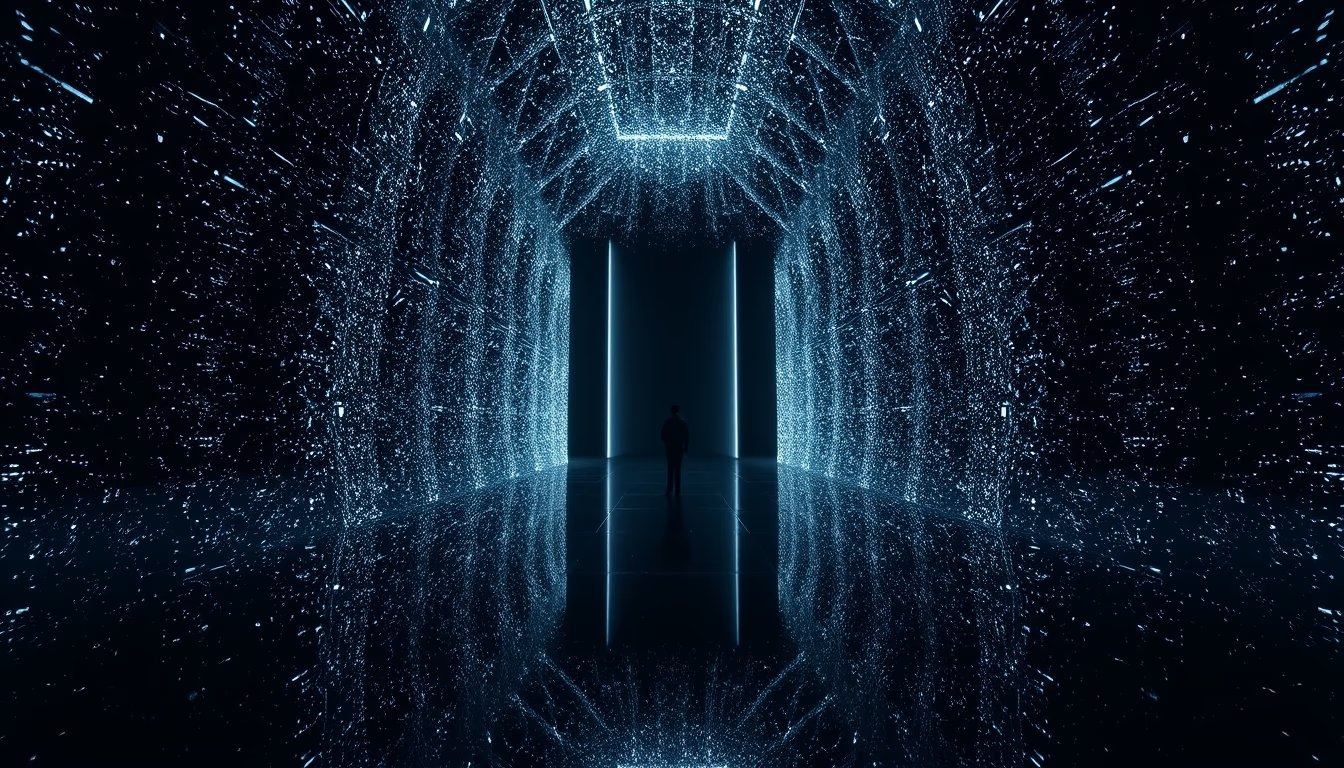
Visualization of dark matter distribution across the universe, the invisible scaffold that shapes cosmic structure.
About this subject
Dark matter is a hypothetical form of matter that does not interact with light, detectable only through its gravitational effects. It is estimated to constitute about 85% of the total mass in the universe, influencing galaxy rotation and cluster formation. Its existence was first proposed by Fritz Zwicky in 1933, when he observed that galaxies in the Coma Cluster moved too fast to be held together by visible mass alone. Later, in the 1970s, Vera Rubin confirmed these anomalies in the rotation curves of spiral galaxies.
Computer simulations, such as the Illustris and Millennium Run projects, recreate the cosmic web of dark matter, where galaxies form at the highest density points. These visualizations show filaments and clusters that resemble large-scale architectural structures, echoing the term "cosmic architecture." Despite no direct detection yet, experiments like LUX, XENON1T, and the Fermi satellite search for candidate particles, such as WIMPs (Weakly Interacting Massive Particles).
Interestingly, dark matter is not uniform: it has a complex halo structure surrounding each galaxy, influencing stellar dynamics. In 2023, the ESA's Euclid telescope began a detailed mapping of dark matter distribution using weak gravitational lensing, a technique that subtly distorts the light of distant galaxies. This approach allows creation of 3D maps of dark matter, revealing the cosmic web in unprecedented detail.
Understanding dark matter is essential for modern cosmology; without it, the standard ΛCDM (Lambda-Cold Dark Matter) model would not explain the formation of observed structures. Although its nature remains one of physics' greatest mysteries, visualizations based on simulations and observations offer a window into the invisible side of the universe.
Frequently Asked Questions
What is dark matter and how was it discovered?
Dark matter is an invisible form of matter that interacts gravitationally but does not emit light. It was proposed by Fritz Zwicky in 1933 while studying the Coma cluster, and confirmed by Vera Rubin in the 1970s through galaxy rotation curves.
How do scientists visualize the distribution of dark matter?
They use computer simulations (e.g., Illustris) and observations with weak gravitational lensing, such as from the Euclid telescope. These methods map the cosmic web in 3D.
Why is dark matter important for the universe?
It provides the gravitational scaffold for galaxy and cluster formation. Without it, the standard cosmological model would not explain the observed distribution of visible matter.
Direct URL
https://pub-c7d6a6ea828543ac903a74a341ccb2e1.r2.dev/imagens/dark-matter-visualization-architectural-photography-p10.avifHow to credit
Include a visible link back to UtilizAí. Copy one of the snippets below:
<a href="https://xn--utiliza-eza.com/en/midia/imagens/dark-matter-visualization-architectural-photography-p10">Dark matter visualization</a> by <a href="https://xn--utiliza-eza.com">UtilizAí</a>, licensed under <a href="https://creativecommons.org/licenses/by/4.0/">CC BY 4.0</a>.
[Dark matter visualization](https://xn--utiliza-eza.com/en/midia/imagens/dark-matter-visualization-architectural-photography-p10) by [UtilizAí](https://xn--utiliza-eza.com), CC BY 4.0
License: CC-BY-4.0