Cyclotron particle
1344×768 · AVIF · CC BY 4.0
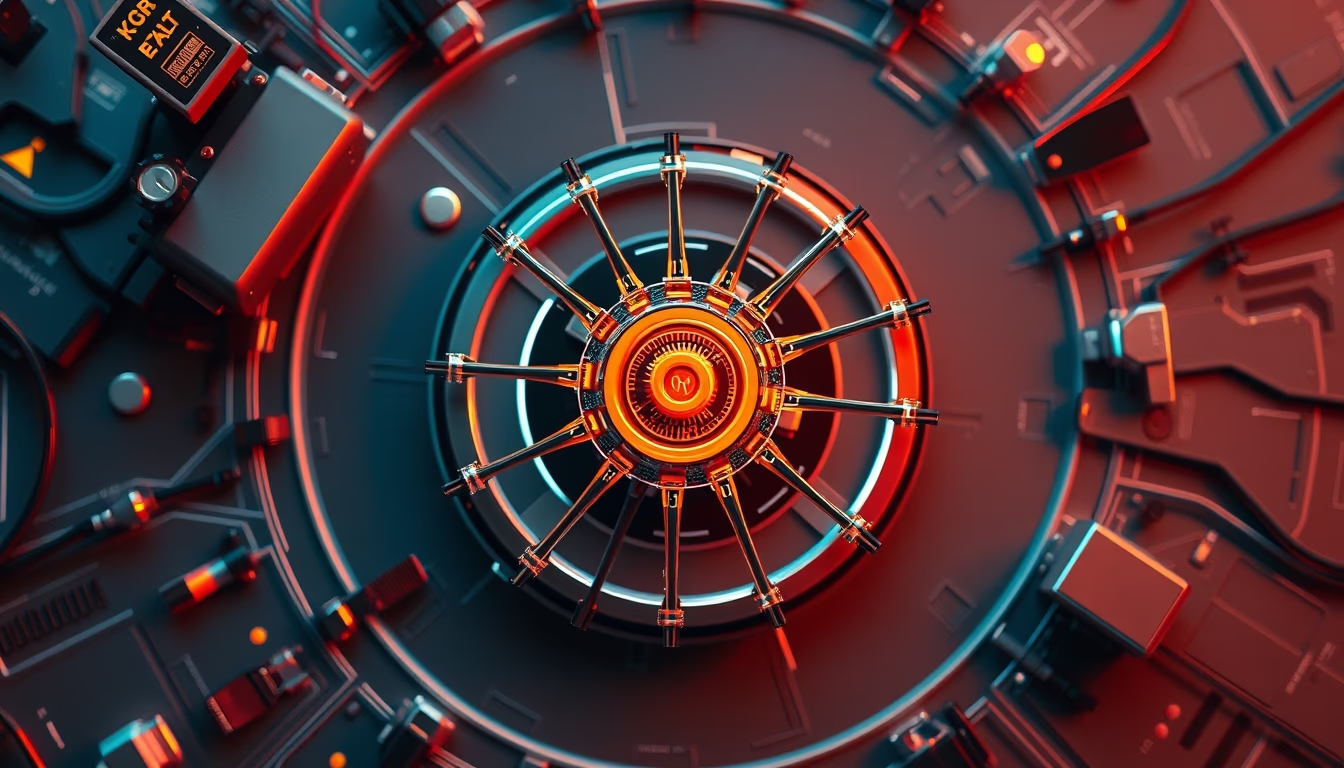
The cyclotron, a circular particle accelerator that revolutionized nuclear physics, enabling studies of atomic structure and medical applications in radiotherapy.
About this subject
The cyclotron is a type of particle accelerator invented by American physicist Ernest Lawrence in 1931 at the University of California, Berkeley. Unlike linear accelerators, the cyclotron uses a constant magnetic field to bend the path of charged particles into a spiral, while an alternating electric field accelerates them at each turn. This design allows particles to reach high energies in a relatively compact space, marking a milestone in experimental physics.
The working principle relies on resonance: the frequency of the electric field is adjusted to match the revolution period of the particles, which remains constant even as energy increases (for non-relativistic speeds). Particles such as protons, deuterons, and alpha particles are accelerated to energies of tens of megaelectronvolts (MeV). This invention earned Lawrence the Nobel Prize in Physics in 1939.
Cyclotrons played a key role in discovering new elements and radioactive isotopes, such as technetium-99m, used in nuclear medicine. Today, besides nuclear physics research, they are widely employed to produce radioisotopes for exams like PET scans and in proton therapy for cancer treatment. The largest cyclotron still in operation is at TRIUMF in Canada, with an 18-meter diameter, capable of accelerating protons to 520 MeV.
A historical curiosity is that the first cyclotron, built by Lawrence and his student M. Stanley Livingston, was only 11 cm in diameter and accelerated protons to 1.2 MeV. The evolution of accelerators led to larger designs, such as the synchrocyclotron and synchrotron, but the original cyclotron concept remains the basis for many practical applications, especially in the medical field.
Frequently Asked Questions
Who invented the cyclotron and when?
The cyclotron was invented by American physicist Ernest Lawrence in 1931 at the University of California, Berkeley. He received the Nobel Prize in Physics in 1939 for this invention.
What is the main medical application of cyclotrons?
Cyclotrons are widely used to produce radioisotopes for imaging exams such as PET scans (Positron Emission Tomography) and for proton therapy in cancer treatment.
How does the acceleration principle work in a cyclotron?
Charged particles are injected at the center and accelerated by an alternating electric field. A constant magnetic field bends them into a spiral path, and each turn they gain energy until they are extracted at the periphery.
Direct URL
https://pub-c7d6a6ea828543ac903a74a341ccb2e1.r2.dev/imagens/cyclotron-particle-isometric-flat-lay-p3.avifHow to credit
Include a visible link back to UtilizAí. Copy one of the snippets below:
<a href="https://xn--utiliza-eza.com/en/midia/imagens/cyclotron-particle-isometric-flat-lay-p3">Cyclotron particle</a> by <a href="https://xn--utiliza-eza.com">UtilizAí</a>, licensed under <a href="https://creativecommons.org/licenses/by/4.0/">CC BY 4.0</a>.
[Cyclotron particle](https://xn--utiliza-eza.com/en/midia/imagens/cyclotron-particle-isometric-flat-lay-p3) by [UtilizAí](https://xn--utiliza-eza.com), CC BY 4.0
License: CC-BY-4.0