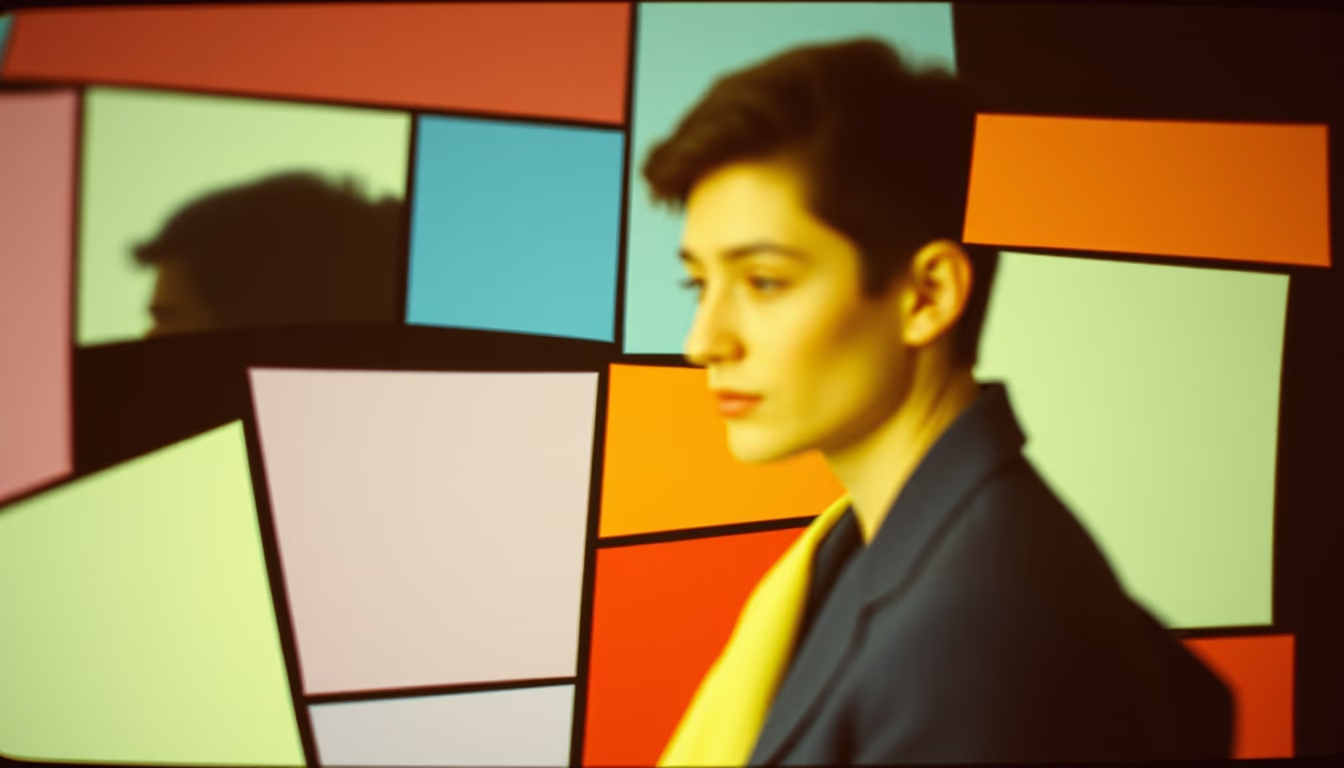
Cubist abstract picasso style
1344×768 · AVIF · CC BY 4.0

Cubism is a revolutionary early 20th century art movement led by Pablo Picasso and Georges Braque, fragmenting reality into geometric forms and multiple viewpoints.
About this subject
Cubism, developed between 1907 and 1914 by Pablo Picasso and Georges Braque, broke with Renaissance perspective by representing objects from multiple angles simultaneously. Cubist works are characterized by geometric forms, overlapping planes, and a restricted color palette, often in browns, grays, and greens. This style evolved into two main phases: Analytical Cubism, which fragmented objects into facets, and Synthetic Cubism, which introduced collage and brighter colors.
Picasso, in particular, became synonymous with Cubism through works such as "Les Demoiselles d'Avignon" (1907), considered a precursor to the movement. The close collaboration between Picasso and Braque was so intense that their works from this period are often indistinguishable. Cubism profoundly influenced modern art, paving the way for abstraction and other European avant-garde movements.
Interestingly, the term "Cubism" originated from a review by journalist Louis Vauxcelles, who described Braque's landscapes as composed of "cubes." The movement also extended to sculpture, with artists like Alexander Archipenko, and to literature, with poets like Guillaume Apollinaire. Despite its short duration, Cubism left a lasting legacy in how we perceive and represent space in art.
Frequently Asked Questions
What is Cubism?
Cubism is an early 20th century art movement that revolutionized painting and sculpture by representing objects from multiple viewpoints simultaneously, using geometric shapes and fragmented planes.
Who are the main Cubist artists?
The main artists are Pablo Picasso and Georges Braque, who founded the movement. Other important names include Juan Gris, Fernand Léger, and Robert Delaunay.
What is the difference between Analytical and Synthetic Cubism?
In Analytical Cubism (1908-1912), objects are decomposed into facets with monochromatic colors. In Synthetic Cubism (1912-1919), collages, brighter colors, and simplified forms are used, prioritizing image construction.
Direct URL
https://pub-c7d6a6ea828543ac903a74a341ccb2e1.r2.dev/imagens/cubist-abstract-picasso-style-tilt-shift-miniature-fresh2.avifHow to credit
Include a visible link back to UtilizAí. Copy one of the snippets below:
<a href="https://xn--utiliza-eza.com/en/midia/imagens/cubist-abstract-picasso-style-tilt-shift-miniature-fresh2">Cubist abstract picasso style</a> by <a href="https://xn--utiliza-eza.com">UtilizAí</a>, licensed under <a href="https://creativecommons.org/licenses/by/4.0/">CC BY 4.0</a>.
[Cubist abstract picasso style](https://xn--utiliza-eza.com/en/midia/imagens/cubist-abstract-picasso-style-tilt-shift-miniature-fresh2) by [UtilizAí](https://xn--utiliza-eza.com), CC BY 4.0
License: CC-BY-4.0