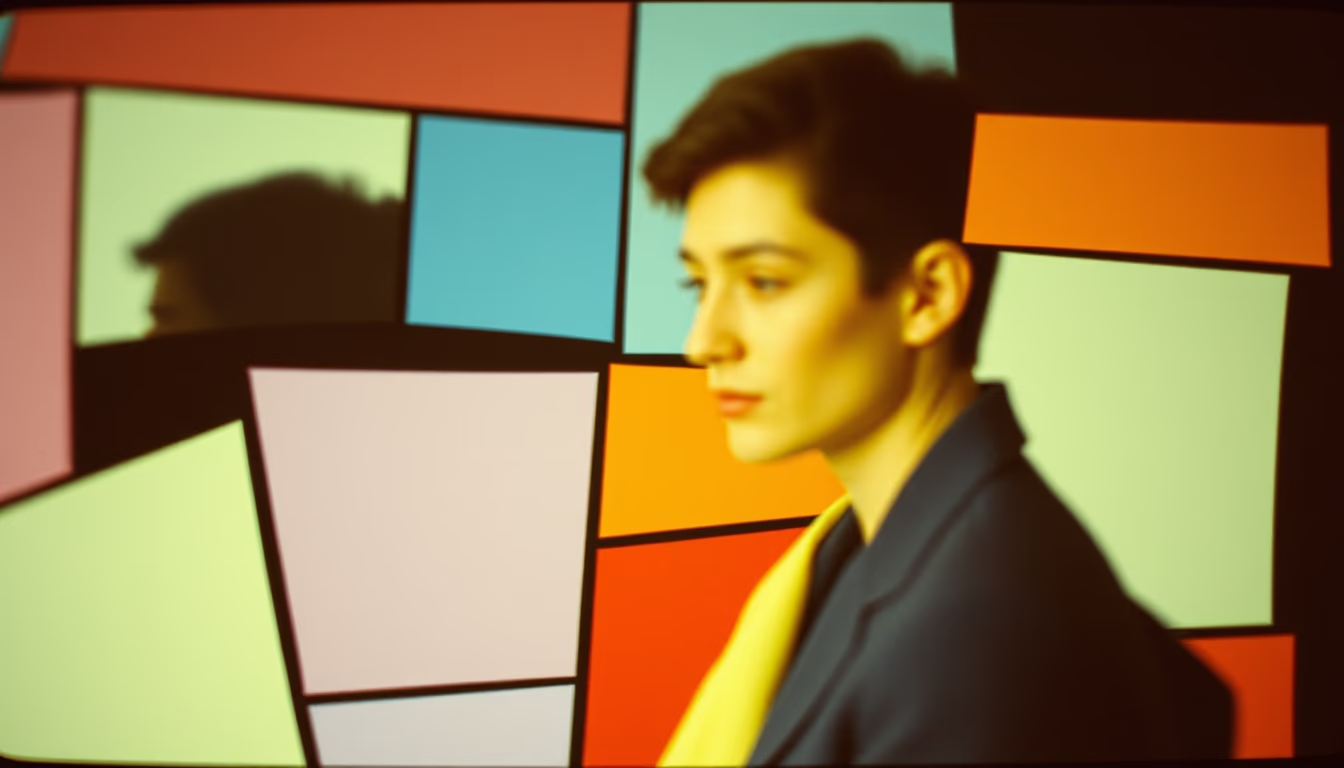
Cubist abstract picasso style
1344×768 · AVIF · CC BY 4.0

Cubism, a revolutionary early 20th-century art movement, transformed visual representation by fragmenting objects into geometric shapes.
About this subject
Cubism was an artistic movement that emerged between 1907 and 1914, led by Pablo Picasso and Georges Braque. Inspired by African art and the works of Paul Cézanne, Cubism broke with Renaissance perspective by representing objects from multiple viewpoints simultaneously. Picasso, in works like "Les Demoiselles d'Avignon" (1907), initiated this radical approach, which later split into two main phases: Analytical Cubism (1909-1912) and Synthetic Cubism (1912-1919).
In Analytical Cubism, artists decomposed objects into geometric fragments, such as cones, cylinders, and spheres, and reassembled them into nearly monochromatic compositions. In Synthetic Cubism, they incorporated elements like paper collage, vibrant colors, and printed letters, creating more abstract works. Picasso, during this phase, produced collages like "Still Life with Chair Caning" (1912), which explored the interplay between reality and representation.
The impact of Cubism was immense, influencing not only painting and sculpture but also architecture, literature, and design. Movements such as Futurism, Constructivism, and Orphism drew from its well. Interestingly, the term "Cubism" was coined by critic Louis Vauxcelles, who ironically referred to Braque's 1908 paintings as "bizarreries cubiques."
Today, Picasso's cubist works are among the most famous in the world. Museums like the Museu Picasso in Barcelona and the MoMA in New York house significant collections. The style continues to inspire contemporary artists and is frequently referenced in popular culture, from fashion to cinema.
Frequently Asked Questions
What characterizes Picasso's Cubism?
Picasso's Cubism is characterized by the fragmentation of objects into geometric shapes, use of multiple simultaneous viewpoints, and in its synthetic phase, incorporation of collage and vibrant colors.
What are Picasso's main Cubist works?
Among Picasso's main Cubist works are "Les Demoiselles d'Avignon" (1907), "Portrait of Daniel-Henry Kahnweiler" (1910), and "Still Life with Chair Caning" (1912).
How did Cubism influence other art movements?
Cubism influenced Futurism, Constructivism, Orphism, and Abstract art, also impacting architecture, design, and literature by challenging traditional representation of reality.
Direct URL
https://pub-c7d6a6ea828543ac903a74a341ccb2e1.r2.dev/imagens/cubist-abstract-picasso-style-magazine-editorial-fresh11.avifHow to credit
Include a visible link back to UtilizAí. Copy one of the snippets below:
<a href="https://xn--utiliza-eza.com/en/midia/imagens/cubist-abstract-picasso-style-magazine-editorial-fresh11">Cubist abstract picasso style</a> by <a href="https://xn--utiliza-eza.com">UtilizAí</a>, licensed under <a href="https://creativecommons.org/licenses/by/4.0/">CC BY 4.0</a>.
[Cubist abstract picasso style](https://xn--utiliza-eza.com/en/midia/imagens/cubist-abstract-picasso-style-magazine-editorial-fresh11) by [UtilizAí](https://xn--utiliza-eza.com), CC BY 4.0
License: CC-BY-4.0