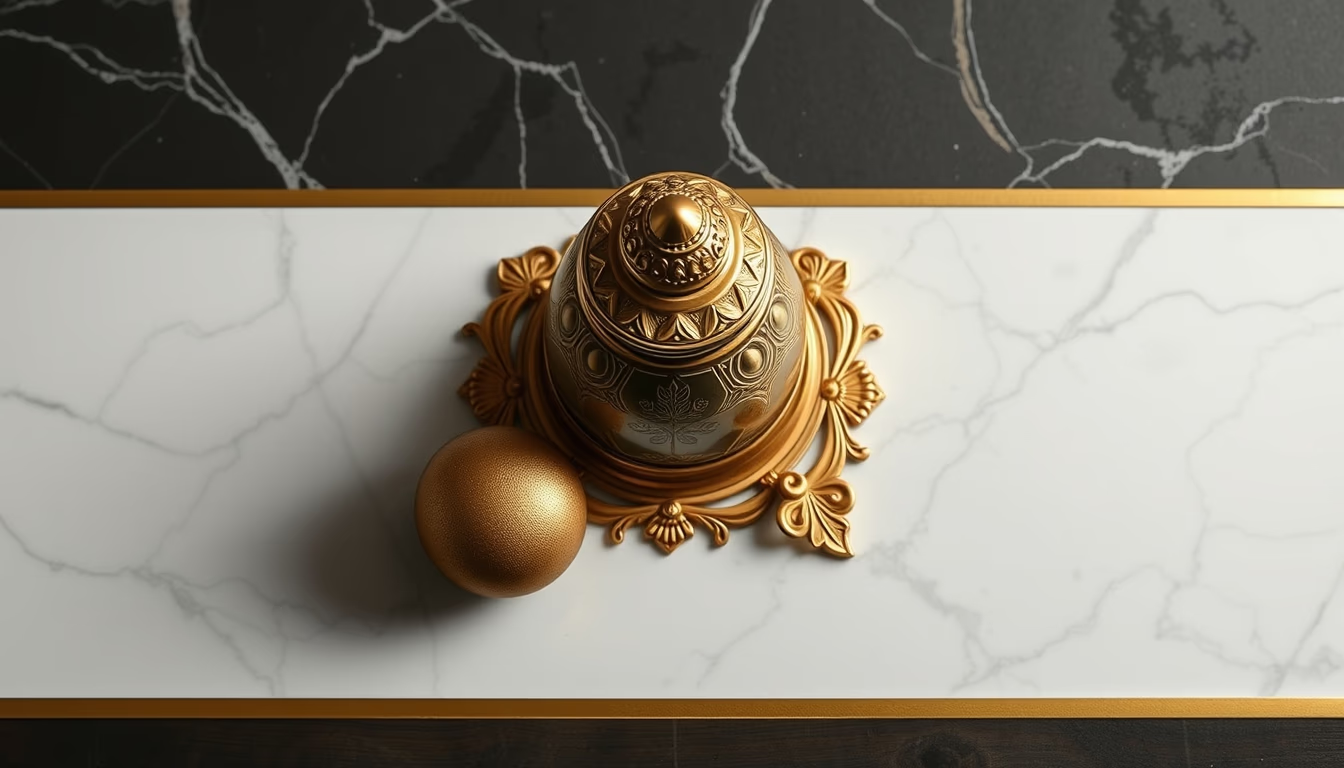
Cubist abstract picasso style
1344×768 · AVIF · CC BY 4.0

Cubism, a revolutionary art movement pioneered by Picasso and Braque in the early 20th century, fragments reality into geometric forms and multiple perspectives.
About this subject
Cubism emerged between 1907 and 1914, primarily in Paris, with Pablo Picasso and Georges Braque as its main pioneers. Inspired by African and Iberian art, as well as Cézanne's paintings, the movement broke with traditional Renaissance perspective by depicting objects from multiple angles simultaneously on the same canvas. Phases such as analytic cubism (1909-1912) and synthetic cubism (1912-1919) mark the style's evolution, including the use of collage and textures.
Picasso's style, in particular, profoundly influenced modern art, architecture, design, and even photography. Works like "Les Demoiselles d'Avignon" (1907) and "Guernica" (1937) are milestones that demonstrate cubism's ability to convey emotion and social criticism through deformation and fragmentation. Although controversial at first, the movement paved the way for later abstractions and became a cornerstone of the European avant-garde.
A curious fact: the term "cubism" was coined by art critic Louis Vauxcelles in 1908, after seeing Braque's paintings that reduced landscapes to cubes, initially as a pejorative. In Brazil, cubism influenced artists such as Tarsila do Amaral and Anita Malfatti, adapting the aesthetic to tropical reality. To this day, the style is a reference in product design and commercial photography, aiming to evoke creativity and visual innovation.
Frequently Asked Questions
What characterizes Picasso's cubist style?
Picasso's cubism is characterized by the fragmentation of figures and objects into geometric shapes like cubes and triangles, and the simultaneous representation of multiple viewpoints. This creates an abstract and dynamic composition that challenges traditional perception.
How did cubism influence modern art?
Cubism revolutionized art by abandoning linear perspective and introducing collage, paving the way for movements such as futurism, constructivism, and geometric abstraction. Its analytical approach inspired new ways of seeing and representing reality.
Is cubism only found in painting, or does it appear in other media?
Cubism expanded into sculpture, architecture, design, and even photography and film. In commercial photography, for example, it is used to create images with unusual angles and fragmented compositions, conveying modernity and creativity.
Direct URL
https://pub-c7d6a6ea828543ac903a74a341ccb2e1.r2.dev/imagens/cubist-abstract-picasso-style-commercial-product-photography-fresh12.avifHow to credit
Include a visible link back to UtilizAí. Copy one of the snippets below:
<a href="https://xn--utiliza-eza.com/en/midia/imagens/cubist-abstract-picasso-style-commercial-product-photography-fresh12">Cubist abstract picasso style</a> by <a href="https://xn--utiliza-eza.com">UtilizAí</a>, licensed under <a href="https://creativecommons.org/licenses/by/4.0/">CC BY 4.0</a>.
[Cubist abstract picasso style](https://xn--utiliza-eza.com/en/midia/imagens/cubist-abstract-picasso-style-commercial-product-photography-fresh12) by [UtilizAí](https://xn--utiliza-eza.com), CC BY 4.0
License: CC-BY-4.0