Crab nebula supernova
1344×768 · AVIF · CC BY 4.0
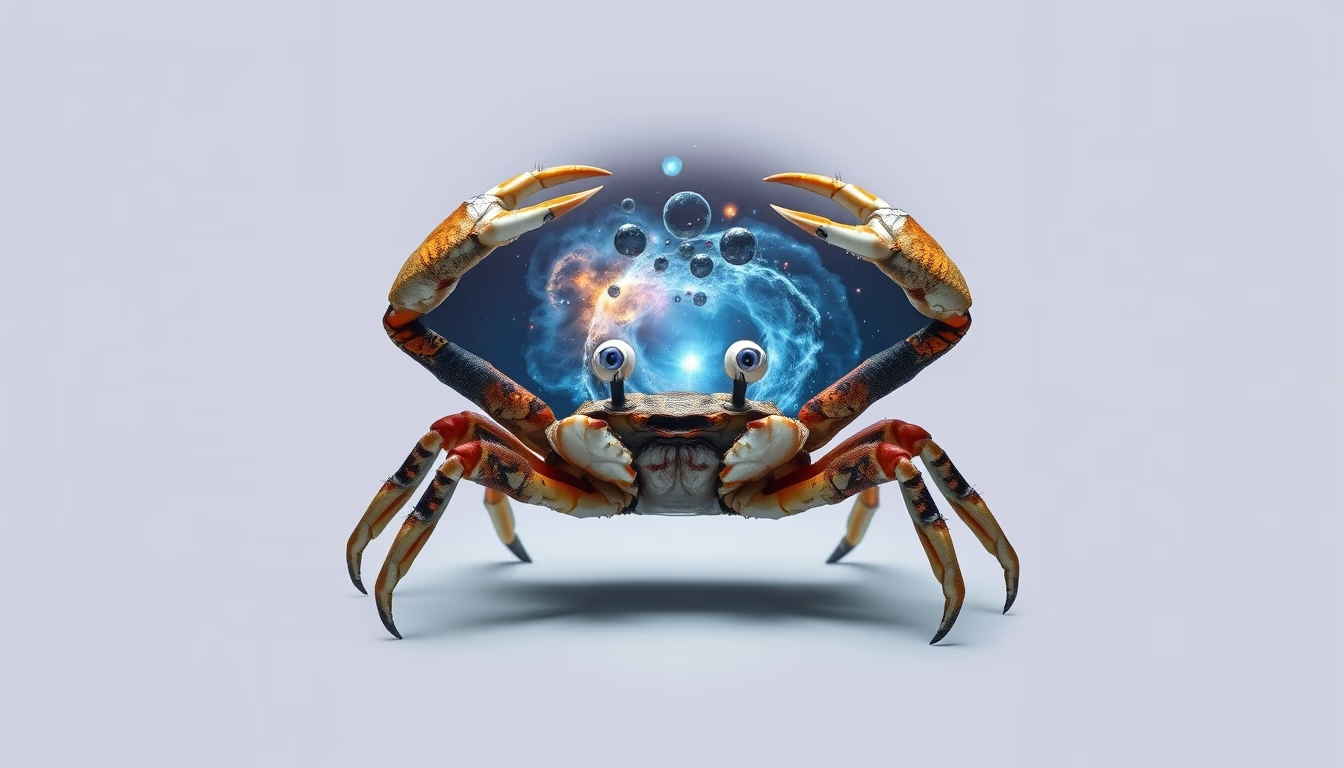
The Crab Nebula, remnant of supernova SN 1054, is one of the most studied objects in the sky and home to a pulsar.
About this subject
The Crab Nebula, cataloged as M1 or NGC 1952, is a supernova remnant located in the constellation Taurus. It was first observed in 1731 by amateur astronomer John Bevis, and later rediscovered by Charles Messier in 1758, who made it the first object in his famous catalog. The name 'Crab' was coined in the 19th century by William Parsons, whose sketch resembled a crustacean.
The nebula is the result of a massive star explosion recorded by Chinese, Arab, and Japanese astronomers in 1054 AD. The supernova was so bright that it remained visible during the day for 23 days. Today, the remnant expands at about 1,500 km/s, and its current diameter is approximately 11 light-years. At the center lies the Crab Pulsar, a neutron star spinning 30 times per second, discovered in 1968.
The pulsar is one of the most powerful sources of electromagnetic radiation in the universe, emitting from radio waves to gamma rays. The nebula is also a strong emitter of X-rays and gamma rays, often used as a 'standard candle' for calibrating space telescopes. Its estimated distance from Earth is about 6,500 light-years.
The Crab Nebula continues to fascinate astronomers as a natural laboratory for studying extreme processes, such as particle acceleration and intense magnetic fields. Recent observations with the Hubble Space Telescope have revealed intricate details of its filamentary structure, composed mainly of ionized hydrogen and helium.
Frequently Asked Questions
What caused the formation of the Crab Nebula?
It was formed by a massive star explosion (supernova) observed in 1054 AD. The core collapsed into a neutron star, while outer layers were ejected forming the nebula.
Why is the Crab Pulsar significant?
The Crab Pulsar is a rapidly spinning neutron star that emits regular pulses of radiation. It is used to study extreme physics and as a calibrator for astronomical instruments.
Where is the Crab Nebula located?
It is in the constellation Taurus, about 6,500 light-years from Earth. It can be observed with amateur telescopes on dark nights.
Direct URL
https://pub-c7d6a6ea828543ac903a74a341ccb2e1.r2.dev/imagens/crab-nebula-supernova-studio-editorial-portrait-p10.avifHow to credit
Include a visible link back to UtilizAí. Copy one of the snippets below:
<a href="https://xn--utiliza-eza.com/en/midia/imagens/crab-nebula-supernova-studio-editorial-portrait-p10">Crab nebula supernova</a> by <a href="https://xn--utiliza-eza.com">UtilizAí</a>, licensed under <a href="https://creativecommons.org/licenses/by/4.0/">CC BY 4.0</a>.
[Crab nebula supernova](https://xn--utiliza-eza.com/en/midia/imagens/crab-nebula-supernova-studio-editorial-portrait-p10) by [UtilizAí](https://xn--utiliza-eza.com), CC BY 4.0
License: CC-BY-4.0