Cpu socket lga
1344×768 · AVIF · CC BY 4.0
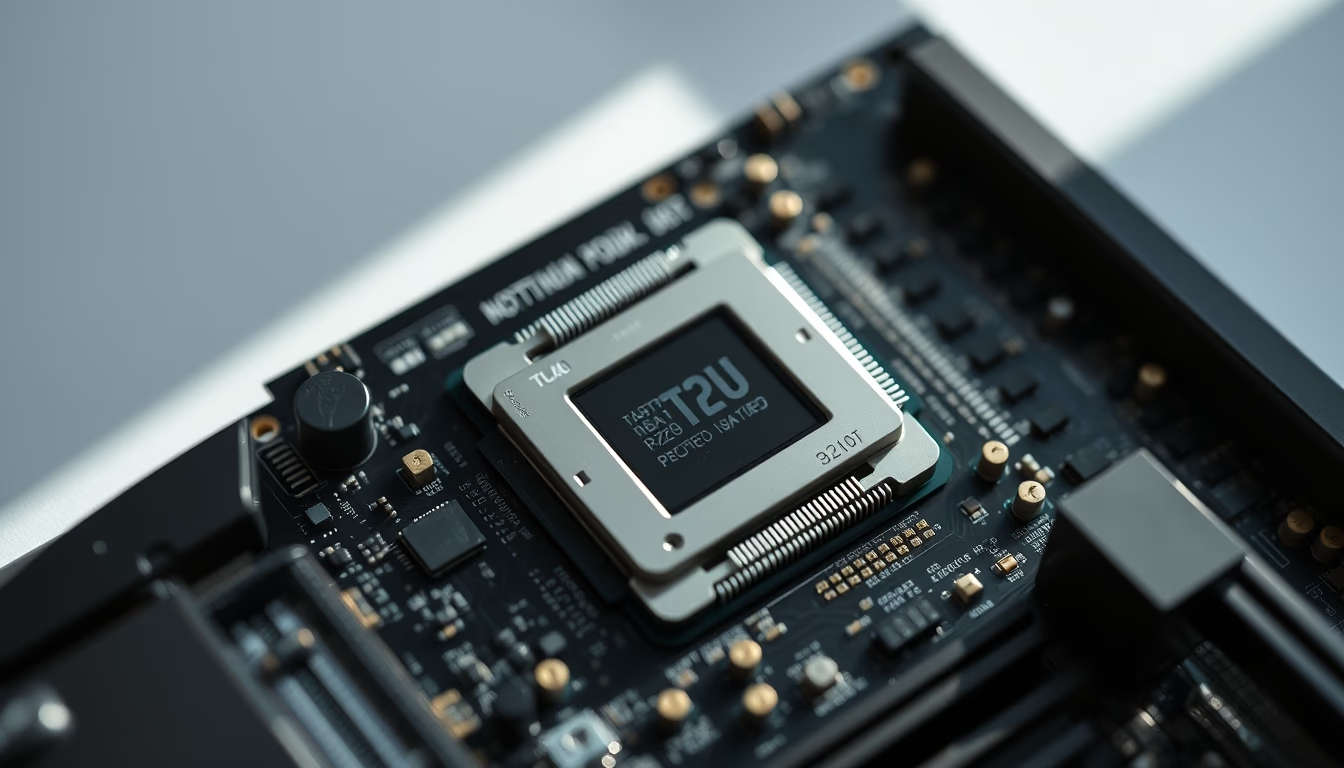
The LGA (Land Grid Array) socket is a processor connection standard used in modern motherboards, replacing fragile pins with flat contacts.
About this subject
The LGA socket, which stands for Land Grid Array, is a type of socket used to connect processors to motherboards. Unlike the PGA (Pin Grid Array) standard, where pins are on the processor, in LGA the pins are on the motherboard socket while the processor has flat contacts. This change reduces the risk of damaging pins during installation and allows for a higher density of connections.
Intel adopted LGA in 2004 with the LGA775 socket for Pentium 4 and Core 2 Duo processors. Since then, the company has released several LGA sockets, such as LGA1156, LGA1155, LGA1150, LGA1151, LGA1200, and most recently LGA1700 for 12th, 13th, and 14th generation Core processors. Each new socket brought support for new technologies, including more memory channels, faster PCIe interfaces, and higher power capacity.
The LGA design is also used in servers, with sockets like LGA3647 and LGA4189, which support multiple processors and large amounts of RAM. The main advantage of LGA is durability: since the pins are on the socket, a processor can be swapped without the risk of bending pins, provided the motherboard is handled carefully. Additionally, the flat contact arrangement allows for better heat dissipation and high-frequency electrical signals.
Currently, AMD does not use LGA for its desktop processors, maintaining PGA (Socket AM4) and, more recently, LGA for the AM5 platform (Socket AM5, which is LGA1718). The choice between LGA and PGA depends on the CPU and motherboard design. For the end user, LGA requires more care when handling the motherboard but offers greater safety for the processor.
Frequently Asked Questions
What is the difference between LGA and PGA sockets?
In LGA, the pins are on the motherboard socket and the processor has flat contacts. In PGA, the pins are on the processor. LGA reduces the risk of pin damage during CPU installation.
Which processors use the LGA1700 socket?
LGA1700 is used by Intel Core processors from 12th, 13th, and 14th generations, such as the i5-12400, i7-13700K, and i9-14900K.
Can I upgrade a LGA processor without replacing the motherboard?
Yes, as long as the new processor is compatible with the same socket. However, the motherboard may require a BIOS update to support newer CPUs.
Direct URL
https://pub-c7d6a6ea828543ac903a74a341ccb2e1.r2.dev/imagens/cpu-socket-lga-minimalist-composition-p0.avifHow to credit
Include a visible link back to UtilizAí. Copy one of the snippets below:
<a href="https://xn--utiliza-eza.com/en/midia/imagens/cpu-socket-lga-minimalist-composition-p0">Cpu socket lga</a> by <a href="https://xn--utiliza-eza.com">UtilizAí</a>, licensed under <a href="https://creativecommons.org/licenses/by/4.0/">CC BY 4.0</a>.
[Cpu socket lga](https://xn--utiliza-eza.com/en/midia/imagens/cpu-socket-lga-minimalist-composition-p0) by [UtilizAí](https://xn--utiliza-eza.com), CC BY 4.0
License: CC-BY-4.0