Cpu chip pin grid
1344×768 · AVIF · CC BY 4.0
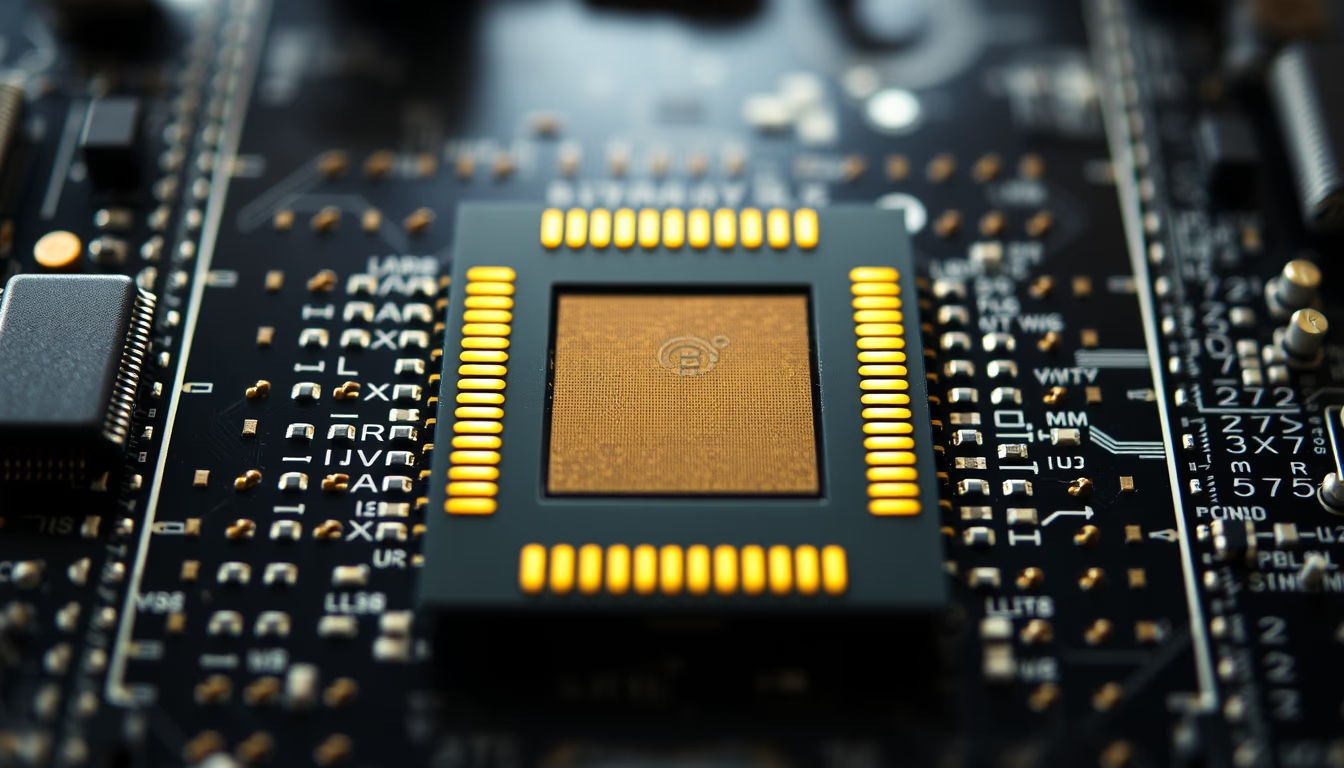
The pin grid array (PGA) pattern on CPUs was widely used in the 1990s and 2000s, providing robust connections between the chip and motherboard.
About this subject
The pin grid array (PGA) is a type of integrated circuit packaging where electrical connection pins are arranged in a grid pattern on the underside of the chip. This design allows for a high number of contacts in a compact area, making it suitable for complex processors. PGA was first introduced commercially in the late 1980s with the Intel 80486, replacing older packages like the DIP (Dual In-line Package).
Through the 1990s and early 2000s, PGA became the standard for desktop and server CPUs. Iconic processors such as the Pentium III, Athlon, and Pentium 4 used PGA variants, including CPGA (Ceramic PGA) and OPGA (Organic PGA). The primary advantage of PGA was ease of installation and replacement: the chip could be manually inserted and removed from a socket. However, the thin metal pins were fragile and prone to bending if mishandled, requiring careful user handling.
As transistor densities increased and more pins were needed for power and signal integrity, PGA gradually gave way to packages like LGA (Land Grid Array) and BGA (Ball Grid Array). In LGA, the pins reside on the motherboard socket, reducing the risk of damaging the processor. BGA, common in laptops and mobile devices, uses solder balls to permanently attach the chip. Nevertheless, PGA remains in use for some microcontrollers and specialized components, valued for its mechanical robustness and ease of prototyping in certain applications.
Frequently Asked Questions
What is a CPU pin grid array (PGA) chip?
It is a processor package where electrical connection pins are arranged in a grid on the bottom of the chip, allowing it to be inserted into a socket on the motherboard. This standard was common in CPUs from the 1990s and 2000s.
How do you install a PGA processor without damaging the pins?
Align the beveled corner of the processor with the corresponding corner of the socket and gently lower the chip into place. Do not force it; the pins should slide in with little resistance. If a pin bends, use a thin object like a needle to carefully straighten it.
Why don't modern processors use PGA anymore?
Because of the high pin density required for current CPUs, LGA (Land Grid Array) became preferred, as it moves the pins to the socket, reducing the risk of processor damage. Additionally, BGA (Ball Grid Array) is common in mobile devices for its compactness and durability.
Direct URL
https://pub-c7d6a6ea828543ac903a74a341ccb2e1.r2.dev/imagens/cpu-chip-pin-grid-lo-fi-disposable-camera-p7.avifHow to credit
Include a visible link back to UtilizAí. Copy one of the snippets below:
<a href="https://xn--utiliza-eza.com/en/midia/imagens/cpu-chip-pin-grid-lo-fi-disposable-camera-p7">Cpu chip pin grid</a> by <a href="https://xn--utiliza-eza.com">UtilizAí</a>, licensed under <a href="https://creativecommons.org/licenses/by/4.0/">CC BY 4.0</a>.
[Cpu chip pin grid](https://xn--utiliza-eza.com/en/midia/imagens/cpu-chip-pin-grid-lo-fi-disposable-camera-p7) by [UtilizAí](https://xn--utiliza-eza.com), CC BY 4.0
License: CC-BY-4.0