Cpu chip pin grid
1344×768 · AVIF · CC BY 4.0
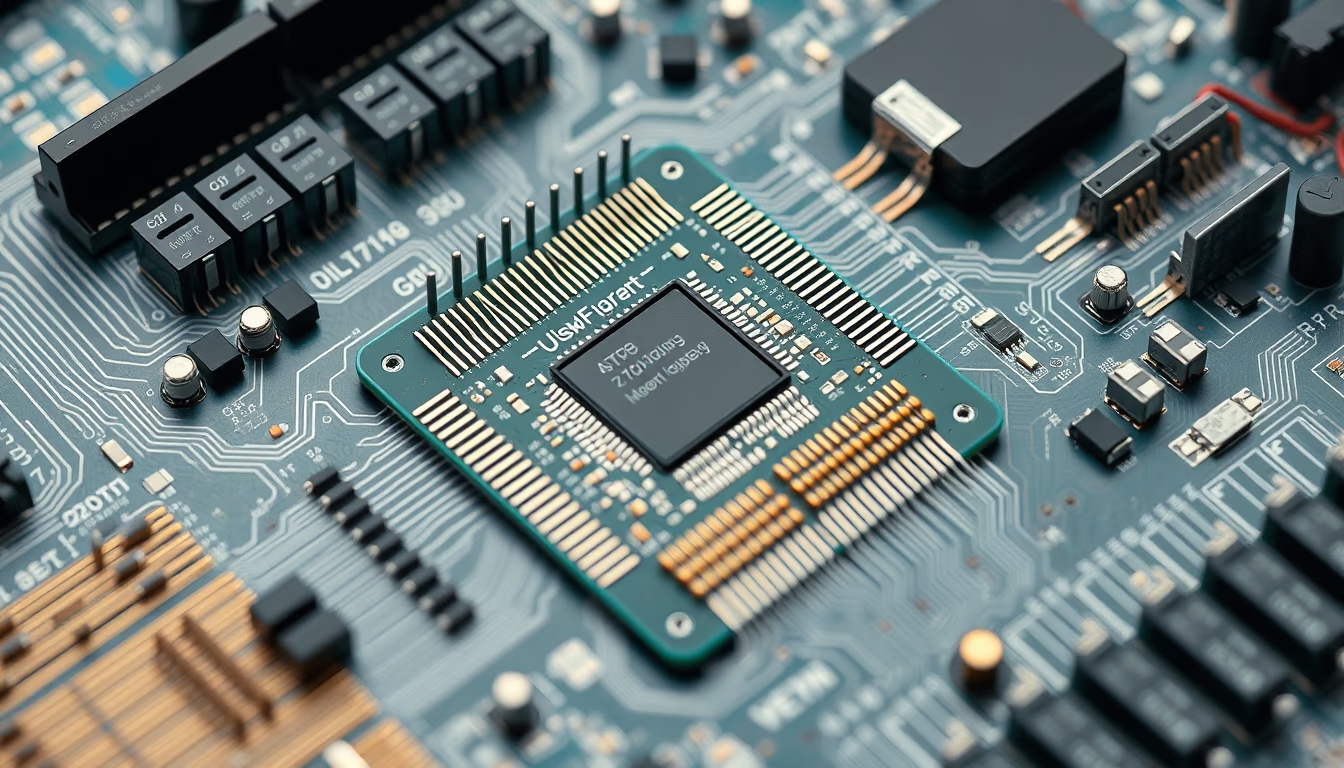
Modern processors use a pin grid array (PGA) to connect the chip to the motherboard, enabling data and power transfer.
About this subject
The CPU chip with a pin grid array (PGA) is the most common packaging architecture for desktop processors. In this design, connection pins are located on the underside of the processor, fitting into corresponding sockets on the motherboard. This arrangement allows high connection density, essential for the thousands of electrical signals a modern processor needs to exchange with the rest of the system.
Historically, Intel used Socket 7 and later Socket 370 with PGA, while AMD popularized AM2, AM3, and AM4 sockets, all based on PGA. The main advantage of PGA is mechanical robustness: the pins are thicker and more resistant to damage from incorrect insertion compared to standards like LGA (Land Grid Array), where pins are on the socket. However, PGA requires careful handling to avoid bending pins.
Currently, PGA continues to be used in entry-level and mid-range processors, especially from AMD, which kept the AM4 socket for several generations. Intel has largely moved to LGA. The isometric layout of PGA chip images highlights the symmetry and precision of manufacturing, which follows strict pin spacing standards, typically 1.27 mm or 1.0 mm, depending on the socket.
A technical curiosity: the number of pins varies by model. The AM4 socket has 1331 pins, while FM2+ has 906. Each pin is responsible for a specific function, such as power, ground, data, or control signals. The arrangement follows a diagram defined by the manufacturer, and a single missing pin can render the processor inoperable.
Frequently Asked Questions
What is a CPU chip with a pin grid array?
It is a processor that has metal pins on its underside arranged in a grid, which fit into a socket on the motherboard to make electrical connections.
What is the difference between PGA and LGA?
In PGA, the pins are on the processor; in LGA, the pins are on the motherboard socket. PGA is more robust against socket damage, but the chip's pins can bend.
Which processors currently use PGA?
AMD uses PGA for its AM4 socket (AM5 is LGA), while Intel has abandoned PGA in favor of LGA for most modern processors.
Direct URL
https://pub-c7d6a6ea828543ac903a74a341ccb2e1.r2.dev/imagens/cpu-chip-pin-grid-isometric-flat-lay-p10.avifHow to credit
Include a visible link back to UtilizAí. Copy one of the snippets below:
<a href="https://xn--utiliza-eza.com/en/midia/imagens/cpu-chip-pin-grid-isometric-flat-lay-p10">Cpu chip pin grid</a> by <a href="https://xn--utiliza-eza.com">UtilizAí</a>, licensed under <a href="https://creativecommons.org/licenses/by/4.0/">CC BY 4.0</a>.
[Cpu chip pin grid](https://xn--utiliza-eza.com/en/midia/imagens/cpu-chip-pin-grid-isometric-flat-lay-p10) by [UtilizAí](https://xn--utiliza-eza.com), CC BY 4.0
License: CC-BY-4.0