Cosmic microwave background
1344×768 · AVIF · CC BY 4.0
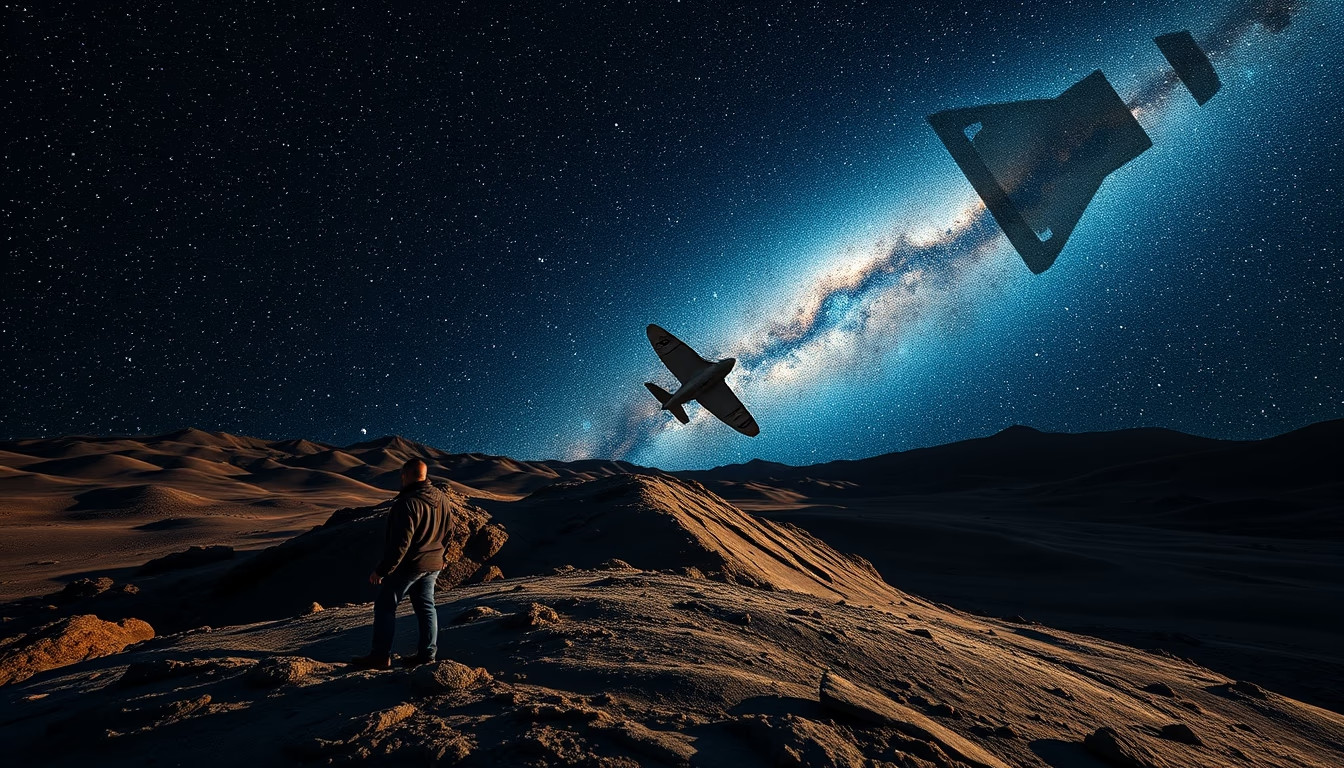
The cosmic microwave background (CMB) is the afterglow of the Big Bang, a fossil radiation filling the universe whose detection confirmed the theory of cosmic expansion.
About this subject
The cosmic microwave background (CMB) is the oldest electromagnetic radiation observable, emitted about 380,000 years after the Big Bang, when the universe cooled enough for protons and electrons to combine into neutral atoms, allowing light to travel freely. This radiation was theoretically predicted by George Gamow and colleagues in the 1940s, but was accidentally discovered in 1965 by Arno Penzias and Robert Wilson in the United States while testing a microwave antenna. They detected a uniform noise coming from all directions, corresponding to a blackbody at about 3 K (kelvins). This finding earned them the Nobel Prize in Physics in 1978 and provided crucial evidence for the Big Bang model, disfavoring competing theories such as the steady state.
The CMB spectrum is a nearly perfect blackbody with an average temperature of 2.725 K, but it exhibits tiny variations (anisotropies) on the order of one part in 100,000. These fluctuations, precisely mapped by the COBE (1989), WMAP (2001), and Planck (2009) satellites, are the seeds of cosmic structures: galaxies, clusters, and filaments. The CMB map, often displayed in false colors representing temperature variations (red for slightly warmer regions, blue for cooler), is one of the most important images in modern cosmology. It reveals the flat geometry of the universe, the composition of matter and dark energy, and supports the theory of cosmic inflation, which posits an exponential expansion in the first instants of the Big Bang.
The CMB allows astronomers to study the primordial universe with extremely high precision, testing models of particle physics and gravitation. The Planck satellite, from the European Space Agency, produced the most detailed map to date, with angular resolution of 5 arcminutes and sensitivity to polarizations that help investigate primordial gravitational waves. CMB observations also set the age of the universe at 13.8 billion years and confirm that cosmic expansion is accelerating. For the general public, the CMB image has become a scientific icon, representing the visible horizon of the cosmos and the first light that emerged after the Big Bang.
Frequently Asked Questions
What is the cosmic microwave background?
It is the remnant radiation from the Big Bang, emitted when the universe was about 380,000 years old. It is a uniform microwave glow filling all space, now at a temperature of 2.725 K.
How was the cosmic microwave background discovered?
It was accidentally discovered in 1965 by Arno Penzias and Robert Wilson at Bell Labs while testing a microwave antenna. They detected a persistent noise from all directions and, after consulting theoretical physicists, realized it was the predicted signal of the Big Bang.
Why is the cosmic microwave background important for cosmology?
It provides the strongest evidence for the Big Bang model, allows measurements of the universe’s age, geometry, and composition, and reveals the seeds of galaxies. Anisotropies mapped by satellites like Planck help test inflation and fundamental physics.
Direct URL
https://pub-c7d6a6ea828543ac903a74a341ccb2e1.r2.dev/imagens/cosmic-microwave-background-magazine-editorial-p4.avifHow to credit
Include a visible link back to UtilizAí. Copy one of the snippets below:
<a href="https://xn--utiliza-eza.com/en/midia/imagens/cosmic-microwave-background-magazine-editorial-p4">Cosmic microwave background</a> by <a href="https://xn--utiliza-eza.com">UtilizAí</a>, licensed under <a href="https://creativecommons.org/licenses/by/4.0/">CC BY 4.0</a>.
[Cosmic microwave background](https://xn--utiliza-eza.com/en/midia/imagens/cosmic-microwave-background-magazine-editorial-p4) by [UtilizAí](https://xn--utiliza-eza.com), CC BY 4.0
License: CC-BY-4.0