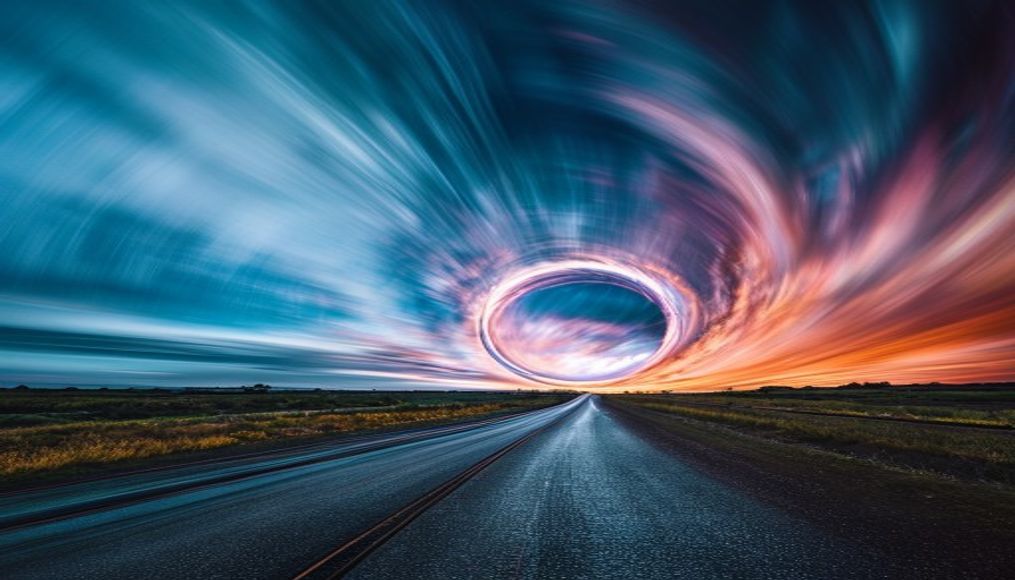
Comet trail bright
1344×768 · AVIF · CC BY 4.0

Comets are icy bodies that, as they approach the Sun, form bright tails and have fascinated humanity for centuries.
About this subject
Comets are celestial objects composed mainly of ice, dust, and rock. Originating from the cold regions of the Solar System, such as the Kuiper Belt and the Oort Cloud, they travel in elliptical orbits around the Sun. When a comet approaches the Sun, heat causes its icy nucleus to sublimate, releasing gas and dust that form a coma (diffuse atmosphere) and one or more tails. The dust tail reflects sunlight and is usually curved, while the ion tail, composed of ionized gases, points directly away from the Sun due to the solar wind.
Famous comets include Halley, visible to the naked eye every 75-76 years, and Hale-Bopp, which in 1997 provided a long-lasting spectacle in the night sky. Comet NEOWISE, discovered in 2020, was one of the brightest visible from the northern hemisphere in decades. The observation of comets has contributed to advances in astronomy, such as confirmation of Newton's theory of gravity and understanding of the Solar System's primitive composition.
The word "comet" comes from the Greek "kometes," meaning "hairy," referring to the appearance of its tail. In ancient times, comets were often seen as omens of important events, either positive or negative. Today we know they are remnants from the formation of the Solar System about 4.6 billion years ago. Space missions like ESA's Rosetta, which landed on comet 67P/Churyumov-Gerasimenko in 2014, have brought valuable data on their composition and origin.
Frequently Asked Questions
What causes a comet's brightness?
A comet's brightness comes mainly from sunlight reflected by dust in its coma and tail, as well as fluorescence from gases like cyanogen and carbon. When the comet is close to the Sun, heat sublimates ices, releasing particles that increase its brightness.
Are comets dangerous to Earth?
Small comets generally pose no danger, but impacts from larger comets can cause significant damage. However, most comets have orbits that do not cross Earth's path. Astronomers monitor near-Earth objects to prevent collisions.
What is the difference between a comet and an asteroid?
Comets are rich in ice and dust, forming tails when near the Sun. Asteroids are composed mainly of rock and metal, usually without a tail. Comets form in colder regions of the Solar System, while asteroids concentrate in the belt between Mars and Jupiter.
Direct URL
https://pub-c7d6a6ea828543ac903a74a341ccb2e1.r2.dev/imagens/comet-trail-bright-commercial-product-photography-p1.avifHow to credit
Include a visible link back to UtilizAí. Copy one of the snippets below:
<a href="https://xn--utiliza-eza.com/en/midia/imagens/comet-trail-bright-commercial-product-photography-p1">Comet trail bright</a> by <a href="https://xn--utiliza-eza.com">UtilizAí</a>, licensed under <a href="https://creativecommons.org/licenses/by/4.0/">CC BY 4.0</a>.
[Comet trail bright](https://xn--utiliza-eza.com/en/midia/imagens/comet-trail-bright-commercial-product-photography-p1) by [UtilizAí](https://xn--utiliza-eza.com), CC BY 4.0
License: CC-BY-4.0