Cave painting lascaux
1344×768 · AVIF · CC BY 4.0
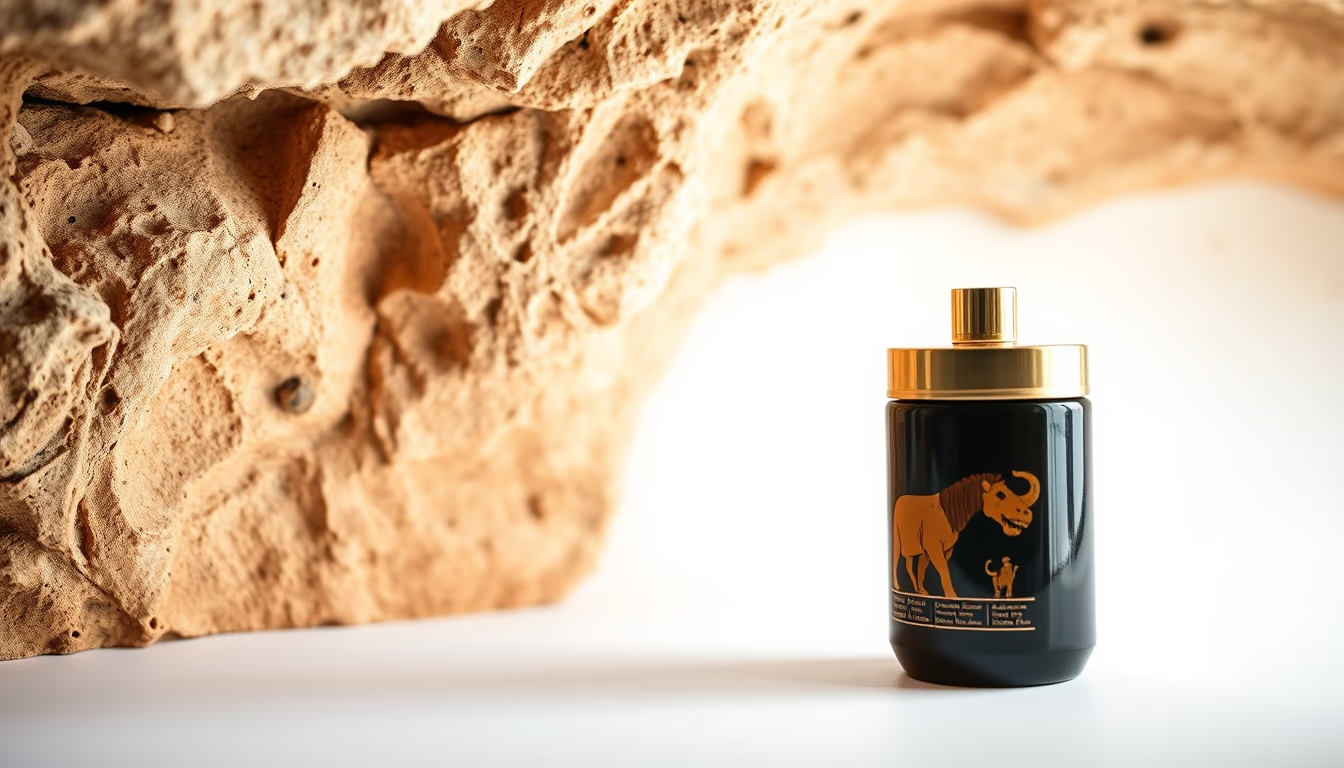
The Lascaux cave paintings in France, dating back about 17,000 years, are one of the most significant prehistoric art sites in the world.
About this subject
Discovered in 1940 by four teenagers in the Dordogne region of southwestern France, the Lascaux caves contain about 600 paintings and 1,500 engravings. The images mostly depict animals such as horses, deer, bison, and aurochs, notably in the Great Hall of the Bulls, where figures up to 5 meters long were painted using mineral pigments like ochre and charcoal. Upper Paleolithic artists used the natural contours of the walls to create three-dimensional effects, revealing advanced knowledge of anatomy and shading techniques.
While the exact purpose remains debated, theories suggest shamanic rituals, fertility beliefs, or hunting records. Recent studies indicate that scaffolding was used to reach higher surfaces, and pigments were mixed with animal fat or resin for adhesion. In 1979, Lascaux was designated a UNESCO World Heritage site, but overtourism led to conservation issues: the original cave has been closed to the public since 1963, replaced by replicas such as Lascaux II, III, and IV, which attract millions of visitors annually.
Lascaux art influenced modern artists like Pablo Picasso and Joan Miró and remains a focus of interdisciplinary research involving archaeologists, art historians, and geologists. Radiocarbon dating and pigment analysis refine the chronology, while technologies like photogrammetry produce detailed digital models. Unfortunately, fungal and microbial growth due to environmental changes threaten the site, requiring constant monitoring.
The imagery of Lascaux has become a cultural icon, appearing in textbooks, films, and commercial products, reinforcing its status as a symbol of human heritage. Despite its age, the paintings retain a narrative freshness that intrigues both experts and laypeople, standing as one of the most remarkable examples of prehistoric symbolic expression.
Frequently Asked Questions
Where are the Lascaux caves located?
The Lascaux caves are in the Vézère Valley, in the Dordogne region of southwestern France, near the village of Montignac.
Why were the Lascaux caves closed to the public?
They were closed in 1963 due to fungal growth, algae, and calcite crystals caused by carbon dioxide and temperature changes from visitors. Replicas such as Lascaux II and IV are open for tourism.
What materials were used in Lascaux paintings?
Artists used mineral pigments like ochre (yellow and red), charcoal, and manganese for black. They mixed these with binders such as animal fat, resin, or clay to adhere to the walls.
Direct URL
https://pub-c7d6a6ea828543ac903a74a341ccb2e1.r2.dev/imagens/cave-painting-lascaux-commercial-product-photography-p11.avifHow to credit
Include a visible link back to UtilizAí. Copy one of the snippets below:
<a href="https://xn--utiliza-eza.com/en/midia/imagens/cave-painting-lascaux-commercial-product-photography-p11">Cave painting lascaux</a> by <a href="https://xn--utiliza-eza.com">UtilizAí</a>, licensed under <a href="https://creativecommons.org/licenses/by/4.0/">CC BY 4.0</a>.
[Cave painting lascaux](https://xn--utiliza-eza.com/en/midia/imagens/cave-painting-lascaux-commercial-product-photography-p11) by [UtilizAí](https://xn--utiliza-eza.com), CC BY 4.0
License: CC-BY-4.0