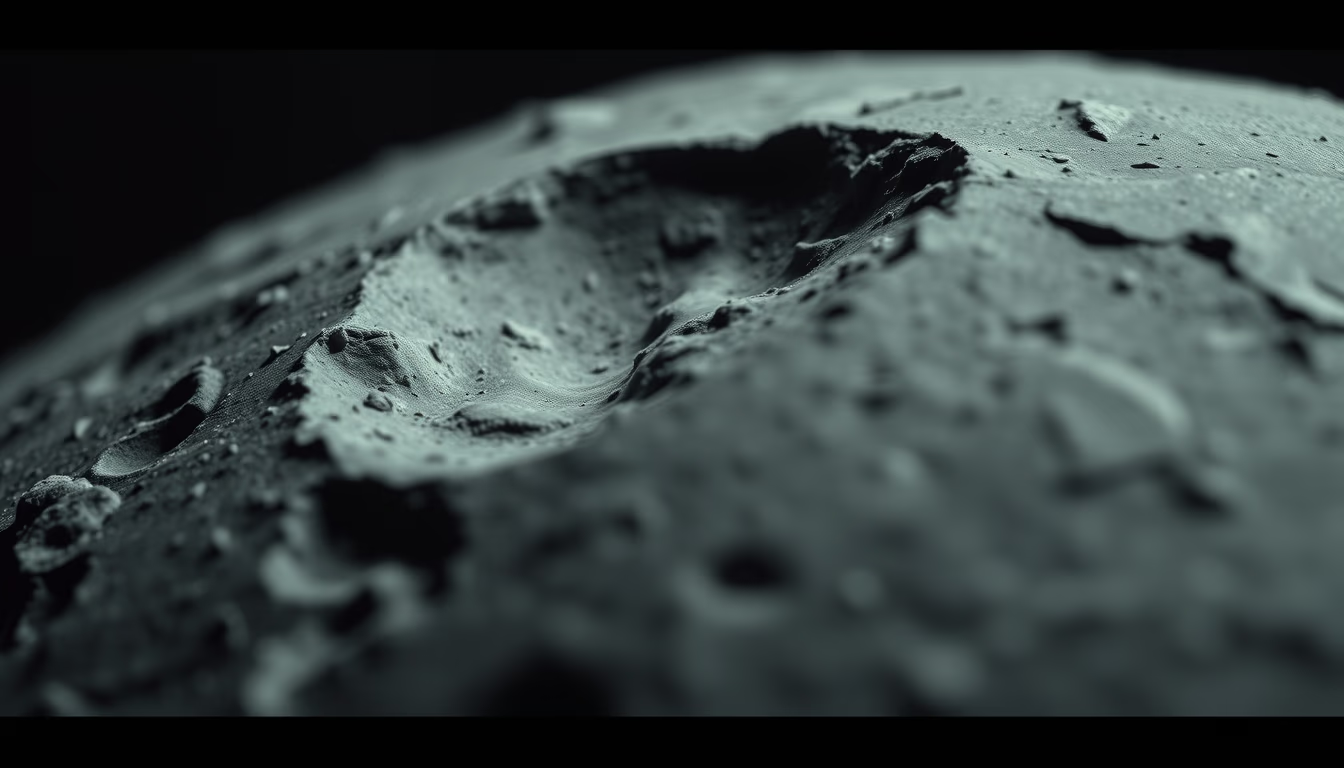
Cassini saturn rings
1344×768 · AVIF · CC BY 4.0

The Cassini spacecraft revealed unprecedented details of Saturn's rings, composed of billions of ice and rock particles.
About this subject
The Cassini-Huygens mission, a collaboration between NASA, ESA, and ASI, launched in 1997 and arrived at Saturn in 2004. Over 13 years, the orbiter studied the planet's rings, moons, and magnetosphere. Saturn's rings are complex structures composed of particles ranging from micrometers to meters in diameter, mostly water ice with traces of dust and organic compounds.
The rings are divided into seven main groups, named D (closest to Saturn) through E (farthest). The brightest is the B ring, while the F ring is narrow and shepherded by small moons. Cassini revealed that the rings are relatively young, estimated between 10 and 100 million years old, suggesting they formed from the destruction of a moon or comet.
The spacecraft also observed features like density waves and small embedded moons such as Daphnis and Pan. During its Grand Finale from 2016 to 2017, Cassini dove 22 times between the rings and Saturn's atmosphere, collecting data on ring composition and mass before disintegrating in the atmosphere in September 2017.
Cassini's legacy transformed our understanding of the Saturn system. The images and data continue to be analyzed, revealing physical processes that also occur in planetary disks around other stars.
Frequently Asked Questions
What are Saturn's rings made of?
Saturn's rings are mostly water ice, with particles ranging from micrometers to meters in size. They also contain traces of dust and organic compounds.
How did Cassini study the rings?
Cassini used cameras, spectrometers, and radio instruments to analyze ring composition, structure, and dynamics. During the Grand Finale, it dove between the rings and the planet for direct measurements.
Why did Cassini end its mission by diving into Saturn?
To avoid contaminating moons like Enceladus and Titan, the spacecraft was deliberately destroyed in Saturn's atmosphere, ensuring terrestrial microorganisms would not reach potentially habitable environments.
Direct URL
https://pub-c7d6a6ea828543ac903a74a341ccb2e1.r2.dev/imagens/cassini-saturn-rings-studio-still-life-fresh9.avifHow to credit
Include a visible link back to UtilizAí. Copy one of the snippets below:
<a href="https://xn--utiliza-eza.com/en/midia/imagens/cassini-saturn-rings-studio-still-life-fresh9">Cassini saturn rings</a> by <a href="https://xn--utiliza-eza.com">UtilizAí</a>, licensed under <a href="https://creativecommons.org/licenses/by/4.0/">CC BY 4.0</a>.
[Cassini saturn rings](https://xn--utiliza-eza.com/en/midia/imagens/cassini-saturn-rings-studio-still-life-fresh9) by [UtilizAí](https://xn--utiliza-eza.com), CC BY 4.0
License: CC-BY-4.0