Cassini saturn rings
1344×768 · AVIF · CC BY 4.0
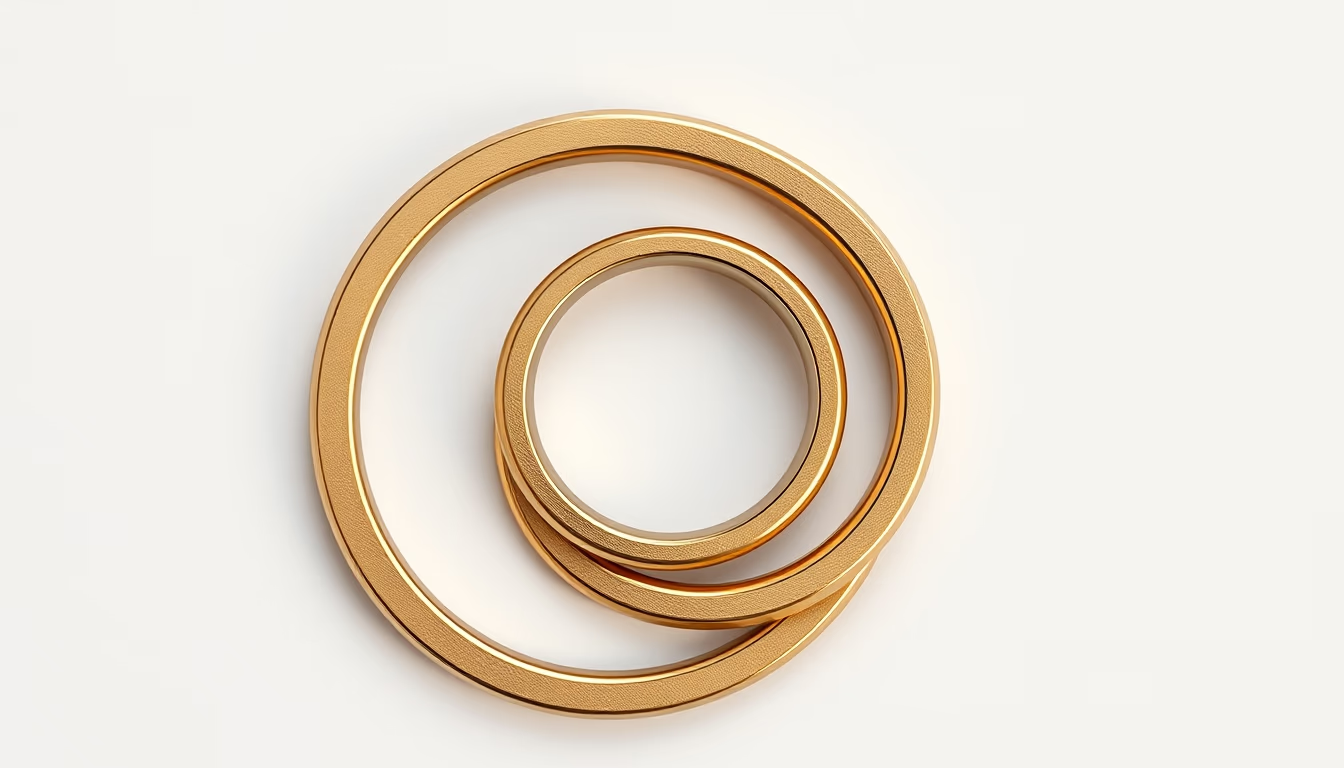
The Cassini spacecraft revolutionized our understanding of Saturn and its rings, revealing unprecedented details.
About this subject
The Cassini-Huygens mission, a collaboration between NASA, ESA, and ASI, launched in 1997 and arrived at Saturn in 2004. For 13 years, the probe orbited the giant planet, studying its rings, moons, and atmosphere. Saturn's rings, primarily composed of water ice and rocky particles, exhibit a complex structure of thousands of rings and gaps. Cassini revealed that the rings are young, estimated to be between 10 and 100 million years old, and are constantly evolving due to gravitational interactions with the planet's moons, such as Enceladus and Titan.
One of Cassini's greatest achievements was the Grand Finale: a series of 22 daring orbits between the planet and its inner rings in 2017, culminating in a controlled destruction into Saturn's atmosphere. This allowed direct measurements of the gravitational field and ring composition, confirming that the rings are made of nearly pure ice particles. Additionally, Cassini discovered that the rings are losing material to Saturn, feeding particle rain into the upper atmosphere.
The mission also detected vertical structures in the rings, such as density waves and small shepherd moons that maintain the edges of gaps. Cassini's legacy includes over 4000 scientific papers and images that transformed our view of the Saturnian system. Data continues to be analyzed, revealing new secrets about ring formation and dynamics.
Frequently Asked Questions
What were Cassini's key discoveries about Saturn's rings?
Cassini found that the rings are young (10-100 million years old), composed of nearly pure ice, and are losing material to the planet. It also revealed vertical structures and shepherd moons.
How did Cassini end its mission?
The probe performed the Grand Finale, diving between Saturn and its inner rings 22 times, then was intentionally destroyed in Saturn's atmosphere to avoid contaminating moons like Enceladus.
Are Saturn's rings solid?
No, they consist of billions of ice and rock particles, ranging from dust grains to mountain-sized chunks, kept in orbit by Saturn's gravity.
Direct URL
https://pub-c7d6a6ea828543ac903a74a341ccb2e1.r2.dev/imagens/cassini-saturn-rings-isometric-flat-lay-fresh11.avifHow to credit
Include a visible link back to UtilizAí. Copy one of the snippets below:
<a href="https://xn--utiliza-eza.com/en/midia/imagens/cassini-saturn-rings-isometric-flat-lay-fresh11">Cassini saturn rings</a> by <a href="https://xn--utiliza-eza.com">UtilizAí</a>, licensed under <a href="https://creativecommons.org/licenses/by/4.0/">CC BY 4.0</a>.
[Cassini saturn rings](https://xn--utiliza-eza.com/en/midia/imagens/cassini-saturn-rings-isometric-flat-lay-fresh11) by [UtilizAí](https://xn--utiliza-eza.com), CC BY 4.0
License: CC-BY-4.0