Cassini saturn rings
1344×768 · AVIF · CC BY 4.0
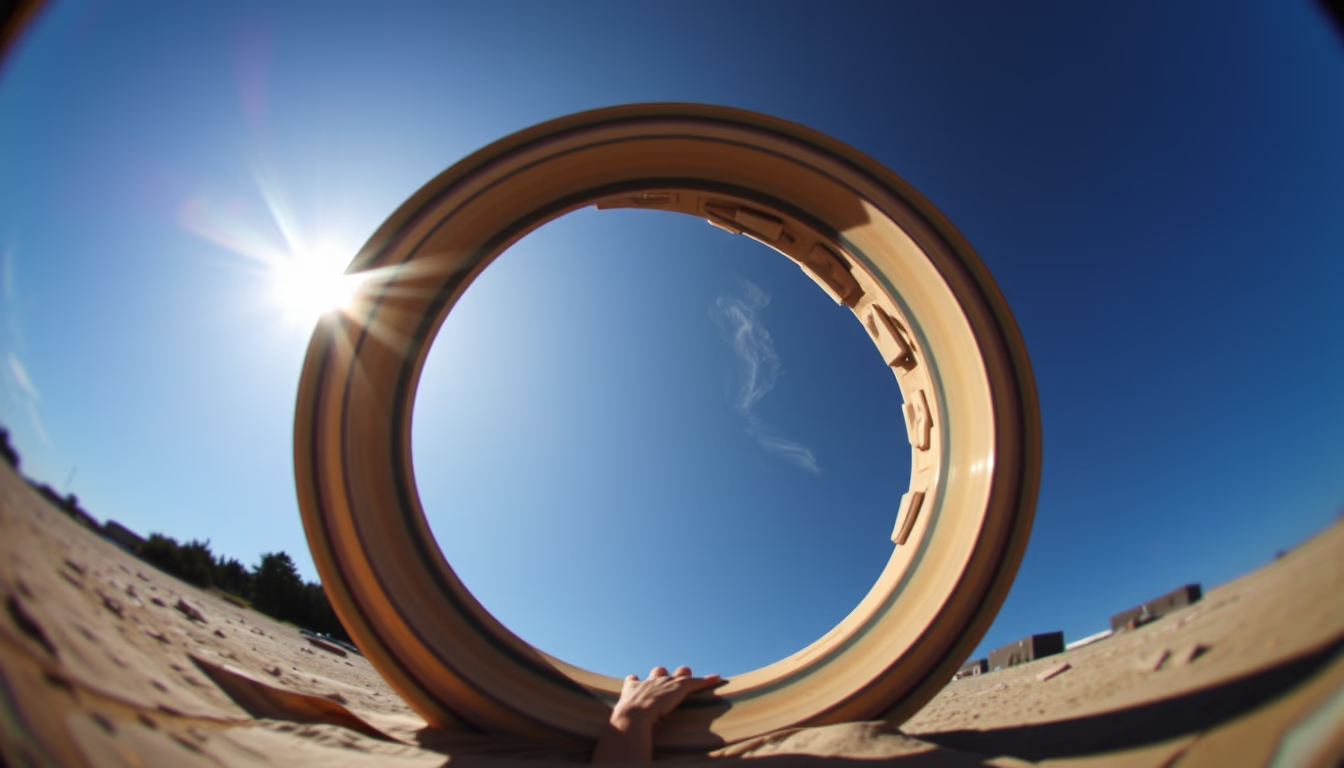
The Cassini spacecraft, which orbited Saturn from 2004 to 2017, revolutionized knowledge of the planet's rings with detailed data on composition and dynamics.
About this subject
The Cassini Huygens mission, a collaboration between NASA, ESA, and ASI, launched in 1997 and entered Saturn orbit in 2004. Over 13 years, the spacecraft collected images and data that transformed our understanding of the gas giant's rings. Saturn's rings, composed mainly of water ice and rocky particles, span hundreds of thousands of kilometers but are only tens of meters thick. Cassini revealed complex structures such as the A, B, and C rings, the faint D, E, F, and G rings, and gaps like the Cassini Division.
The probe discovered phenomena such as ring spokes, propeller shaped structures caused by small moonlets, and ring rain falling onto Saturn. Measurements from the infrared spectrometer and radar allowed estimates of the rings' age, possibly between 10 and 100 million years, much younger than the solar system. Cassini also identified 'propellers', small disturbances created by kilometer sized objects, and observed the complex interaction between rings and moons like Pan and Atlas.
The mission's grand finale in 2017 consisted of 22 grazing orbits between the planet and its inner rings, enabling unprecedented measurements of ring mass and structure. The data suggest the rings may be remnants of a shattered moon or primordial material that never formed a satellite. Final analysis indicated that the rings have a total mass less than that of the moon Mimas and are constantly evolving, with particles colliding and re aggregating.
Cassini ended its mission by plunging into Saturn's atmosphere, transmitting data until the last moment. The probe's legacy is a wealth of information that continues to be studied, offering clues about the formation of the solar system and the dynamics of protoplanetary disks. High resolution images of the rings are among the greatest treasures of space exploration.
Frequently Asked Questions
How many rings does Saturn have?
Saturn has a main ring system divided into seven groups: D, C, B, A, F, G, and E. There are also fainter rings such as the Phoebe ring. The classification includes subrings and gaps like the Cassini Division between the A and B rings.
What are Saturn's rings made of?
The rings are composed mainly of water ice (99%) with a small fraction of dust and rocky particles. Particle size varies from microscopic grains to house sized chunks.
Why was the Cassini spacecraft destroyed at the end of its mission?
Cassini was deliberately directed into Saturn's atmosphere to avoid contaminating moons like Enceladus and Titan, which may harbor conditions suitable for life. The final plunge also allowed unique scientific data collection on the planet's atmosphere.
Direct URL
https://pub-c7d6a6ea828543ac903a74a341ccb2e1.r2.dev/imagens/cassini-saturn-rings-fish-eye-wide-angle-fresh12.avifHow to credit
Include a visible link back to UtilizAí. Copy one of the snippets below:
<a href="https://xn--utiliza-eza.com/en/midia/imagens/cassini-saturn-rings-fish-eye-wide-angle-fresh12">Cassini saturn rings</a> by <a href="https://xn--utiliza-eza.com">UtilizAí</a>, licensed under <a href="https://creativecommons.org/licenses/by/4.0/">CC BY 4.0</a>.
[Cassini saturn rings](https://xn--utiliza-eza.com/en/midia/imagens/cassini-saturn-rings-fish-eye-wide-angle-fresh12) by [UtilizAí](https://xn--utiliza-eza.com), CC BY 4.0
License: CC-BY-4.0