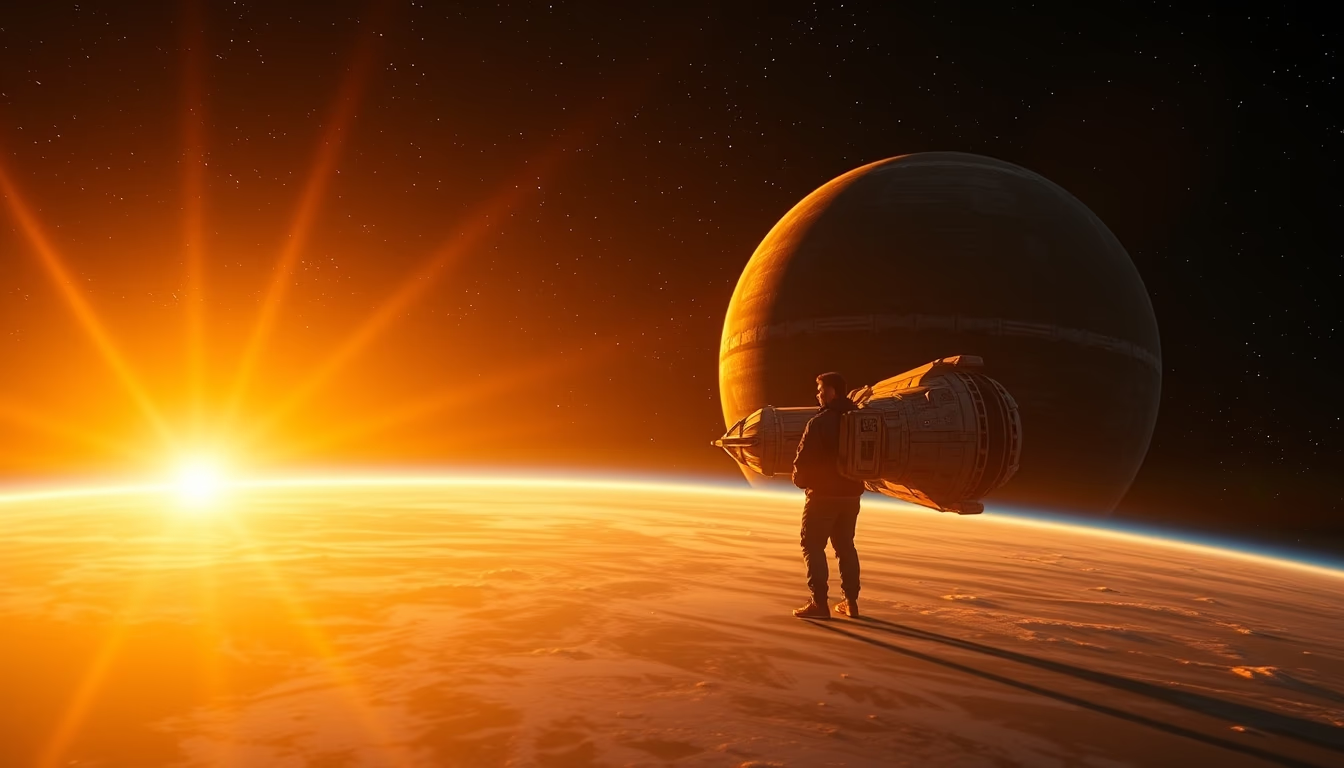
Cassini saturn rings
1344×768 · AVIF · CC BY 4.0

The Cassini spacecraft revolutionized knowledge about Saturn's rings with detailed observations from 2004 to 2017, revealing their complex structure and dynamics.
About this subject
The Cassini-Huygens mission, a collaboration between NASA, ESA, and ASI, orbited Saturn from 2004 to 2017, providing the most detailed study ever of the planet's rings. The rings are composed primarily of water ice, with particles ranging from micrometers to meters. Cassini revealed intricate structures: main rings (A, B, C) and fainter ones (D, E, F, G). It discovered that the rings are dynamic, with density waves, gravitational perturbations from shepherd moons (like Prometheus and Pandora), and embedded small moons such as Daphnis and Pan.
Cassini's instruments, including the ion and neutral mass spectrometer, analyzed ring composition, detecting organic material and dust. It also observed spokes in the B ring, short-lived phenomena attributed to electrostatically charged particles. The spacecraft showed that the rings are very young by astronomical standards, with an estimated age between 10 and 100 million years, suggesting they may have originated from the breakup of a moon or comet.
The mission ended spectacularly: in September 2017, Cassini plunged into Saturn's atmosphere, transmitting unique data about ring and atmospheric composition until the last moment. Final measurements indicated that the rings are losing material to the planet, a process that could make them disappear in less than 300 million years. Cassini's legacy includes over 4,000 scientific papers and an unprecedented understanding of the Saturn system.
Frequently Asked Questions
How did Saturn's rings form?
The rings are believed to have formed from the breakup of a moon or comet that came too close to Saturn, between 10 and 100 million years ago. The resulting ice particles were captured by the planet's gravity.
What did Cassini discover about the rings?
Cassini revealed the detailed structure of the rings, including density waves, shepherd moons, and embedded small moons. It also found that the rings are very young and are losing material to Saturn.
Why was Cassini destroyed at the end of the mission?
To avoid contamination of potential ocean moons like Enceladus and Titan, Cassini was deliberately sent to plunge into Saturn's atmosphere, collecting final data about the rings and atmosphere.
Direct URL
https://pub-c7d6a6ea828543ac903a74a341ccb2e1.r2.dev/imagens/cassini-saturn-rings-fine-art-photography-fresh1.avifHow to credit
Include a visible link back to UtilizAí. Copy one of the snippets below:
<a href="https://xn--utiliza-eza.com/en/midia/imagens/cassini-saturn-rings-fine-art-photography-fresh1">Cassini saturn rings</a> by <a href="https://xn--utiliza-eza.com">UtilizAí</a>, licensed under <a href="https://creativecommons.org/licenses/by/4.0/">CC BY 4.0</a>.
[Cassini saturn rings](https://xn--utiliza-eza.com/en/midia/imagens/cassini-saturn-rings-fine-art-photography-fresh1) by [UtilizAí](https://xn--utiliza-eza.com), CC BY 4.0
License: CC-BY-4.0