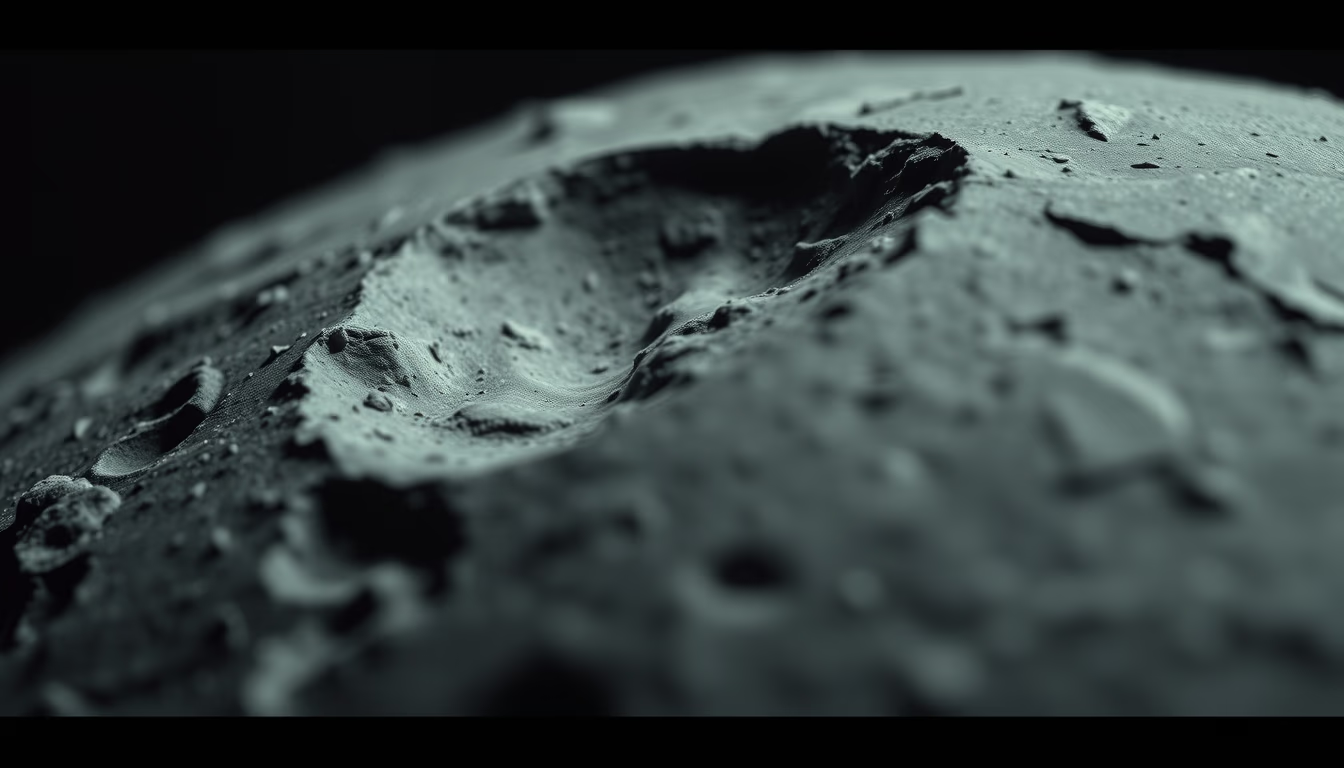
Cassini saturn rings
1344×768 · AVIF · CC BY 4.0
The Cassini spacecraft revealed unprecedented details about Saturn's rings, composed of ice and rock particles.
About this subject
The Cassini-Huygens mission, a collaboration between NASA, ESA, and ASI, orbited Saturn from 2004 to 2017. Cassini studied Saturn's ring system in unprecedented detail, revealing the rings as complex structures composed of billions of particles. The main rings (A, B, C) are visible from Earth, but Cassini discovered faint rings such as the F ring, shaped by the moon Prometheus, and the E ring, fed by plumes from Enceladus.
The rings consist mostly of water ice (99%) with traces of rock and dust. Their thickness is deceptive: although they appear solid, they are only tens of meters thick. Cassini detected vertical structures like 'walls' of particles in the B ring, caused by gravitational perturbations from shepherd moons. Data also showed that the rings are losing material to Saturn in a phenomenon called 'ring rain', about 10 tons of particles per second falling into the planet.
One of the most surprising discoveries was the rings' age. Measurements of dust and composition suggest the rings may be only 100 to 200 million years old, young compared to Saturn itself (4.5 billion years). This indicates the rings may be temporary, formed from the destruction of a moon or comet. Cassini also revealed shepherd moons like Daphnis, which create waves in the rings, and small moons embedded in the rings, such as Pan and Atlas.
The mission ended as planned: in 2017, Cassini plunged into Saturn's atmosphere to avoid contaminating potentially habitable moons. Before the plunge, it performed 22 close orbits between the rings and the planet, obtaining unprecedented images of ring structure. These data continue to be analyzed by scientists, revealing complex physical processes that help understand ring systems on other planets and even exoplanets.
Frequently Asked Questions
How many rings does Saturn have?
Saturn has hundreds of rings, but the main ones are the A, B, and C rings, visible with telescopes. The Cassini spacecraft discovered many additional faint rings, totaling thousands of rings and gaps between them.
What are Saturn's rings made of?
The rings are composed mainly of water ice (about 99%), with small amounts of rock and dust. Particles range from microscopic grains to house-sized chunks.
Why are Saturn's rings disappearing?
The rings are slowly losing material to Saturn through 'ring rain,' where icy particles fall into the planet. It is estimated that the rings may completely disappear within 100 million years.
Direct URL
https://pub-c7d6a6ea828543ac903a74a341ccb2e1.r2.dev/imagens/cassini-saturn-rings-cinematic-wide-shot-fresh16.avifHow to credit
Include a visible link back to UtilizAí. Copy one of the snippets below:
<a href="https://xn--utiliza-eza.com/en/midia/imagens/cassini-saturn-rings-cinematic-wide-shot-fresh16">Cassini saturn rings</a> by <a href="https://xn--utiliza-eza.com">UtilizAí</a>, licensed under <a href="https://creativecommons.org/licenses/by/4.0/">CC BY 4.0</a>.
[Cassini saturn rings](https://xn--utiliza-eza.com/en/midia/imagens/cassini-saturn-rings-cinematic-wide-shot-fresh16) by [UtilizAí](https://xn--utiliza-eza.com), CC BY 4.0
License: CC-BY-4.0